24 Jul 2026 • Reading Time: 11 min
Key Takeaways
- Off-the-shelf gun safes and handcrafted custom cabinets are not competing products in the same category. They serve different buyers at different stages of ownership with different priorities.
- An off-the-shelf safe optimizes for maximum forced-entry resistance and fire protection at the lowest possible cost. These are the right priorities for a buyer who wants secure storage above all else.
- A handcrafted custom cabinet optimizes for the combination of genuine security, furniture quality, display function, and interior configuration precision that a collection of meaningful size and value requires. These priorities are not available from a production line at any price point.
- The word “custom” matters in a specific way here: not a factory safe with a personalized nameplate, but a piece whose dimensions, interior layout, wood species, and security specifications are determined by the specific collection and space it is built for.
- For a collector who has been building a serious collection for a decade or more, the storage question evolves from “how do I secure these firearms” to “how do I store, organize, display, and protect something I have invested significantly in.” These are different questions with different answers.
- The honest answer to “is handcrafted worth it” is: for a buyer whose collection and priorities fit the right profile, unambiguously yes. For a buyer who simply needs secure storage, an off-the-shelf safe at the appropriate quality tier is the right answer.
The Question Worth Asking Honestly
“Is handcrafted worth it” is a question that deserves a direct answer, not a marketing answer.
The marketing answer is predictable: of course handcrafted is worth it, look at the quality, feel the difference, etc. A company selling handcrafted cabinets is not going to tell you to buy a steel safe from a sporting goods retailer.
But the honest answer is more useful, and it is also the answer that actually serves the right buyers well.
Here it is: handcrafted custom storage is worth it for a specific type of buyer with a specific type of collection and specific priorities. It is not worth it for every buyer.
The rest of this post explains how to determine which type you are, what the actual differences between the two categories look like in practice, and what the comparison looks like when you account for the full range of factors that matter rather than just the upfront price.
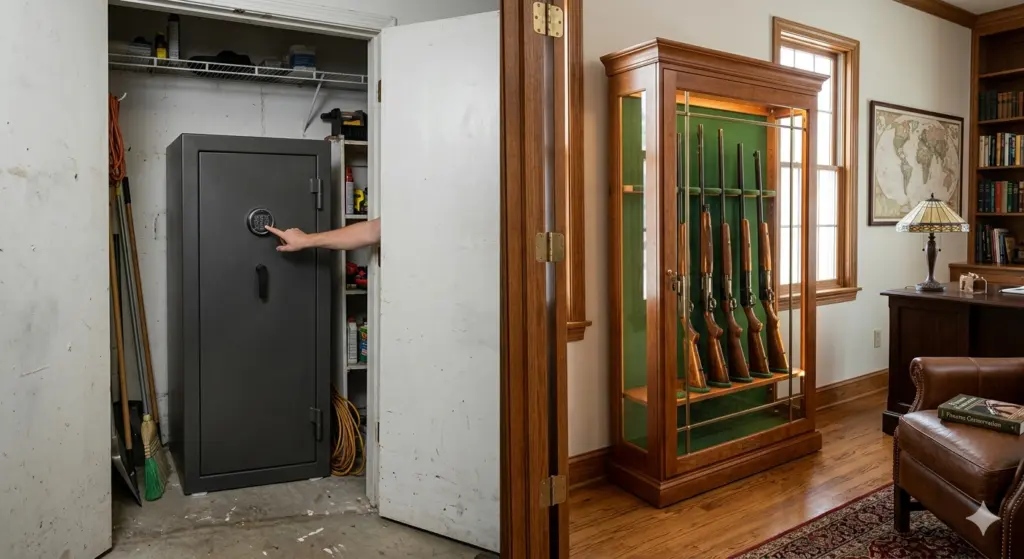
What Off-the-Shelf Gun Safes Actually Offer (Honestly)
A quality off-the-shelf gun safe does several things well, and it is worth acknowledging those clearly before discussing what it does not do.
The Genuine Strengths of Off-the-Shelf Safes
Forced-entry resistance: A properly made steel safe with 10 to 12-gauge or heavier steel walls and a multi-bolt locking system provides meaningful resistance to forced entry. A determined intruder with professional tools and unlimited time can defeat almost any residential security measure. But a quality steel safe significantly raises the time and capability threshold required for unauthorized access.
Fire protection: Fire-rated safes use a combination of steel construction and interior material (typically drywall compound) to slow heat transfer to the interior. A safe rated for “30 minutes at 1,200 degrees” provides some protection against the temperatures a typical house fire reaches in its early stages. This is real and meaningful protection for a collection that would be catastrophic to lose.
Immediate availability: An off-the-shelf safe can be purchased and delivered within days. There is no lead time, no consultation process, and no design decisions to make beyond model selection.
Familiar transaction: Purchasing a safe from a retailer is a known process with clear pricing, return policies, and standardized product specifications. There is minimal uncertainty about what you are getting.
Lower upfront cost: At equivalent security specifications, a steel safe costs less than a handcrafted custom cabinet. This is simply true, and it is a legitimate consideration for buyers for whom budget is the primary constraint.
The Honest Limitations of Off-the-Shelf Safes
These strengths come with real limitations that are significant for the buyer who has outgrown the basic storage question.
Interior design as afterthought: The interior of most off-the-shelf safes is designed by someone who has never met the buyer or seen the collection. It consists of adjustable wire or metal shelving, foam barrel rests that hold guns in generic orientations, and a carpet lining that looks reasonable in a product photograph and adequate in person. For a collection of five identical full-size rifles, this works. For a collection that spans different barrel lengths, stock configurations, and handguns of various sizes, the generic interior is a source of ongoing frustration.
Aesthetics that limit placement: A steel safe communicates its function immediately and unambiguously. It belongs in a utility space, a closet, or a dedicated room. Placing it in a study, a library, or a living room makes that room look like an armory rather than a finished living space. For a buyer who wants the collection accessible and visible in the spaces where they actually live, this limits the useful placement options significantly.
Material degradation at the interior: MDF shelving, vinyl carpet lining, and foam components degrade over time. MDF absorbs humidity and can swell or crumble after years in a closed environment with any humidity variation. The foam barrel rests compress and lose their shape. The interior of a ten-year-old mid-grade safe that has been in regular use typically looks significantly worse than when it was new.
No display function: A steel safe secures firearms. It does not display them. Opening the safe door and looking at the rifles standing in generic rests is functional but not an experience. For a collector who has invested meaningfully in pieces with visual character, historical significance, or aesthetic beauty, the inability to see and appreciate those pieces in an organized display format is a real daily cost.
One-size-fits-most dimensions: Off-the-shelf safes come in standardized sizes. If your collection requires 18 rifles and you can find a safe rated for 20, you get a safe that also has two unused rifle slots and an oversized footprint. If your collection requires 22 rifles, you are choosing between a safe that is technically undersized and one that is larger than you need. Custom dimensions, matched to the actual collection, do not exist in the off-the-shelf market.
What Handcrafted Custom Storage Offers (Also Honestly)
With the off-the-shelf picture established, what does handcrafted custom storage actually provide that off-the-shelf cannot?
Interior Configuration That Fits the Actual Collection
This is the most immediately practical advantage of custom storage, and it affects the daily experience of owning the collection more than any other factor.
A handcrafted cabinet built for a specific collection is designed around the actual firearms in that collection. The vertical rests are at the correct height for the specific mix of barrel lengths. The spacing between rests accommodates the actual stock widths and configurations in the collection. The drawer configuration in the lower section holds the actual handguns in the collection, with compartments sized for each piece rather than for a generic pistol outline.
The result is a piece whose interior is genuinely organized. Every firearm has a defined position. Accessing any specific gun does not require moving others. The arrangement is logical, clean, and reflects the collection rather than a generic storage template.
This is not a luxury feature. It is the difference between a collection that is organized and one that is crammed into whatever space is available. For a collector who accesses the collection regularly, who shows pieces to others, who has built the collection carefully over years, this matters every single day.
Furniture Quality That Allows Correct Placement
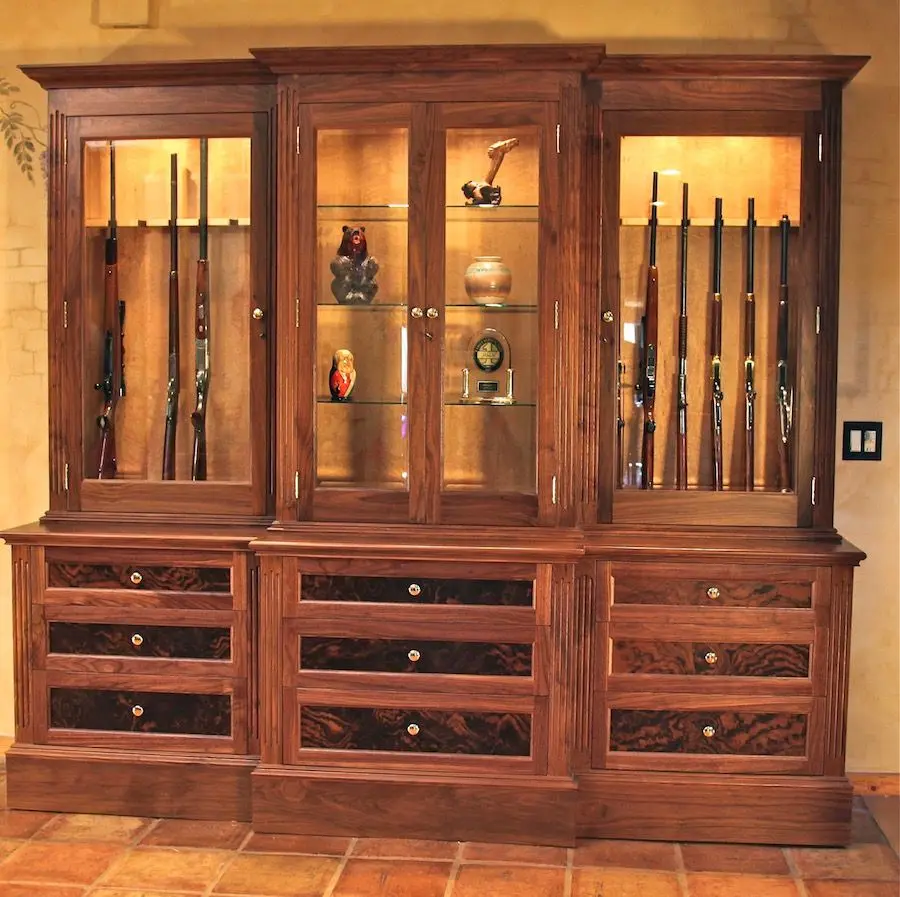
A handcrafted solid hardwood cabinet is furniture. It belongs in rooms that contain other quality furniture. A study, a library, a living room, a master bedroom: these are appropriate settings for a piece built at this level.
This means the collection can be housed where the collector actually spends time. Not in a closet or a utility room. Not in a basement or a garage. In the room where the collector reads, works, and entertains, where the collection is accessible and visible and part of daily life rather than locked away in a space that is accessed specifically to retrieve a gun.
For a collector who values the collection as something to be enjoyed, not just stored, correct placement is not incidental. It determines whether ownership of the collection is an active daily experience or a storage management problem.
Security That Is Integrated, Not Added
The security features in a Custom Cabinet Security piece are not a lock added to a furniture frame. They are designed into the piece from the beginning.
The steel-reinforced locking bar engages through the wood structure. The pick-resistant high-security lock cylinder is specified for the piece and fitted into the door in a way that is mechanically secure. The bulletproof glass panels in display configurations are built into frames designed to carry the additional weight. The dehumidifier system is sized for the specific interior volume and positioned for effective air circulation.
This integration produces security that is real without visually or functionally compromising the piece as furniture. The cabinet looks like a furniture piece. It secures like a security piece. These are not in tension because the design accounts for both from the start.
Off-the-shelf gun furniture that adds security features to a wood case without this integration typically shows the compromise: a padlock hasp that does not fully secure the door, a glass panel in standard float glass, or a lock cylinder that provides nominal rather than genuine resistance to picking.
The Ability to Specify What You Actually Need
Custom work means the conversation starts with what the buyer actually needs and works toward a design that serves those needs, not a product line that the buyer chooses between.
If the collection has seventeen long guns including three with unusually long barrels and four with traditional walnut stocks that require wider rest spacing: the cabinet is designed around those dimensions.
If the space where the cabinet will sit is 42 inches wide and has a specific wall height: the cabinet is dimensioned to fit that space exactly, not approximately.
If the collector has a specific preference for hickory with a particular grain character, or for interior felt in a specific color, or for a specific lock configuration: these are choices made in the consultation, not compromises made in a product selection menu.
Longevity That Changes the Financial Comparison
Solid hardwood with traditional joinery does not have the same aging trajectory as a steel safe with MDF interior components.
The wood of a well-constructed solid hardwood cabinet does not degrade over time in the way that engineered panel products do. The dovetailed drawer joints get tighter, not looser, as the wood ages and settles. The hand-applied finish can be renewed if the surface ever needs refreshing without replacing the piece.
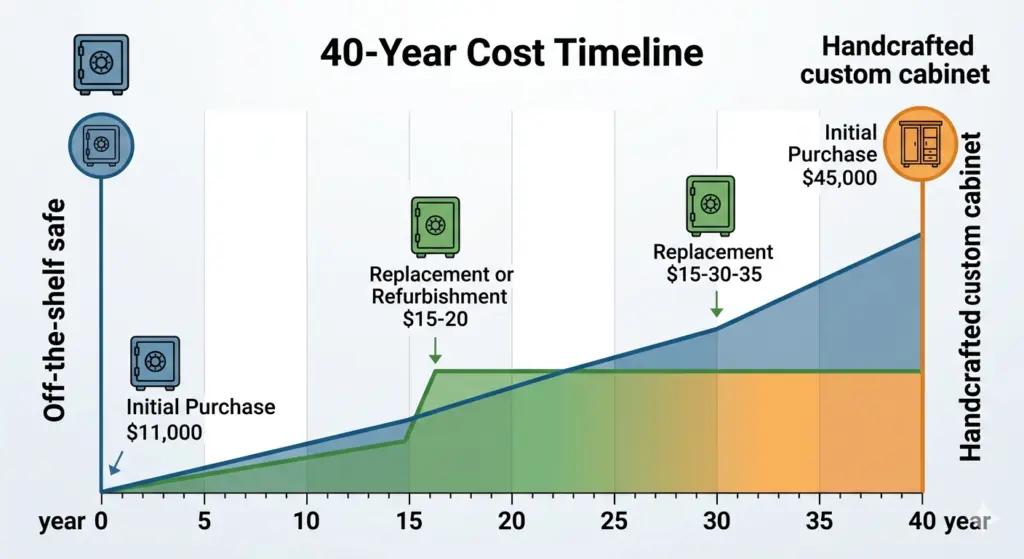
A quality off-the-shelf steel safe has a functional service life of approximately fifteen to twenty years before the interior components have degraded to the point where the interior needs refurbishment or the piece is replaced. This is a reasonable lifespan for a consumer product.
A handcrafted solid hardwood cabinet has a generational lifespan. It is the type of piece that is passed from one generation to the next because it continues to be serviceable and beautiful. This is not marketing language. It is the practical consequence of building with the right materials and methods.
Over a forty-year period, the buyer who purchased a steel safe and then replaced or refurbished it has spent money twice. The buyer who purchased a custom cabinet once has not.
The Profile of the Buyer for Whom Custom Is Worth It
With the comparison established, here is the specific buyer profile for whom the handcrafted answer is unambiguous.
The collector who has been building for a decade or more. A collection assembled with care and knowledge over ten or fifteen years is a meaningful asset: financially, historically, and personally. The storage solution for this collection should reflect what it has become, not what it was when it started.
The collector with more than eight to ten firearms. Below this threshold, a quality off-the-shelf safe with reasonable interior organization serves the storage function adequately. Above it, the organizational limitations of a generic interior become daily friction.
The collector who values the display function. If the ability to see, access, and show the collection in a context that honors it matters, an off-the-shelf safe provides none of this. A quality display cabinet provides it completely.
The collector who wants the storage piece in a living space. If the cabinet needs to belong in a room where the collector lives and receives guests, aesthetics and furniture quality are not optional. A steel safe in the living room is not acceptable to most homeowners. A quality hardwood cabinet is exactly appropriate.
The collector building toward a legacy. A collection that is intended to be passed to the next generation deserves storage that will still be appropriate and functional when that transfer happens. A steel safe replaced twice in forty years is not the legacy piece. A custom cabinet that ages beautifully alongside the collection is.
The collector whose collection includes historically significant or aesthetically remarkable pieces. A blued Colt Python, an original Winchester lever-action, a matched pair of custom-engraved pistols: pieces of this character warrant housing that reflects their significance. A foam-lined steel box does not.
The Profile of the Buyer for Whom Off-the-Shelf Remains the Right Answer
The honest answer requires this section as well.
The collector who needs maximum forced-entry resistance above all else. A heavy-gauge steel safe with a quality multi-bolt locking system and a UL-listed rating provides forced-entry resistance that a wood cabinet, regardless of its security features, does not match at the high end of the specification. For a buyer with a specific security concern at this level, the steel safe is the right choice.
The collector whose primary concern is fire protection. Fire-rated safes provide meaningful fire protection. Custom wood cabinets do not offer fire ratings. For a collection that would be catastrophic to lose in a fire, a fire-rated safe or a combination of fire-rated safe and custom cabinet serves the full range of concerns.
The buyer with a small collection and no plans to grow it. A collector with four rifles and no interest in expanding beyond twelve guns does not need the organizational capacity and interior precision of a custom cabinet. A quality off-the-shelf safe serves this collection appropriately.
The buyer for whom budget is the primary constraint right now. A quality off-the-shelf safe provides genuine security at a lower upfront cost. For a buyer who cannot yet make the investment in custom storage, the right answer is a quality safe now and potentially a custom piece when the financial situation allows.
The buyer who needs storage immediately. Custom work requires lead time. If the security need is urgent (a recent purchase that needs to be secured, a security concern that cannot wait), an off-the-shelf safe available for immediate delivery is the appropriate solution. Custom storage is for when the lead time is acceptable.
The Case Where Both Are Right
The buyer who has thought this through most carefully often concludes that the right answer is both: a custom display cabinet for the working collection and a heavy steel safe for the highest-value pieces and for maximum-security redundancy.
This is not an extravagance if the collection justifies it. The display cabinet houses the collection in the way the collector wants to experience it: organized, accessible, and beautifully presented in a room that is part of daily life. The steel safe provides the forced-entry resistance that the wood cabinet does not offer at the highest levels, and it serves as a fire-protected vault for documentation, the most irreplaceable pieces, and any ammunition storage.
Each piece does what it does best. Neither is being asked to compromise.
For a collector at this stage of the conversation, the custom consultation process at Custom Cabinet Security is the right starting point. The craftsmen in Arthur can discuss what configuration of display cabinet serves the specific collection, what the right dimensions are for the specific space, and how a custom piece would work alongside the security-focused steel safe the collector may already own.
What “Custom” Actually Means in This Context
A note on terminology that matters: custom does not mean a standard product with a name engraved on it.
When Custom Cabinet Security describes custom work, the word has a specific meaning: a piece whose dimensions, interior layout, wood species, and security specifications are determined by the specific collection and space it is built for, by craftsmen who build one piece at a time in a workshop where the reputation for quality is personal and local.
This is different from:
- A factory safe with an optional nameplate
- An off-the-shelf wood cabinet with optional “custom” upholstery colors
- A catalogue piece chosen from a menu of standardized options
Custom work in the tradition that Custom Cabinet Security represents means beginning with a conversation about the actual collection, the actual space, and the actual priorities of the specific buyer, and producing a piece that serves those needs specifically.
The full collection of available pieces provides a reference for what the standard configurations look like in finished form, and the consultation process is where the conversation about a fully custom piece begins.
The Bottom Line
Is handcrafted worth it for a serious collector?
For the collector who has built a meaningful collection, who values the ability to display and experience that collection in a living space, who wants interior organization that serves the actual collection rather than a generic one, and who is thinking about the piece in terms of decades rather than years, the answer is unambiguous: yes.
For the collector whose primary need is maximum forced-entry resistance, immediate delivery, or the lowest possible upfront cost, a quality off-the-shelf safe remains the right answer.
Most serious collectors who have been at this long enough already know which category they are in. The collection itself tells them. When the generic interior of the safe starts creating daily frustration. When the collection has pieces that deserve to be seen. When the storage feels like it is holding the collection back rather than honoring it.
That moment is when the handcrafted answer becomes worth it. And for the buyers who reach it, the comparison stops being about price and starts being about what the collection deserves.
Related Posts
View All
Uncategorized
Reading Time: 12 min
How to Childproof Your Gun Storage Without Sacrificing Display or Quick Access
Key Takeaways A note on this topic: Child gun safety is a serious subject that deserves honest, specific treatment rather
Read More
Uncategorized
Reading Time: 12 min
Gun Safes for Home Offices and Studies: How to Blend Security Into a Professional Space
Key Takeaways The Problem With the Standard Approach Most gun owners who have a dedicated home office or study eventually
Read More
Uncategorized
Reading Time: 10 min
What the Custom Order Process Actually Looks Like: From Consultation to Delivery of Your Amish Gun Cabinet
Key Takeaways The Uncertainty Most Buyers Feel Before They Reach Out A significant number of people who spend time on
Read More
