25 Sep 2026 • Reading Time: 10 min
Key Takeaways
- Antique and vintage firearms are simultaneously vulnerable to two forces inside wood storage: moisture from the environment and off-gassing from the cabinet materials themselves.
- The ideal long-term storage environment for collectible firearms is between 45% and 55% relative humidity and between 60°F and 70°F.
- Certain wood species, finishes, and interior linings are significantly safer for antique metal and original stock finishes than others.
- Original bluing, case hardening, and patina on vintage firearms can be permanently damaged by contact with reactive materials, including some common felt liners.
- A properly built wood gun cabinet that uses stable hardwoods, appropriate finishes, and active humidity control is one of the most protective environments available for a serious collection.
Why Antique Firearms Demand a Different Standard of Storage
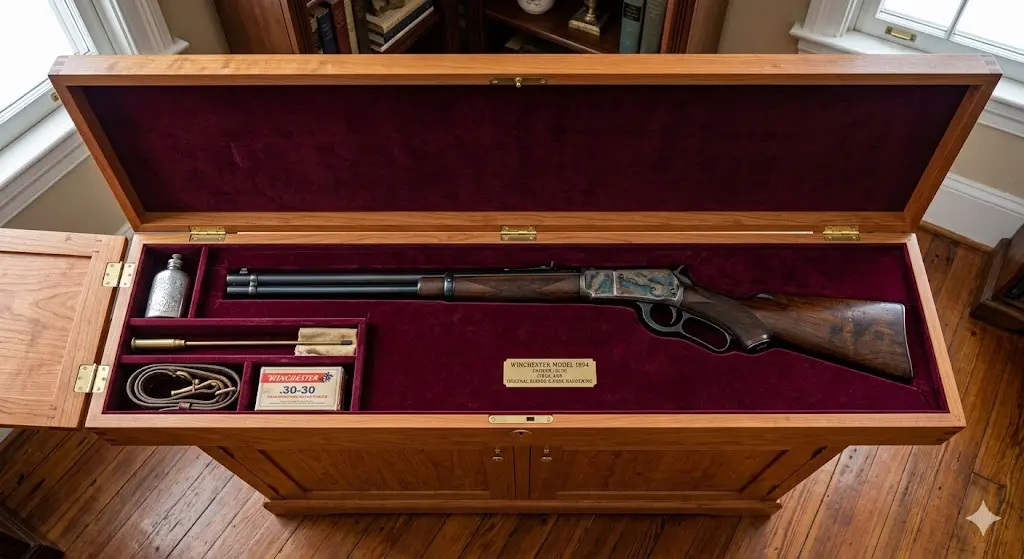
Storing a modern production firearm and storing an 1860s Colt revolver are not the same task, even if both end up behind locked glass.
Modern firearms are manufactured with consistent, durable metal treatments and synthetic stock materials that tolerate humidity swings and temperature variation reasonably well. A vintage firearm is an entirely different system. Its metal may carry original bluing that has not been reproduced in 100 years. Its stock may be finished with shellac, oil, or varnish from an era before modern polymer coatings. Its mechanical components may have been hand-fitted and are irreplaceable.
Every one of those elements responds to its storage environment constantly. Humidity rises, wood expands. Temperatures swing, metal contracts. Reactive materials in the cabinet off-gas acids that attack both the metal and the original finish over years of contact.
For a collector whose pieces carry both monetary and historical significance, storage is not a passive decision. It is an ongoing conservation practice. This guide explains the specific factors that matter and what to look for when choosing or building a wood storage solution for serious collections.
The Two Primary Threats Inside Any Storage Environment
Before discussing specific materials and settings, it helps to understand the two mechanisms by which wood storage environments damage antique firearms.
Threat One: Ambient Moisture and Relative Humidity
Humidity is the most consequential variable in firearm storage, and it operates in both directions.
Too much humidity (above 60% relative humidity) creates the conditions for rust and active corrosion on bare metal. It also promotes mold growth on organic materials including leather slings, wood stocks, and original leather-covered cases. Moisture accelerates the failure of original stock finishes by softening adhesion layers and promoting wood swelling that stresses joinery.
Too little humidity (below 40% relative humidity) is equally damaging, though collectors often overlook it. At low humidity, wood stocks dry and contract. In extreme cases this causes checking, or hairline cracks that run along the grain. Original finishes become brittle and flake. Wooden grips shrink and can split along their contact with metal frame hardware.
The target range for antique firearm storage is 45% to 55% relative humidity, maintained as consistently as possible. Fluctuation within a narrow band is less damaging than consistent readings at either extreme, but consistent fluctuation between extremes is the worst scenario of all.
Threat Two: Chemical Off-Gassing from Cabinet Materials
This threat is less understood by collectors but is responsible for significant long-term damage to antique collections stored in otherwise well-intentioned cabinets.
Many materials used in furniture and cabinetry construction release volatile organic compounds (VOCs) and acidic vapors over time. These emissions come from:
- Particleboard and MDF used in lower-cost cabinet construction (releases formaldehyde)
- Reactive wood species including oak, which releases acetic acid as it ages
- Certain felt liners made from synthetic materials treated with adhesives that off-gas over time
- Oil-based varnishes that have not fully cured before firearms are placed inside the cabinet
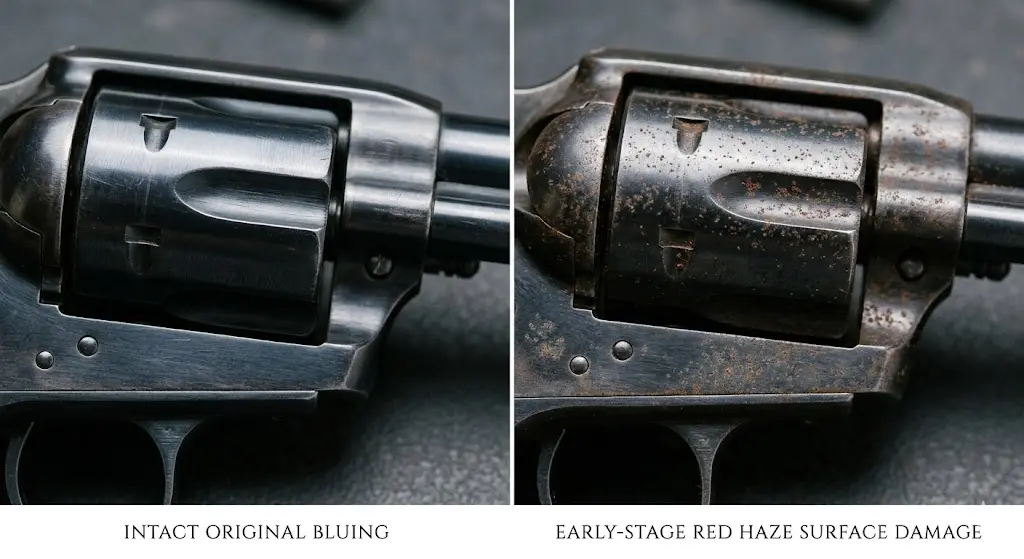
- Rubber foam padding that releases sulfur compounds capable of causing a phenomenon called red haze on blued steel surfaces
These emissions are invisible. The damage they cause accumulates slowly and is often not noticed until the collector examines a piece under magnification or takes it to an appraiser. By that point, the original finish has been altered and the piece’s historical value has been permanently reduced.
Wood Species and Their Effect on Stored Firearms
Not all hardwoods are equal when it comes to firearm storage. The species used in cabinet construction matters because wood itself is a chemical environment, and different species release different compounds as they age and respond to humidity.
Woods That Are Safer for Antique Firearms
Cherry: A close-grained, stable hardwood with low acid emissions and excellent dimensional stability. Cherry is one of the most appropriate wood species for fine firearm cabinetry. It responds to humidity changes gradually rather than sharply, reducing the stress on stored contents. It also develops a rich patina over decades that collectors and furniture enthusiasts both value.
White Oak: Counterintuitively, white oak is considerably safer for firearm storage than red oak. White oak has closed cell structures (tyloses) in its grain that dramatically reduce its acetic acid emissions compared to red oak. It is dimensionally stable and finishes cleanly.
Hickory: A dense, stable hardwood with low reactivity. Hickory is highly resistant to physical impact and humidity-induced movement, making it a sound choice for cabinets that will be used regularly.
Woods to Approach with Caution
Red Oak: A common cabinet wood that emits acetic acid as it ages. Long-term contact with red oak components inside a closed cabinet can contribute to surface corrosion on unprotected metal. If a cabinet uses red oak as a secondary material, ensure adequate ventilation and consider barriers between the wood and the firearms.
Particleboard and MDF: These engineered sheet goods are widely used in mass-produced cabinetry because they are inexpensive and dimensionally stable. However, they are bonded with urea-formaldehyde resins that off-gas for years. No collector storing antique or vintage firearms should accept particleboard or MDF construction in any cabinet interior that contacts their collection.
Interior Linings: What Is Safe and What Is Not
The liner inside a gun cabinet is the surface your firearm physically rests against. It is also one of the most common sources of chemical damage to original finishes.
Safe Interior Options
Wool felt: Natural wool felt is the traditional lining used in museum-quality cases and high-end cabinetry. It is pH-neutral, soft enough to protect surface finishes from abrasion, and does not off-gas reactive compounds. It is moisture-absorbing without being chemically active.
Archival-grade foam with appropriate barrier: Conservation-grade foam that meets the Oddy test standards used by museum conservators can be appropriate when wrapped in a breathable, neutral fabric. Bare foam is almost never safe for direct contact with antique metal.
Soft velvet over inert batting: When the velvet is made from natural fibers and the batting beneath it is inert, this is an acceptable lining for display areas of a cabinet.
Liners That Damage Antique Firearms
Dyed synthetic felt: Low-cost cabinets often use synthetic felt adhered with reactive adhesives. Over time, these adhesives off-gas and the dyes can transfer to metal surfaces.
Open-cell polyurethane foam (bare): Polyurethane foam releases sulfur compounds. Direct contact with blued, case-hardened, or white steel surfaces causes measurable surface changes. Even brief long-term storage can alter original finishes in ways that are not reversible.
Rubber-backed mats: Rubber releases sulfur at room temperature continuously. It is not appropriate for any storage surface where antique metal will rest.
Temperature and Relative Humidity: The Specific Numbers That Matter
Collectors frequently hear “control humidity” as generic advice. Here are the specific parameters that conservation professionals work within for historical firearms and the reasoning behind each.
Relative Humidity Targets
| Condition | RH Range | Risk Level |
|---|---|---|
| Active corrosion risk | Above 65% | High |
| Mold growth threshold | Above 70% | Critical |
| Ideal storage zone | 45% to 55% | Optimal |
| Brittle finish risk | Below 40% | Moderate |
| Stock checking risk | Below 35% | High |
| Rapid check cracking | Below 30% | Critical |
The 45% to 55% range is not arbitrary. It represents the zone where wood moisture content stabilizes at a level that prevents both excessive swelling and excessive drying, and where metal corrosion rates for iron and steel alloys are at their lowest in ambient air.
Temperature Targets
The ideal temperature range for antique firearm storage is 60°F to 70°F. Higher temperatures accelerate chemical reactions including corrosion and accelerate off-gassing from all materials in the storage environment. Temperature cycling, particularly swings of more than 15 to 20 degrees within 24 hours, drives condensation on metal surfaces even when relative humidity readings appear acceptable.
Avoid storing valuable collections in:
- Uninsulated garages (extreme seasonal temperature swings)
- Basements without climate control (high humidity and cold-to-warm cycling in spring)
- Attics (extreme summer heat accelerates off-gassing and dries stocks)
- Exterior walls in cold climates (condensation risk on cold surfaces)
Active Humidity Control Inside Wood Cabinets
Understanding target humidity is one thing. Maintaining it inside a closed wood cabinet requires active tools.
Golden Rod Dehumidifier Rods
A heating rod positioned inside the cabinet creates a slight warming effect that lowers relative humidity within the enclosed space. These are passive, low-wattage devices that run continuously and have been used in gun storage for decades. They are appropriate for cabinets where ambient humidity is a concern and where the primary risk is moisture creep.
The limitation of a golden rod is that it raises temperature slightly while lowering humidity. In spaces that are already warm, this tradeoff requires monitoring.
Silica Gel Desiccant Packets
Silica gel absorbs moisture passively and requires no power source. Indicating silica gel changes color when it approaches saturation, making it easy to monitor. Saturated silica gel can be regenerated in an oven and reused indefinitely.
Silica gel is particularly appropriate for sealed or airtight storage of individual pieces. For an entire cabinet, the quantity of silica gel required to meaningfully affect humidity in the space is substantial, and the maintenance burden of monitoring multiple packets makes this a supplemental rather than primary strategy.
Dedicated Cabinet Dehumidifiers
Small Peltier-effect dehumidifiers sized for enclosed spaces pull moisture from the air and require periodic drainage or use an evaporation mechanism. These are the most precise active option for larger cabinets with significant firearm collections.
Monitoring: Do Not Skip This Step
A Govee, Inkbird, or similar digital hygrometer placed inside the cabinet gives you real data rather than assumptions. Loggers with mobile app connectivity allow collectors to monitor temperature and humidity continuously without opening the cabinet. For collections with significant value, this investment is trivial compared to the cost of discovering corrosion after the fact.
The Original Finish: What You Are Protecting and How to Not Damage It
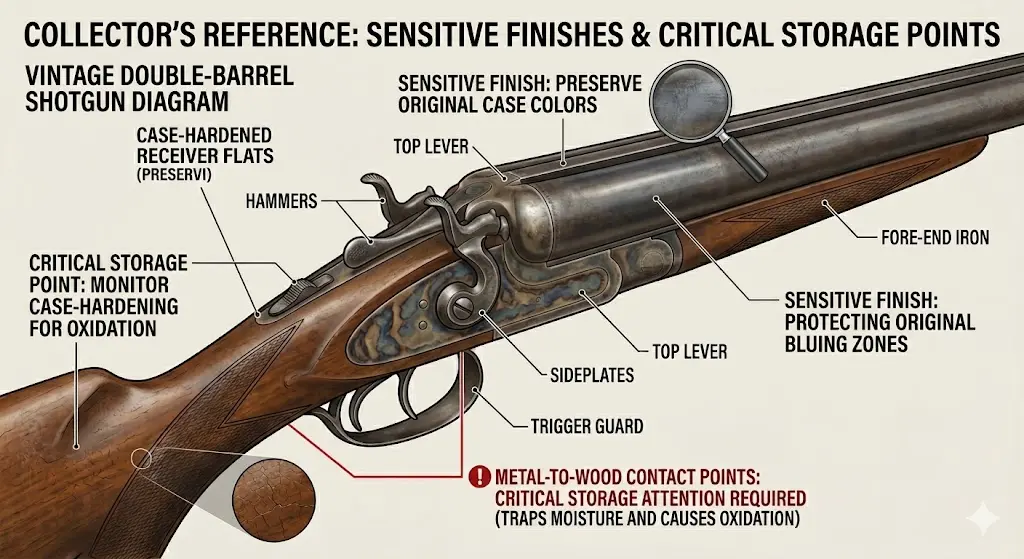
Antique and vintage firearms carry finish types that are not reproducible once damaged. Understanding what you are working with changes how you approach both storage and handling.
Original Bluing
19th and early 20th century bluing was applied through hot caustic salt processes that create a thin iron oxide layer on the steel surface. This finish is protective but extremely thin, typically only a few microns deep. It is sensitive to:
- Fingerprint acids from direct handling without gloves
- Contact with reactive materials (sulfur compounds, acetic acid)
- Moisture cycling that causes iron oxide to continue oxidizing beneath the surface
The patina on a 150-year-old revolver is not just cosmetic. It is evidence of original manufacture and directly affects appraisal value. Even light surface rust removal that touches original bluing reduces value.
Case Hardening
Case-hardened receivers on early lever actions and revolvers carry color patterns (case colors) created through a metal hardening process using bone charcoal and high heat. These colors are particularly fragile because they exist only in the very outermost layer of the metal surface. They are irreplaceable once degraded.
Brown Patina
Many antique firearms, particularly long arms from the flintlock and percussion eras, carry a natural brown patina that developed over decades. This patina is not corrosion in the deteriorating sense. It is a stable iron oxide layer that actually provides some protection. Cleaning or polishing that removes this patina damages both the protection and the historical character of the piece.
Shellac and Oil Stock Finishes
Original stock finishes from the 19th and early 20th century were most commonly linseed oil, shellac, or varnish. These finishes breathe with the wood beneath them, which means humidity control matters more for original-finish stocks than for modern synthetic-coated ones. Excessive dryness causes shellac to crack. Excessive humidity causes linseed-finished stocks to soften and become tacky.
Choosing a Wood Cabinet for an Antique Collection: What to Evaluate
Given everything above, here is what a collector should assess before choosing or commissioning a wood gun cabinet for a serious antique collection.
Construction Materials
- Primary wood species: Cherry, white oak, or hickory are appropriate. Avoid red oak interiors and any use of particleboard or MDF in interior components.
- Finish on the wood: The cabinet’s own finish should be fully cured before firearms are placed inside. Water-based finishes and certain lacquers that have fully off-gassed are preferable to reactive oil-based varnishes in enclosed storage environments.
- Interior lining: Natural wool felt or archival-grade barrier materials only. Ask specifically what the liner is made from and how it is adhered.
Climate Features
- Dehumidifier provision: A cabinet built with a golden rod dehumidifier rod or provision for one is a meaningful upgrade for collectors in humid climates or basement storage environments.
- Ventilation design: Some degree of controlled air exchange is better than a fully hermetically sealed environment for long-term storage, because off-gassing accumulates in sealed spaces.
Display vs. Storage Orientation
Glass-front display cabinets expose firearms to more light. UV radiation degrades organic materials including wood stocks, leather slings, and certain original finishes. UV-filtering glass, or positioning the cabinet away from direct light sources, matters for long-term preservation of displayed pieces.
How Custom Cabinet Security Approaches Collector-Grade Storage
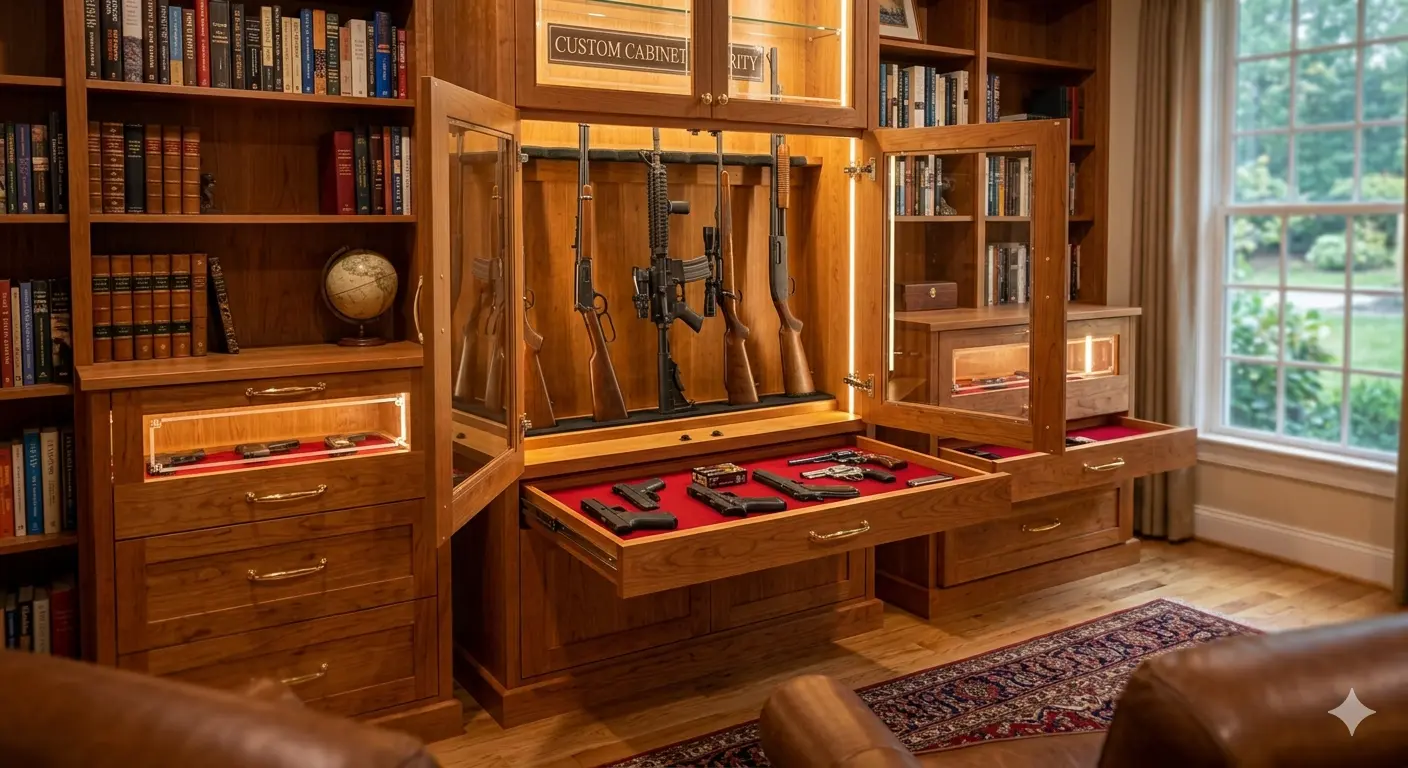
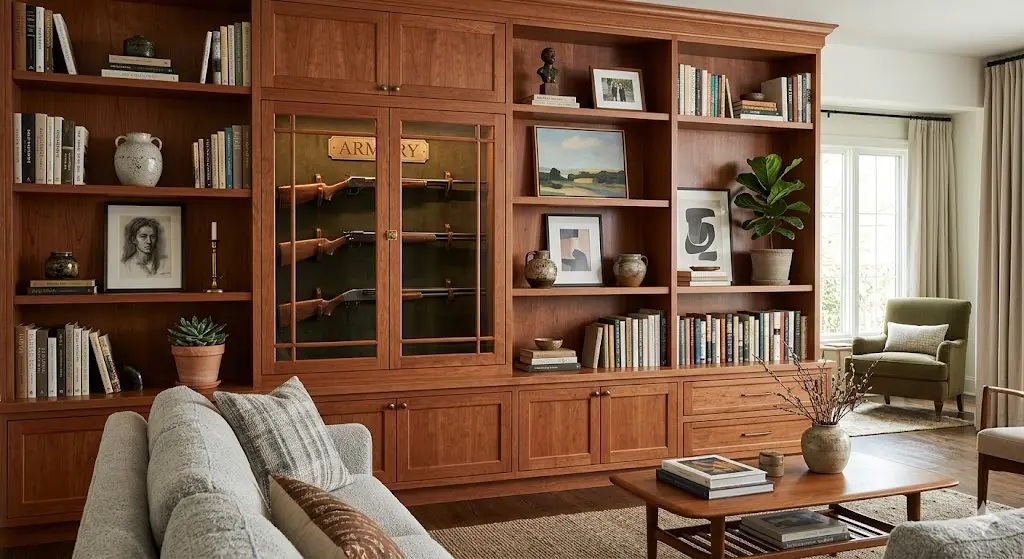
At Custom Cabinet Security, every cabinet is built by Amish craftsmen in Arthur, Illinois, using solid hardwoods including cherry and white oak. These are not production-line pieces assembled from composite materials. They are hand-crafted cabinetry that treats the storage environment as part of the product.
Each cabinet is built with features specifically relevant to collectors who take climate and finish protection seriously:
- Golden rod dehumidifier integration to maintain appropriate interior humidity levels
- Hardwood construction throughout, avoiding the particleboard and MDF shortcuts common in mass-produced gun furniture
- Eco-friendly, responsibly applied finishes that are fully cured before delivery
- High-security locking systems that protect your investment from unauthorized access as effectively as from environmental damage
For collectors building out a display that needs to accommodate antique pieces alongside modern firearms, our custom consultation process allows you to specify interior liner materials, wood species, and humidity control provisions for your particular collection requirements.
Browse our full collection of wood gun cabinets to see current standard configurations, or contact us to discuss a fully custom build tailored to your specific needs.
A Practical Storage Checklist for Antique Firearm Collectors
Use this as a reference when evaluating your current storage or planning an upgrade:
Climate Control
- [ ] Target RH maintained between 45% and 55% (verified with a hygrometer inside the cabinet)
- [ ] Storage area temperature kept between 60°F and 70°F
- [ ] No storage on exterior walls or in uninsulated spaces
- [ ] Active dehumidification in place if ambient humidity is above 55%
- [ ] Hygrometer or datalogger installed and monitored regularly
Cabinet Materials
- [ ] Primary wood species confirmed as cherry, white oak, or hickory
- [ ] No particleboard or MDF in any interior component
- [ ] Cabinet finish confirmed fully cured before placing collection inside
- [ ] Interior liner confirmed as natural wool felt or archival-grade material
- [ ] No rubber, bare foam, or dyed synthetic felt in contact with firearms
Handling and Access
- [ ] Cotton or nitrile gloves used for all handling of antique metal surfaces
- [ ] Original finish areas not wiped with solvents or reactive cleaning products
- [ ] Pieces inspected under magnification annually for early signs of surface change
- [ ] Storage orientation avoids metal-to-metal contact between pieces
Display Considerations
- [ ] Cabinet positioned away from direct sunlight and UV sources
- [ ] UV-filtering glass used if the cabinet is positioned near windows
- [ ] LED lighting used inside the cabinet rather than incandescent (lower heat output)
Final Thoughts: Storage as Conservation
A serious antique firearm collection represents a physical record of manufacturing history, craftsmanship, and in many cases, significant events. The original metal treatments, stock finishes, and mechanical components on these pieces cannot be reproduced. Once degraded, their historical character and financial value are both permanently reduced.
Treating storage as an active conservation practice, rather than simply a security measure, is the distinguishing mindset of collectors who preserve their collections intact across decades. The specific choices you make about wood species, interior linings, humidity control, and cabinet construction are not minor details. They are the difference between a collection that passes to the next generation in the same condition you received it and one that quietly deteriorates behind locked glass.
If you are building out storage for a serious collection and want a cabinet built from appropriate materials with the craftsmanship to match, Custom Cabinet Security is ready to talk through your specific requirements.
Call or contact us: 217-439-3790 | customgunsafe.com/contact
Related Posts
View All
Uncategorized
Reading Time: 8 min
The Resale Value of a Custom Gun Cabinet: Does a Handcrafted Amish Safe Hold Its Value Over Time?
If you’ve ever bought a mass-produced gun safe from a big-box retailer, you already know what happens the moment it
Read More
Uncategorized
Reading Time: 11 min
Women Gun Owners: How to Choose a Gun Storage Solution That Fits Your Home’s Style Without Compromise
Key Takeaways The Storage Problem Nobody Talks About Walk into almost any sporting goods store and look at the gun
Read More
Uncategorized
Reading Time: 10 min
How to Protect Antique and Vintage Firearms in Wood Storage: What Collectors Need to Know About Climate and Finish
Key Takeaways Why Antique Firearms Demand a Different Standard of Storage Storing a modern production firearm and storing an 1860s
Read More
