14 Aug 2026 • Reading Time: 12 min
Key Takeaways
- The term “bulletproof glass” is technically imprecise. The correct industry terms are “bullet-resistant” or “ballistic-rated” glass, and the protection level varies significantly by the specific glass construction and the rating it carries.
- The glass panels in a quality gun display cabinet serve multiple security functions simultaneously: resistance to forced entry by impact, containment of the display without exposing the firearms, and protection against the specific threat of someone attempting to break the glass to access a displayed collection.
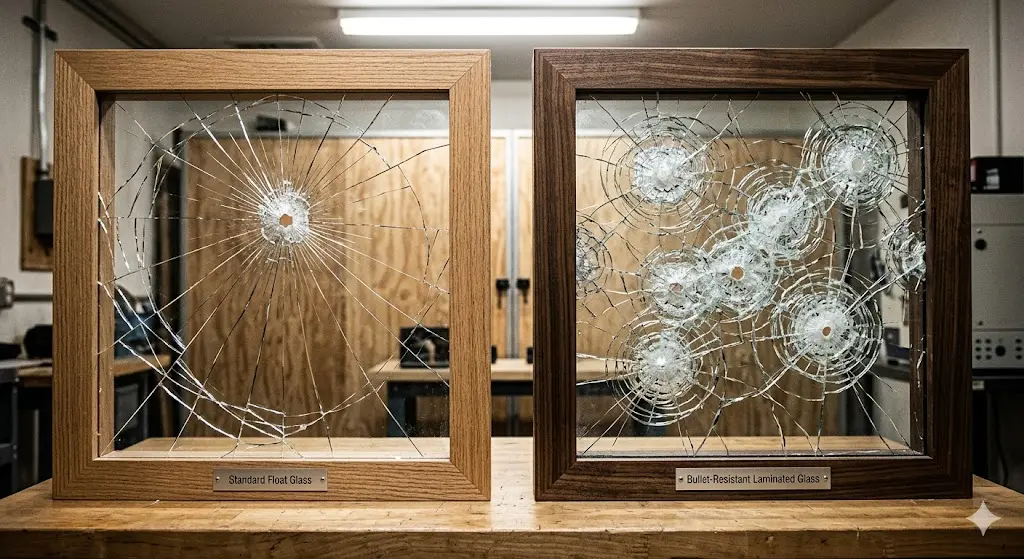
- Standard float glass, the clear glass in most cabinet doors, can be broken with a single moderate impact from a common tool. Bullet-resistant laminated glass requires sustained, deliberate effort to defeat and significantly raises the threshold for casual or opportunistic forced entry.
- Bullet-resistant glass in a gun cabinet does not make the cabinet impenetrable. No residential cabinet does. The purpose of any security measure is to raise the time and effort threshold required for unauthorized access to a level that deters the most common threat profile.
- The glass in a Custom Cabinet Security display cabinet is integrated into the design from the start, not added as an afterthought. The frame construction accounts for the additional weight and the specific installation requirements of laminated safety glass.
- For collectors whose primary concern is maximum forced-entry resistance, a steel safe remains the higher-security option. For collectors who want to display their collection with both visibility and genuine security, quality bullet-resistant glass in a well-constructed wood cabinet provides a meaningful security level that standard glass does not.
Why the Glass Matters More Than Most Buyers Realize
When collectors evaluate a display gun cabinet, most of the attention goes to the lock, the wood quality, and the interior configuration. The glass is often treated as a secondary consideration, evaluated primarily for clarity and whether it distorts the view of the collection inside.
This underestimates what the glass actually does in the security architecture of the cabinet.
A display cabinet with glass panels has a fundamental characteristic that a solid-door cabinet does not: the primary barrier between the collection and the outside world, along part of the cabinet’s perimeter, is transparent material rather than wood or steel. The lock on a quality cabinet secures the door from being opened. The glass in the door is what determines how the cabinet responds if someone attempts to bypass the lock entirely by attacking the glass.
A display cabinet with standard float glass and a quality lock is a cabinet that can be bypassed with a common center punch or a single sharp impact to the glass panel. The lock, however excellent, is not the limiting factor.
A display cabinet with quality bullet-resistant laminated glass and a quality lock requires sustained deliberate effort at a level that changes the threat profile the cabinet can realistically protect against.
This distinction is what makes the glass specification one of the most important security decisions in a display cabinet, and it is why Custom Cabinet Security integrates genuinely rated glass into their display pieces rather than using standard float glass as a cost-saving measure.
What “Bulletproof Glass” Actually Is
The popular term “bulletproof glass” suggests a material that is impervious to bullets under all conditions. This is not accurate, and understanding what the term actually refers to requires understanding how impact-resistant glass is constructed and rated.
The Construction of Bullet-Resistant Glass
Standard float glass is a single layer of annealed or tempered glass. When it breaks, it fractures. Tempered glass shatters into small, relatively safe fragments. Both types fail under modest impact from a pointed tool.
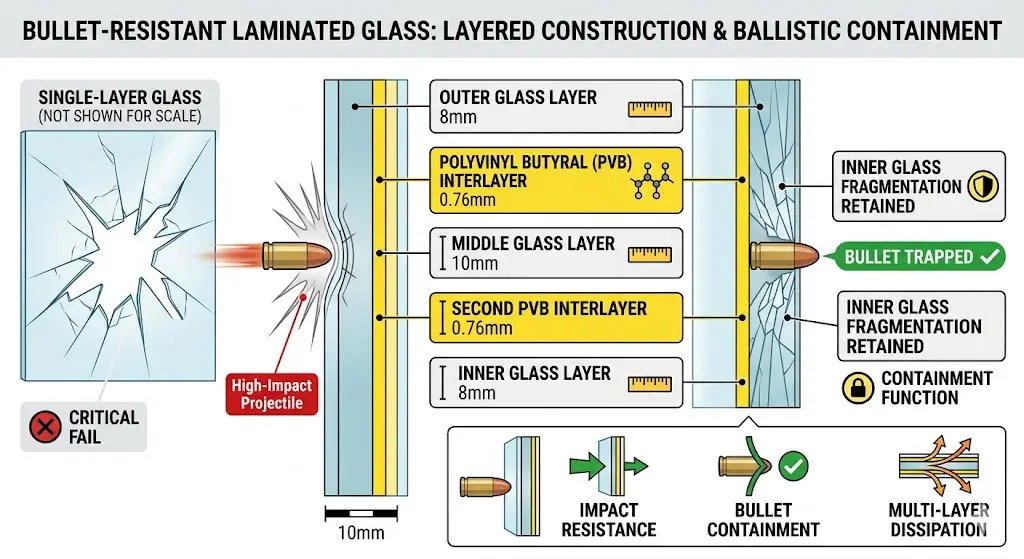
Bullet-resistant glass is a composite material constructed from multiple layers of glass and interlayers of plastic (typically polycarbonate or polyvinyl butyral, abbreviated PVB). The layers are bonded under heat and pressure into a unified panel.
How the layered construction works:
When an impact or projectile strikes the outer glass surface, that layer fractures. The energy is partially absorbed and partially transferred to the interlayer. The interlayer, being a ductile plastic material, deforms rather than shattering, absorbing additional energy. The next glass layer absorbs further energy. Depending on the panel’s construction and the energy of the impact, the projectile may be stopped within the panel, or it may penetrate but with dramatically reduced velocity.
The key property: The interlayers hold the fractured glass in position. A bullet-resistant panel that has been struck does not collapse or create an opening. The fractured material remains bound to the interlayers, and the panel continues to function as a physical barrier even after impact.
This “remain in place” property is what distinguishes bullet-resistant glass from tempered glass for security applications. A tempered glass panel that is struck falls out of the frame and creates an immediate opening. A bullet-resistant panel that is struck may show the impact but remains physically in place, requiring continued and deliberate effort to create an opening.
The Rating Systems
Bullet-resistant glass is tested and rated under several standards:
UL 752: Underwriters Laboratories standard for bullet-resistant glazing. Rates from Level 1 (9mm handgun) through Level 8 (7.62mm rifle). Higher levels require thicker panel construction.
NIJ Standards: National Institute of Justice standards used primarily for law enforcement protective equipment. Levels from IIA through IV, with IV being rifle-rated.
EN 1063: The European standard for bullet-resistant glazing, using BR1 through BR7 classifications.
What level is relevant for a gun cabinet? For a residential display cabinet, the threat model is not primarily rifle fire. The realistic forced-entry threat profile is an improvised impact tool (a hammer, a pointed object, or similar), not a firearm. A bullet-resistant panel rated for handgun fire is also well above the impact resistance required to defeat standard float glass and provides meaningful resistance against the realistic forced-entry threat.
The glass in a Custom Cabinet Security display cabinet is specified for its impact resistance and structural integrity under forced-entry conditions. The specific panel construction and its performance characteristics are integrated into the cabinet design from the beginning, not sourced from a standard glass catalog and installed without engineering consideration.
What Bullet-Resistant Glass in a Gun Cabinet Actually Protects Against
The security function of bullet-resistant glass in a display cabinet is best understood by identifying the specific threats it addresses and the specific threats it does not.
Opportunistic Forced Entry
The most common threat to a residential firearm collection is opportunistic burglary: someone who identifies an opportunity in a relatively short time window and uses whatever tools are available to access the collection quickly.
The research on residential burglary consistently shows that time is the most important deterrent factor. An intruder who encounters a security measure that cannot be defeated quickly will typically abandon the attempt and move to a more accessible target.
Standard float glass in a display cabinet can be broken with a single impact, creating an opening in seconds. Bullet-resistant laminated glass under the same impact visibly deforms at the impact point but does not create an opening. Continued strikes gradually increase the damage but do not produce a clean opening as quickly. The deformed panel, with its fractured glass held in place by the interlayers, requires sustained effort to create an opening large enough to access the interior.
This sustained effort requirement is the deterrent function. An intruder who cannot create access quickly faces the time pressure of continued exposure, the noise of continued striking, and the increasing likelihood of detection. For the opportunistic threat, this is a meaningful deterrent.
Casual or Accidental Contact
Display cabinets in living spaces are environments where children, visitors, and household members interact with the room. A standard glass panel that could be broken by a moderately forceful accidental impact (a toy thrown against the cabinet, an adult stumbling against it) is an ongoing household safety concern in ways that a bullet-resistant panel is not.
The impact resistance that makes bullet-resistant glass effective against deliberate forced entry also makes it resistant to accidental breakage. This is a secondary benefit that is practically significant for collectors whose display cabinets are in regularly occupied living spaces.
Smash-and-Grab Attempts
A specific variant of the opportunistic forced-entry threat is the smash-and-grab attempt: breaking the glass to access a single high-value visible piece and departing quickly. This threat is specifically relevant for display cabinets because the collection is visible through the glass and individual pieces can be identified without opening the cabinet.
A collector whose display includes a historically significant or high-value visible piece is creating a specific attraction for this type of attempt if the glass barrier is standard float. Bullet-resistant glass raises the time threshold for this type of attempt from seconds to minutes.
What Bullet-Resistant Glass Does Not Protect Against
Honest characterization requires addressing what the glass does not do.
It Does Not Make the Cabinet Impenetrable
A determined, skilled intruder with appropriate tools and sufficient time can defeat any residential cabinet, regardless of glass specification. The purpose of security is deterrence and delay, not absolute protection. Bullet-resistant glass extends the time required and raises the effort required. It does not make the cabinet inviolable.
It Does Not Address the Wood Surround
A display cabinet glass panel is set into a wood frame. The wood surround, while robust in a quality solid hardwood cabinet, is not as hard as the glass panel. A tool applied to the wood at the frame junction can potentially compromise the glass panel by attacking its mounting rather than its face.
Custom Cabinet Security’s frame construction accounts for this by building cabinet frames from solid hardwood with sufficient thickness and traditional joinery to resist point-load attacks at the glass mounting. This integrated approach to the whole cabinet’s security is different from using quality glass in an inadequate frame.
It Does Not Replace a Locked Steel Safe for Maximum Security
For a collector whose primary security concern is maximum forced-entry resistance, a steel safe provides a level of security that a wood cabinet with any glass specification cannot match. Steel safes with 10 to 12-gauge or heavier walls, multi-bolt locking systems, and no glass panels represent the highest residential security option.
The honest answer to the question “should I use a display cabinet or a steel safe for my most valuable pieces?” is: it depends on what you are trying to accomplish.
A display cabinet with bullet-resistant glass is the right choice when visibility and furniture quality matter alongside genuine security that exceeds standard glass. A steel safe is the right choice when maximum security is the overriding priority and display is not.
Many serious collectors use both: a display cabinet for the collection they want to present and appreciate in a living space, and a steel safe for maximum-security storage of the highest-value pieces. Each serves its purpose without being asked to compromise.
How the Glass Integrates Into Custom Cabinet Security’s Design
The use of bullet-resistant glass in Custom Cabinet Security’s display pieces is not an option applied after the fact to a standard furniture frame. It is designed into the piece from the beginning, and this distinction matters for both security and structural performance.
Why Integration Matters
Bullet-resistant laminated glass is significantly heavier than standard float glass of the same dimension. A standard 3/16-inch float glass panel weighs approximately 2.5 pounds per square foot. A bullet-resistant panel of equivalent visual performance weighs 4 to 6 pounds per square foot or more, depending on construction.
A cabinet door frame designed for standard glass and retrofitted with bullet-resistant glass is carrying significantly more weight than it was engineered to support at the door hinges, the locking mechanism interfaces, and the glass mounting details. Over time, this creates stress at exactly the points where structural integrity is most important.
When the cabinet is designed around the bullet-resistant glass specification from the beginning, the hinge hardware is specified for the actual door weight, the frame thickness at the glass mounting is sized appropriately, and the locking mechanism interfaces are robust enough for the actual door mass. This is the difference between integrated security design and retrofitted security.
The Visual Character of Laminated Safety Glass
A common concern about bullet-resistant or safety glass is that it will reduce visual clarity, distort the view of the displayed collection, or give the cabinet a visibly “industrial” appearance. Quality laminated glass for cabinet display applications is produced specifically for high visual clarity and is not distinguishable from standard float glass by casual observation.
The collection displayed behind quality bullet-resistant glass looks exactly like a collection displayed behind standard float glass. The visual performance difference is not meaningful. The security performance difference is.
Evaluating Glass Specification When Shopping for a Display Cabinet
For buyers comparing display cabinets, the glass specification is worth asking about specifically and directly. The difference between marketing language and meaningful specification is worth understanding.
Questions Worth Asking
Is the glass standard float, tempered, or laminated safety glass?
Tempered glass is frequently described in marketing materials as “safety glass” because it shatters safely into small fragments rather than large shards. This is a true safety property for accidental breakage. It is not a security property. Tempered glass shatters as easily as standard float glass under a pointed impact.
Laminated safety glass holds together under impact. Bullet-resistant laminated glass holds together under sustained impact and ballistic testing. These are very different products.
What specific performance rating does the glass carry?
A manufacturer who uses the term “bullet-resistant” or “bullet-proof” without specifying the rating and test standard is using marketing language rather than engineering specification. A meaningful claim includes the specific rating level and the standard under which it was tested.
How is the glass integrated into the frame construction?
As discussed above, the frame must be designed for the weight and properties of the specific glass used. A question about the frame specification for the glass panels reveals whether the cabinet was designed around the glass or whether the glass was added to a standard frame.
Custom Cabinet Security’s display cabinet collection uses bullet-resistant glass integrated into solid hardwood construction that was designed for it. For buyers with specific questions about the glass specification in a particular piece, the consultation process is the appropriate place to address those specifics.
The Broader Security Architecture of a Display Cabinet
Bullet-resistant glass is one component of the security architecture of a quality display cabinet. Understanding how it works alongside the other components clarifies the overall security picture.
Steel-Reinforced Locking Bar
The primary locking mechanism in a Custom Cabinet Security piece is a steel-reinforced bar that extends from the door frame into the cabinet structure when engaged. This mechanism is designed to resist the pry forces that are applied when someone attempts to force the door open without defeating the lock.
The relationship between the glass specification and the locking bar is important: the glass panels protect against access attempts that bypass the lock by attacking the glass, while the locking bar protects against access attempts that attack the door directly. Together, they address the two primary forced-entry approaches.
Pick-Resistant Lock Cylinders
The lock cylinders in Custom Cabinet Security pieces are specified for resistance to picking, drilling, and bypass techniques beyond what a standard residential cabinet lock provides. Pick-resistant lock cylinders raise the skill and time threshold for lock bypass attempts.
The security logic is cumulative: pick-resistant locks raise the threshold for lock bypass, steel-reinforced bars raise the threshold for door forcing, and bullet-resistant glass raises the threshold for glass bypass. Each component addresses a different attack vector, and together they create a security profile that is meaningfully above what any single measure provides.
The Solid Hardwood Structure
The solid hardwood frame and panel construction of a Custom Cabinet Security piece contributes to security in ways that are sometimes overlooked. Quality hardwood with traditional joinery, particularly the mortise and tenon frame construction and the solid panel thickness used in these pieces, is not trivially defeated by the tools most casual intruders bring to a forced-entry attempt.
The combination of solid hardwood structure, steel-reinforced locking, pick-resistant cylinders, and bullet-resistant glass creates a security architecture that reflects serious consideration of the realistic threat profile a residential display cabinet faces.
The Decision Framework: Is Bullet-Resistant Glass Right for Your Cabinet?
Not every collector needs bullet-resistant glass in every cabinet. The decision depends on what the collector is trying to accomplish and what threat profile they are protecting against.
When Bullet-Resistant Glass Is Worth the Specification
Collectors whose display includes high-value or historically significant pieces: For pieces that are both valuable and visible, the smash-and-grab deterrent function of bullet-resistant glass is directly relevant. A piece worth $5,000 or more that is visible through a glass panel is an attractive target for a quick forced-entry attempt. Bullet-resistant glass raises the time required for that attempt past the threshold where the risk-reward calculation changes for the intruder.
Collectors whose cabinet is in a home that is unoccupied for extended periods: A cabinet in a vacation home, a home whose owners travel frequently, or a home in a location with higher-than-average burglary risk benefits more from the deterrent function of bullet-resistant glass than one that is in constant occupancy.
Collectors who want genuine security alongside display functionality: For a buyer who is explicitly choosing a display cabinet with the understanding that they are accepting a different security profile than a steel safe, bullet-resistant glass is the specification that provides meaningful security at the glass panel rather than nominal security.
Collectors with children in the home: The impact resistance that provides security also provides meaningful protection against accidental breakage, which is a practical household safety benefit that standard glass does not provide.
When the Trade-Off Favors Other Approaches
Collectors whose primary security requirement is maximum forced-entry resistance: A steel safe provides the highest available residential security and should be considered alongside or instead of a display cabinet for the highest-value pieces.
Collectors whose display pieces are lower-value range items: The security premium of bullet-resistant glass is most justified when the value of what is displayed warrants it. A cabinet displaying a working collection of standard sporting firearms presents a different cost-benefit calculation than one displaying significant historical or collector-grade pieces.
The consultation process at Custom Cabinet Security is designed to help buyers think through exactly this kind of decision for their specific collection and situation. For a collector who wants to discuss how glass specification relates to their overall security approach, reaching out to begin that conversation is the appropriate starting point.
The Bottom Line
Bullet-resistant glass in a gun display cabinet is not a feature that turns a piece of furniture into an impenetrable vault. It is a specific security specification that addresses a specific vulnerability, the glass panel itself, in a way that standard float or tempered glass does not.
The protection it provides is real: it raises the time and effort threshold for forced entry through the glass from seconds to minutes, deters opportunistic and smash-and-grab attempts, and resists the kind of casual or accidental impact that standard glass cannot withstand.
The limitations are equally real: it does not replace a steel safe for maximum security, it does not make the cabinet inviolable, and its value is proportional to the value and visibility of what is displayed inside.
Custom Cabinet Security integrates bullet-resistant glass into their display pieces because they take the security function of a display cabinet seriously and because their buyers have collections that warrant genuine security alongside display quality. The glass is one component of a security architecture that includes steel-reinforced locking, pick-resistant cylinders, and solid hardwood construction that was designed with security in mind from the beginning.
For collectors who want to understand specifically how these pieces are built and what security specifications apply to a particular configuration, the full collection and the consultation process provide the detailed answers that general information cannot.
Related Posts
View All
Uncategorized
Reading Time: 8 min
The Resale Value of a Custom Gun Cabinet: Does a Handcrafted Amish Safe Hold Its Value Over Time?
If you’ve ever bought a mass-produced gun safe from a big-box retailer, you already know what happens the moment it
Read More
Uncategorized
Reading Time: 11 min
Women Gun Owners: How to Choose a Gun Storage Solution That Fits Your Home’s Style Without Compromise
Key Takeaways The Storage Problem Nobody Talks About Walk into almost any sporting goods store and look at the gun
Read More
Uncategorized
Reading Time: 10 min
How to Protect Antique and Vintage Firearms in Wood Storage: What Collectors Need to Know About Climate and Finish
Key Takeaways Why Antique Firearms Demand a Different Standard of Storage Storing a modern production firearm and storing an 1860s
Read More
