21 Aug 2026 • Reading Time: 12 min
Key Takeaways
- A hunter’s collection is typically one of the most practically mixed collections a gun owner assembles: bolt-action deer rifles, semi-automatic hunting rifles, pump and autoloading shotguns, over-unders, lever-actions, and carry handguns all with legitimate daily-use roles.
- The storage challenge for a hunting collection is different from a collector’s challenge. A collector optimizes for display. A hunter optimizes for organized access, condition protection between seasons, and the ability to find the right firearm quickly for the right use.
- Long guns, shotguns, and handguns have different storage requirements that a generic safe addresses awkwardly and a properly configured custom cabinet addresses specifically.
- Seasonal use patterns in hunting create specific humidity and corrosion risks. A deer rifle that sits between October and the following September is vulnerable to corrosion accumulation in ways that regularly accessed firearms are not.
- A custom cabinet configured for the hunting collection it actually holds, with appropriate height allocation for different long gun lengths, fitted handgun storage, and integrated humidity control, solves the “wrong size for everything” problem that plagues generic storage solutions.
- The practical hunting cabinet is not primarily about display. It is about an organized, protected, accessible home for a working tool collection that is used hard in the field and deserves good care in the off-season.
The Hunter’s Collection: Why Generic Storage Always Falls Short
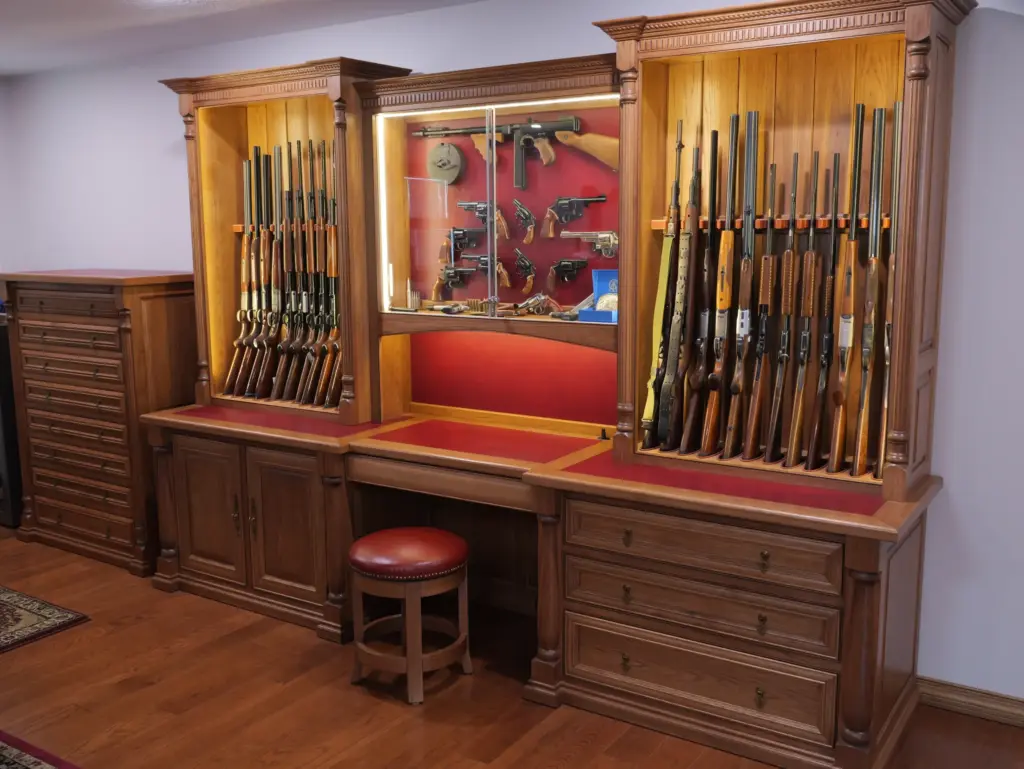
Ask a serious hunter what is in their gun cabinet and the list tells a story: a heavy-barreled varmint rifle with a bipod attached and a large scope, a deer rifle in a lever-action that has been in the family since before they were born, a 12-gauge pump shotgun for pheasant and turkey, an over-under for sporting clays, a slug gun for close-cover deer, and a 9mm or .45 on the shelf because it is always useful.
Every one of those firearms has a specific use case, a specific place in the hunting season calendar, and a specific set of storage requirements. The heavy-barreled varmint rifle with the scope needs more clearance from the cabinet’s top than a standard short-actioned bolt gun. The over-under has two barrels that sit differently in a vertical rest than a single-barrel shotgun. The handgun needs a secured drawer, not a shelf.
The typical approach to storing this collection is a factory safe or a basic gun cabinet that was sized for “20 long guns” and then fitted with whatever shelf configuration seemed reasonable for the general case. The collection goes in, and nothing quite fits right. The scope on the varmint rifle prevents the door from closing properly. The over-under’s break-action puts it at an angle that leaves the muzzle resting against the cabinet wall. The handgun ends up on the top shelf next to a cleaning kit because there is nowhere better for it.
This arrangement works in the sense that the firearms are technically secured. It does not work well in the sense that accessing the specific firearm needed requires moving others, the configuration does not protect any of them optimally, and after ten years of this, the cabinet’s felt lining has wear marks from scopes and barrel bands that were never supposed to be contact points.
A properly configured custom cabinet solves this problem specifically, for the actual collection it holds. This post explains how.
Understanding the Storage Requirements of Each Firearm Type
Before designing a storage solution for a mixed hunting collection, it helps to be specific about what each type of firearm actually needs.
Long Guns: Scoped Rifles and Their Clearance Requirements
The most significant storage variable in a hunting rifle collection is the optics attached to the rifles. A rifle without a scope has a relatively predictable vertical profile. A rifle with a mounted scope, particularly the larger objective diameter scopes used for long-range or low-light hunting applications, adds height above the action that must be accounted for in the vertical clearance between the top of the stored firearm and the cabinet’s top rail or interior ceiling.
Common scope configurations and their storage implications:
A standard 3-9×40 deer rifle scope with a 40mm objective lens adds modest height. A 6-24×50 or 4-16×56 long-range or low-light scope with a 50 or 56mm objective adds significantly more. A rifle with a night-vision or thermal optic mounted may be taller than any standard scope configuration.
What this means for cabinet configuration: The vertical rests in the upper section of a rifle cabinet determine how much height the stored rifles occupy and how many rifles can be stored in a given vertical space. A cabinet designed for bare-barrel rifles may not accommodate optic-mounted rifles at the same density. A cabinet designed for the actual scopes on the actual rifles in the collection stores them correctly.
Muzzle-up vs. muzzle-down storage: Hunters are sometimes advised to store rifles muzzle-down to prevent the small amount of oil applied to the bore from migrating to the action and stock. The practical concern is legitimate for very frequent oiling. For properly maintained rifles stored in a humidity-controlled environment with appropriate protective oil applied to the bore, muzzle-up storage is standard and does not create meaningful problems. The orientation preference can be accommodated in either direction in a custom configuration.
Shotguns: The Over-Under Storage Problem
Break-action shotguns, including over-unders and side-by-sides, present a storage challenge that most standard gun racks do not address well. When stored vertically in a standard barrel rest, the break-action hinge of the gun creates a lateral offset in the lower stock section relative to the upper barrel section. The gun does not sit vertically straight; it sits at an angle that puts the barrels in one position and the stock in another.
This offset angle means the barrel tip contacts the top barrel rest at one point while the stock contacts the lower rest at a different lateral position. The result is that the gun is not fully supported and is effectively resting against the rest at an angle, creating contact points between the barrel or receiver and cabinet surfaces that were not designed for that contact.
The specific fix in a custom configuration: A rest designed for break-action shotguns accounts for the angle created by the hinge. The lower rest supports the stock at the appropriate lateral offset from the barrel rest above, so the gun sits at its natural resting angle without contact between the receiver or barrel and unintended surfaces.
Barrel arrangement on over-unders: An over-under stored vertically sits with its two barrels stacked. The width of a double-barrel shotgun at the muzzle is slightly greater than a single barrel, which affects the spacing required between adjacent long guns in a multi-gun display.
Shotguns: Pump and Semi-Automatic
Pump and semi-automatic shotguns are mechanically similar to bolt-action rifles in their storage profile and do not create the specific angular challenge of break-actions. They do, however, vary significantly in overall length depending on barrel length and stock configuration.
A field-length 26-inch or 28-inch barrel waterfowl or upland shotgun is considerably longer than an 18 or 20-inch barrel turkey or deer slug gun. A collection that includes both requires a cabinet with adequate vertical clearance for the longer barrels, which is typically not a problem in a full-height display cabinet but is a real constraint in shorter storage configurations.
Handguns: The Drawer vs. Shelf Question
Handguns stored on shelves within a long gun cabinet are handguns that will shift, contact other items on the shelf, and be harder to organize and access than handguns stored in a dedicated drawer with fitted compartments.
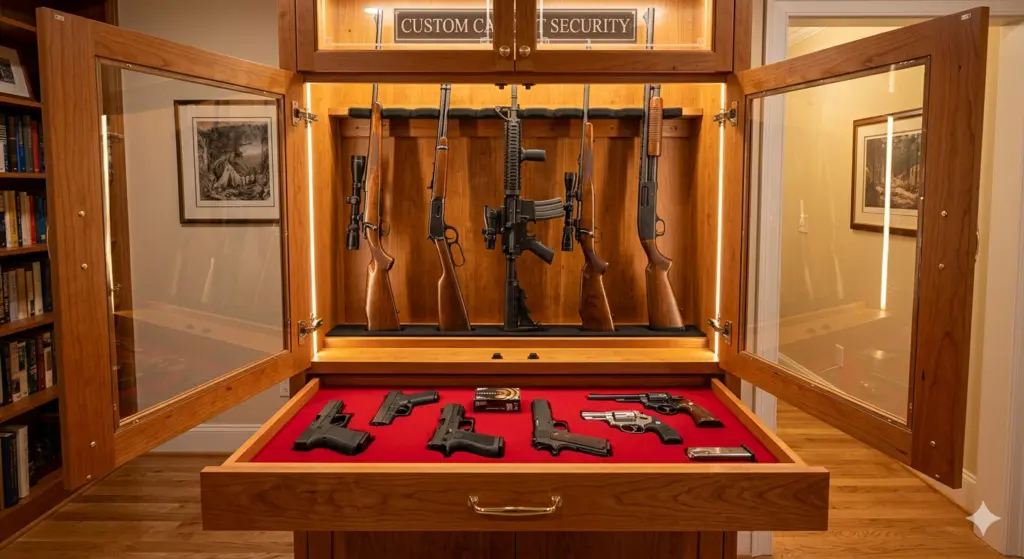
The appropriate storage for a hunter’s handgun complement, whether that is a single carry pistol or a broader pistol collection, is a dedicated drawer section with red felt-lined compartments sized for the specific handguns being stored. Each handgun sits in its own defined position, does not contact adjacent pieces, and can be retrieved without disturbing others.
The integration in a custom cabinet: A custom cabinet for a hunting collection can incorporate a dedicated handgun drawer section in the lower portion of the piece, below the long gun display, with drawer compartments configured for the specific handguns in the collection. This integration gives handguns their appropriate storage format while keeping the entire collection in one organized piece.
The Seasonal Use Factor: Why Hunters Need Better Humidity Control
Hunters have a specific relationship with their firearms that differs from collectors and from self-defense-focused owners. The typical hunting rifle or shotgun has a defined season and then a long off-season, during which it sits in storage for eight to ten months.
This storage pattern creates specific risks.
The Off-Season Corrosion Accumulation Problem
A self-defense pistol that is handled, inspected, and maintained regularly gets the attention that catches early-stage surface oxidation before it progresses. A deer rifle stored in October and retrieved in September has sat for eleven months in whatever environment the storage provides.
If that environment has humidity variation, which is the default for most residential storage without active humidity management, the rifle’s metal surfaces have been exposed to the humidity’s effects for eleven months without anyone looking.
The bore is particularly vulnerable. A bore that was protected with a light oil coat at the start of storage but sits for eleven months in a humid environment may have developed rust in the bore, damage that affects both accuracy and the long-term condition of what may be a family-heirloom piece.
What humidity control does for the hunting collection:
The Golden Rod dehumidifier rod integrated into Custom Cabinet Security’s cabinets maintains interior humidity in the 45 to 55 percent range consistently, without any active management required beyond being plugged in. The bore, the metalwork, and the stock finish of every stored firearm are protected by this consistent interior environment throughout the off-season.
A hunting collection that goes into storage in October and comes out in September in a properly humidity-controlled cabinet should be in essentially the same condition it was in when it was stored. A hunting collection stored in an uncontrolled environment may require bore cleaning, surface rust treatment, and potentially stock refinishing before it is ready for use.
The Pre-Season Inspection and Maintenance Rhythm
Serious hunters have a pre-season maintenance routine: cleaning bores, checking stocks for any moisture damage, verifying scope mounting, and functioning the action. When the firearms have been in a properly humidity-controlled environment, this inspection confirms good condition and the maintenance work is light. When they have been in an uncontrolled environment, the inspection sometimes finds work that requires either DIY remediation or gunsmith attention before the season starts.
The cabinet is part of the pre-season workflow. A well-organized, humidity-controlled cabinet makes the pre-season check easy, allows every firearm to be accessed without disturbance to the others, and starts the process of the hunt with equipment that is ready rather than needing remediation.
How a Custom Cabinet Configuration Works for a Typical Hunting Collection
The following is a practical illustration of how a custom cabinet configuration would be developed for a specific, representative hunting collection. The details are illustrative; actual configurations are developed through the consultation process based on the specific pieces in a specific collection.
The Example Collection
- 1 heavy-barreled .308 with a 6-24×50 scope and bipod mounted
- 1 lever-action .30-30 (no scope, short overall profile)
- 1 .30-06 bolt-action with a 3-9×40 scope
- 1 12-gauge pump shotgun, 28-inch barrel field configuration
- 1 12-gauge over-under, 30-inch barrels for sporting clays
- 1 20-gauge semi-auto, 26-inch barrel for upland
- 2 handguns: one full-size .45 and one compact 9mm carry pistol
The Configuration That Fits
Upper section (long gun display):
The critical constraint is the heavy-barreled .308 with the large-objective scope. This rifle requires the most vertical clearance of any piece in the collection. The cabinet height and the position of the upper barrel rests must accommodate this rifle without the scope contacting the top of the cabinet interior.
The lever-action, without a scope, requires significantly less clearance. Placing it adjacent to the heavily scoped rifle is possible but creates wasted clearance height on that adjacent rest position. Better placement: position the scoped rifles in the section with the full clearance, and position the lever-action in a section where a lower overall height could be accommodated in a multi-zone upper configuration.
Middle section (shotguns):
The over-under requires a rest configuration that accommodates its break-action lateral offset. The rest pairing for this gun uses an offset lower support that accounts for the angle. The pump and semi-auto shotguns use standard vertical rests.
The 30-inch barrels of the over-under are the longest pieces in the collection. The overall cabinet height must accommodate this length in the upper barrel rest position.
Lower section (handgun drawers):
Two drawers, each with two dedicated compartments: one compartment sized for the full-size .45 and one for the compact 9mm in each drawer. The extra compartments in each drawer accommodate accessories or future additions without crowding the existing pieces.
Total cabinet profile:
A cabinet configured this way is taller than the shortest standard-depth gun safe would be (to accommodate the over-under barrel length), has a specific upper-section height relationship between the scoped and non-scoped rifle positions, and has a lower drawer section sized for the specific handguns rather than a generic “pistol tray” accommodation.
This configuration is not a standard product that can be picked from a catalog. It is the result of a conversation about the specific collection, which is what the consultation process at Custom Cabinet Security is designed to produce.
Wood Selection for a Practical Hunting Cabinet
The wood species choice for a hunting cabinet is a different conversation than it is for a formal collector’s display piece.
The Character Match
Hunting culture across much of the country has its own aesthetic tradition that is different from the formal library-and-study register of much collector cabinet design. A hunting cabinet in a farmhouse mudroom, a rural property’s gun room, or a hunting lodge has a different visual context than a cherry wood formal display in a suburban study.
Hickory is the wood species most naturally aligned with hunting cabinet aesthetics. Its dramatic grain variation, the visible contrast between light sapwood and dark heartwood, and its general character as an American hardwood with a working-tool tradition make it the natural fit for a cabinet that houses working hunting firearms rather than a collector’s display collection. Hickory is also the hardest of the three available species, which is practically relevant for a cabinet whose drawers and doors will be opened and closed regularly in the practical daily rhythm of a working hunting collection.
White oak works well for hunters whose home context is more contemporary or whose hunting property has architectural character that suits oak’s open grain and neutral tone.
Cherry is the most formal of the three species and is a beautiful choice for a hunting cabinet that will live in a study, a library, or a formal gun room where the visual register calls for refined furniture rather than rustic character. Many hunting families with long traditions build collections that include heirloom pieces that deserve the dignified presentation cherry provides.
The species choice is ultimately a decision about what feels right for the collection, the room, and the person who built both.
Practical Features That Matter to Hunters
Beyond the core configuration for the specific firearms, hunters often have accessory needs that a custom cabinet can incorporate.
Ammunition Storage
A dedicated locked section for ammunition, either a shelf below the handgun drawers with its own locking mechanism or integrated drawers beside the handgun section, keeps ammunition organized and secured alongside the firearms it belongs with.
Hunters with multiple firearms in multiple calibers benefit from labeled or organized ammunition storage that prevents reaching for the wrong cartridge before a hunt.
Accessories and Documentation
Scope covers, sling swivels, bore brushes, cleaning patches, and field accessories accumulate with any active hunting collection. A dedicated drawer or shelf section for these items keeps them organized and accessible alongside the firearms they belong to.
Documentation, including licenses, tags, and any heirloom history for significant pieces, can be stored in a dedicated document section within the cabinet’s interior.
The Question of Door Style
For a working hunting collection, solid wood door panels rather than glass display panels have a practical argument: the collection is accessed regularly, privacy is often preferred (visitors to a property do not need to know what is there), and the display function is less relevant than for a collector’s piece.
That said, a glass-panel display cabinet for a hunting collection is entirely legitimate, particularly for pieces with personal history that the owner enjoys seeing. The over-under from the first pheasant season with a grandfather, the lever-action that has tagged thirty deer over four decades, the handgun from a particularly significant hunt: these are objects worth seeing, not just storing.
The choice between glass and solid panels is the owner’s, and it reflects a personal relationship with the collection that no general recommendation can anticipate correctly.
The Right Cabinet for the Right Owner
A hunting cabinet is not the same conversation as a collector’s display cabinet or a home-defense-focused storage solution. It serves a specific person with a specific collection used in specific ways.
The practical hunter who wants organized, protected, accessible storage for a working collection that includes long guns, shotguns, and handguns is describing a specific design problem. That design problem has a specific solution: a custom cabinet with the right height, the right upper-section configuration for the scoped and unscoped long guns in the collection, the right shotgun accommodation for break-actions and single-barrel guns, and dedicated handgun drawers sized for the specific handguns that belong in it.
This solution is not available off a shelf. It comes from a conversation about the specific collection, the space where it will live, and the way the owner actually uses and accesses their firearms.
The current collection of pieces at Custom Cabinet Security includes configurations that serve many hunting collections directly. For owners whose collection has specific requirements that standard configurations do not address, the custom consultation process begins with exactly the kind of conversation this post describes: what is in the collection, how is it used, where will the cabinet live, and what does a piece designed specifically for this owner and this collection look like?
The Bottom Line
A hunter’s collection deserves storage designed for the way hunters own and use firearms: organized, accessible, protective through the off-season, and configured for the specific mix of long guns, shotguns, and handguns that make up a practical hunting battery.
Generic safes and standard gun cabinets solve the security problem while creating the configuration problem. A custom cabinet built for the specific collection solves both.
Cherry for the family hunting room with its long tradition. Hickory for the farmhouse or hunting property with a more rustic character. White oak for the contemporary home where the cabinet needs to fit a different visual context. Any of these, configured for the specific rifles, shotguns, and handguns in the collection, produces a piece that works correctly from day one and continues to work correctly through decades of hunting seasons.
For hunters who are ready to have that conversation, start with a consultation. The craftsmen in Arthur build one piece at a time for the specific collection it will house. A hunting collection that has been assembled over a lifetime deserves exactly that.
Related Posts
View All
Uncategorized
Reading Time: 8 min
The Resale Value of a Custom Gun Cabinet: Does a Handcrafted Amish Safe Hold Its Value Over Time?
If you’ve ever bought a mass-produced gun safe from a big-box retailer, you already know what happens the moment it
Read More
Uncategorized
Reading Time: 11 min
Women Gun Owners: How to Choose a Gun Storage Solution That Fits Your Home’s Style Without Compromise
Key Takeaways The Storage Problem Nobody Talks About Walk into almost any sporting goods store and look at the gun
Read More
Uncategorized
Reading Time: 10 min
How to Protect Antique and Vintage Firearms in Wood Storage: What Collectors Need to Know About Climate and Finish
Key Takeaways Why Antique Firearms Demand a Different Standard of Storage Storing a modern production firearm and storing an 1860s
Read More
