28 Aug 2026 • Reading Time: 10 min
Key Takeaways
- The custom order process at Custom Cabinet Security begins with a conversation, not a form. The consultation is designed to understand the collection, the space, and the buyer’s priorities so the craftsmen in Arthur can build a piece that serves them specifically.
- Buyers do not need to arrive at the consultation with a fully formed design in mind. The consultation is structured to draw out the relevant information through questions, and the design recommendations emerge from that conversation.
- Lead time for a custom piece is typically eight to twelve weeks from confirmed order to delivery, though complex configurations or peak production periods can extend this. Buyers with deadline-driven timelines (a gift for a specific occasion, a home completion date) should communicate that at the beginning of the consultation.
- Custom work does not mean unlimited price uncertainty. The consultation produces a specific quoted price for the agreed configuration before any commitment is made. No buyer is asked to commit without knowing the cost.
- Standard pieces from the current collection are available with shorter lead times than fully custom pieces. For buyers whose collection fits a standard configuration, this is often the faster and simpler path.
- After delivery, Custom Cabinet Security remains the point of contact for any questions about the piece, assembly if applicable, or follow-up needs. The relationship is not transactional.
The Uncertainty Most Buyers Feel Before They Reach Out
A significant number of people who spend time on the Custom Cabinet Security website do not immediately contact the team to begin a consultation. Not because they are not interested, but because they are not sure what the consultation involves or whether they are “ready.”
The concerns that hold buyers back typically come in variations of the same few questions:
I don’t know exactly what I want. Am I too early?
How long does this actually take? I have a date in mind.
I’m not sure if my collection fits a standard piece or if I need something custom. How do I know?
What does this commit me to? I don’t want to be in a situation where I’m pressured.
These are reasonable concerns that deserve honest answers. This post is that answer: a clear, honest walkthrough of the actual process from first contact to the piece arriving at the buyer’s home. No step is vague, no timeline is aspirational, and no concern is dismissed.
Step 1: The Initial Contact
The process begins when the buyer reaches out. There is no right level of readiness required before making contact.
How to Start
The consultation can be initiated through the contact form on the website, by phone, or by email. All three work. The form is convenient for buyers who have questions they want to think through in writing before a conversation. Phone works well for buyers who prefer to talk through their situation directly. Email works for buyers with specific questions or who are in a time zone or schedule that makes phone contact difficult.
What to bring to the initial contact:
Very little is required. Useful information to share includes:
- An approximate description of the collection: how many long guns, how many handguns, anything unusual about specific pieces (oversized scopes, unusually long barrels, heirloom pieces requiring specific care)
- The general setting where the cabinet will live: a study, a bedroom, a dedicated gun room, a living room
- Whether display (glass panels) or private storage (solid doors) is the general preference
- Any timing consideration: a gift for a specific date, a home under construction or renovation with a move-in window, or simply flexibility
What is not required:
A complete design. The room’s exact dimensions. Certainty about wood species or color. Experience with custom furniture. The buyer does not need to have this figured out to begin.
Step 2: The Consultation Conversation
The consultation is a conversation, not a form or a specification meeting. Its purpose is to understand the buyer and the collection well enough to recommend and design a configuration that actually fits.
What the Consultation Covers
The collection:
How many long guns? How many handguns? What is the mix — bolt-actions, semi-autos, lever-actions, shotguns, break-actions? Are any pieces unusually sized: very long barrels, large-objective scopes, short suppressors, unusual stock configurations?
Are there pieces in the collection with specific significance — heirloom firearms, historically notable pieces, matched pairs — that warrant specific display placement or special care in the interior configuration?
Is the collection likely to grow, and if so, in what direction? Building a cabinet that accommodates the collection as it will be in three years rather than as it is today saves a second purchase.
The space:
Where will the cabinet live? What are the approximate dimensions of the wall space available? Is there a ceiling height constraint? Is the room’s access point (door width, staircase configuration) a factor in what can be delivered and placed?
What is the general aesthetic of the room — formal and traditional, contemporary, rustic, transitional? What other furniture is present, and what wood tones or finishes does the room already contain?
The buyer’s priorities:
Is the primary goal display (the collection should be visible, beautifully presented) or secure storage (the collection should be organized, protected, and private)?
Is there a specific security need that drives the conversation — children in the home, a high-value collection, a specific concern about the storage environment?
The timeline:
Is there a delivery date that matters? A gift for a specific occasion, a home completion date, a seasonal window for a hunting collection before a specific season?
What the Consultation Does Not Pressure
The consultation does not pressure toward a commitment. It is a design and information conversation. The buyer’s questions are answered honestly. The craftsmen’s recommendations emerge from what they hear, not from what produces the highest price point.
If the buyer’s collection and priorities are best served by a standard piece from the current collection rather than a fully custom build, that is what the team recommends. If the standard pieces are not the right fit, the custom path is explained specifically.
Step 3: The Design Recommendation and Quote
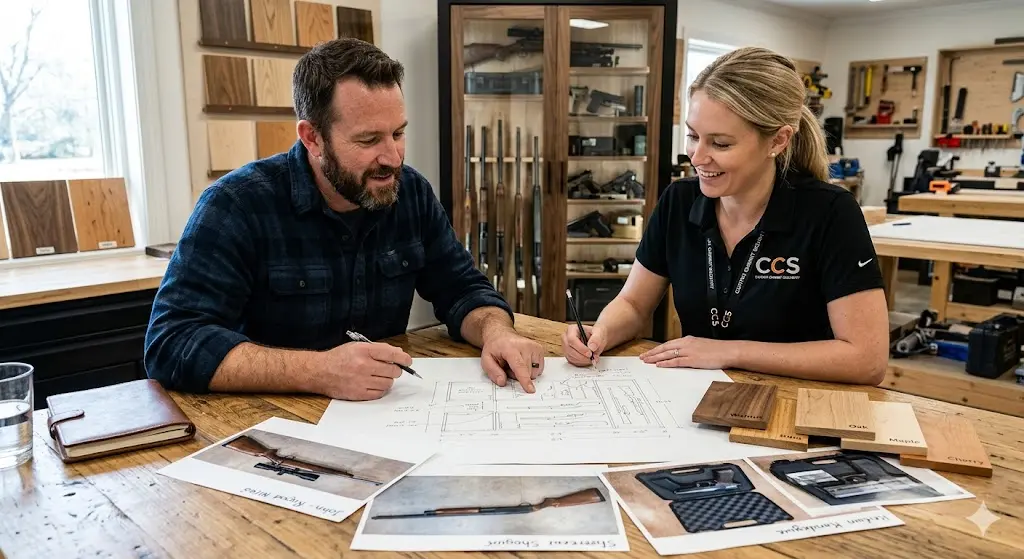
After the consultation, the team develops a design recommendation based on what was discussed. This is not a generic quote for “a custom cabinet.” It is a specific design for the specific collection, space, and priorities that emerged from the consultation.
What the Quote Covers
Cabinet dimensions:
Height, width, and depth of the piece, sized for the collection and the space. These dimensions are not generic; they reflect the tallest long gun in the collection, the space available on the wall, and the relationship between storage capacity and the room’s proportions.
Interior configuration:
The number and type of rifle rests, the configuration of the lower drawer or shelf section, the handgun drawer layout if applicable, and any specific accommodations for unusual pieces (break-action shotgun rests, scope clearance provisions).
Wood species:
The recommended species based on the room’s aesthetic and the buyer’s priorities, with a brief explanation of why that recommendation fits the context.
Door style:
Glass panel display, solid panel storage, or a combination. If glass, whether the configuration uses the standard bullet-resistant glass that Custom Cabinet Security specifies for their display pieces.
Security specifications:
The steel-reinforced locking bar, pick-resistant lock cylinder, and Golden Rod dehumidifier integration are standard on every piece. Any additional security specifications are noted.
Price:
A specific price for the configuration described. Not a range. A number.
This quote is the full picture before any commitment is required. The buyer reviews it, asks any follow-up questions, and decides whether to proceed.
What Happens If the Quote Needs Adjustment
If the buyer reviews the quote and wants to adjust the configuration, that conversation happens before any commitment. The design is not fixed until the buyer confirms it.
Common adjustments include:
- Changing the wood species after seeing it on a sample
- Adjusting the interior configuration after thinking through the specific pieces more carefully
- Modifying the door style based on the placement location
- Adjusting dimensions based on a measurement taken after the initial consultation
The quote is a starting point for a confirmed design, not a take-it-or-leave-it offer.
Step 4: Order Confirmation and Production
When the buyer confirms the design and the quote, the order is placed with the craftsmen in Arthur. This step involves:
A deposit: Custom work requires a deposit before production begins. The deposit amount and the payment structure for the remaining balance are confirmed at order placement.
A confirmed production timeline: Based on the current production queue and the complexity of the piece, the estimated completion date is confirmed at order placement.
Design documentation: The confirmed configuration is documented so that the craftsmen building the piece have a clear and complete specification.
What Happens in the Workshop
The piece is built one at a time by the craftsmen in Arthur. The production process follows the sequence described in our post on how Amish craftsmen build a gun cabinet, which covers the material selection, joinery methods, finishing process, and security hardware integration that define the quality of every piece.
The production timeline reflects real craftsmanship. These pieces are not pulled from inventory or assembled from stock components. Each is built from the beginning for the buyer who ordered it.
Typical production time for a custom piece: Six to ten weeks from confirmed order.
Typical total timeline (production plus shipping): Eight to twelve weeks from confirmed order to delivery.
Complex configurations, unusual wood selections, or peak production periods can extend this timeline. Buyers with a specific delivery date requirement should communicate that clearly at the beginning of the consultation so the team can confirm whether the timeline is achievable.
Step 5: Quality Review Before Shipping
Before the piece is prepared for shipping, it goes through a quality review. This review covers:
- All joinery and structural components for fit and integrity
- Surface finish quality across all visible surfaces
- Hardware function: lock operation, door alignment and closure, drawer operation
- Interior configuration: felt lining installation, dehumidifier placement and wiring
- Overall dimensional accuracy against the confirmed specification
If anything in the quality review does not meet the standard, it is addressed before the piece leaves the workshop. The craftsmen who build the piece are also the people whose reputation for quality is directly attached to it in the community where they live and work.
Shipping Preparation
Shipping a piece of solid hardwood furniture of this quality requires packaging that protects it through the transit process. Custom Cabinet Security packages pieces to protect the wood surfaces, the glass panels where applicable, and the hardware components from damage in transit.
The shipping carrier and method are appropriate to the piece’s dimensions, weight, and fragility. Delivery is coordinated with the buyer to ensure someone is present to receive the piece and inspect it at delivery.
Step 6: Delivery and Placement
When the piece arrives, the buyer inspects it at delivery before the carrier departs. This inspection confirms that the piece arrived in the condition it left the workshop.
What to Confirm at Delivery
Exterior surfaces: Look at all visible surfaces for any finish damage, scratching, or impact marks that occurred in transit. Most pieces arrive undamaged, but the delivery inspection is the time to document anything that needs to be addressed.
Glass panels: Check any glass panels for cracks or damage.
Hardware: Confirm that the lock functions correctly and the key works as expected.
Interior: Check the felt lining for any displacement or damage and confirm the dehumidifier is present and undamaged.
If any issue is identified at delivery, document it with photographs before the carrier departs. Contact Custom Cabinet Security immediately so any transit-related issue can be addressed.
Placement and Setup
Some pieces are delivered ready to place as a single unit. Larger pieces may be delivered in sections that are assembled on-site. The delivery documentation will specify the assembly requirements, and the team is available by phone or email to answer any assembly questions.
The dehumidifier connection: The Golden Rod dehumidifier requires an electrical outlet. The cabinet should be positioned near an outlet, or an appropriate power solution should be planned in advance. The dehumidifier cable is typically routed through a small exit point in the cabinet’s back panel.
Timeline Reference: What to Plan For
| Milestone | Typical Timing |
|---|---|
| Initial contact to consultation conversation | 1 to 3 business days |
| Consultation to design recommendation and quote | 3 to 7 business days |
| Quote review and order confirmation | Buyer-paced; no time pressure |
| Order confirmation to production completion | 6 to 10 weeks |
| Production completion to delivery | 1 to 2 weeks |
| Total: consultation to delivery | 8 to 12 weeks |
For deadline-sensitive orders:
Buyers with a specific delivery date, such as a holiday gift, a birthday, a home completion, or a specific occasion, should communicate the required delivery date at the first contact. The team confirms at that point whether the timeline is achievable. Earlier contact is always better for deadline-sensitive projects.
For gifts delivered as announcements:
If the timeline does not allow physical delivery by the occasion date, many buyers choose to give the gift as an announcement with a description of the piece and the confirmed delivery date. This approach works well and is common for major birthdays, anniversaries, and significant occasions.
Standard Pieces vs. Custom: How to Know Which Path Is Right
Not every buyer needs a fully custom piece. Custom Cabinet Security’s current collection of standard pieces includes configurations that serve a wide range of collection types and sizes.
Standard pieces make sense when:
- The collection size and type fits a standard configuration without meaningful compromise
- The buyer’s timeline is tighter than a custom build allows
- The room and aesthetic context fits one of the available standard configurations
- Budget is a constraining factor and a standard piece meets the essential needs
Custom work makes sense when:
- The collection has specific dimensions, unusual pieces, or a configuration that no standard piece accommodates correctly
- The room has specific constraints (available wall width, ceiling height, door access) that require non-standard dimensions
- The buyer has a specific vision for the piece that standard configurations do not deliver
- The collection will be the primary display in a significant room and the piece needs to be exactly right
The consultation is the mechanism for determining which path applies. If the standard collection solves the problem, the team says so. If it does not, the custom path is explained specifically and without pressure.
Common Questions About the Custom Process
Do I need to have the collection physically present during the consultation?
No. A description of the collection, ideally with approximate counts and any notable pieces identified, is sufficient for the consultation. Photographs of specific pieces that have unusual storage requirements are helpful but not required.
Can I see wood samples before committing?
Yes. Wood species samples can be provided to help buyers visualize the actual material in their space before committing to a specification.
What if my collection changes after the order is placed?
If the collection changes significantly before the piece is in production, modifications to the configuration can typically be accommodated. Once production has begun, changes become more complex and depend on where the piece is in the production process.
What warranty does the piece carry?
Custom Cabinet Security stands behind the workmanship of every piece built in Arthur. Specific warranty terms are confirmed at the time of order. Manufacturer warranties apply to the security hardware components. The craftsmanship itself is backed by the personal accountability of the craftsmen who built it.
Is shipping to my state available?
Custom Cabinet Security ships to buyers across the country. The shipping logistics for your specific location are confirmed during the order process.
Starting the Conversation
The consultation process begins with a single step: reaching out. There is no commitment required, no design fully formed in the buyer’s mind, and no question too basic to ask.
For buyers who want to understand what a piece built for their specific collection would look like, the consultation is where that understanding develops. The craftsmen in Arthur build one piece at a time, for one buyer’s specific situation. The consultation is the process that makes that possible.
Begin the consultation here. The conversation is straightforward, the process is transparent, and the result is a piece that reflects the collection it was built to house.
The Bottom Line
The custom order process at Custom Cabinet Security is not complex, but it is specific. It begins with a conversation about the collection and the space. It produces a specific design recommendation and a specific price. It results in a piece built by craftsmen in Arthur for the buyer who ordered it, delivered to their door in eight to twelve weeks.
For buyers who have been thinking about this and are not sure whether to reach out: the consultation costs nothing, commits to nothing, and produces useful information regardless of whether the buyer proceeds with an order. The best first step is the same one it always is: starting the conversation.
Visit the current collection to see what the standard configurations look like, and reach out to begin a consultation when the collection, the space, or the occasion suggests that a custom piece is the right answer.
Related Posts
View All
Uncategorized
Reading Time: 8 min
The Resale Value of a Custom Gun Cabinet: Does a Handcrafted Amish Safe Hold Its Value Over Time?
If you’ve ever bought a mass-produced gun safe from a big-box retailer, you already know what happens the moment it
Read More
Uncategorized
Reading Time: 11 min
Women Gun Owners: How to Choose a Gun Storage Solution That Fits Your Home’s Style Without Compromise
Key Takeaways The Storage Problem Nobody Talks About Walk into almost any sporting goods store and look at the gun
Read More
Uncategorized
Reading Time: 10 min
How to Protect Antique and Vintage Firearms in Wood Storage: What Collectors Need to Know About Climate and Finish
Key Takeaways Why Antique Firearms Demand a Different Standard of Storage Storing a modern production firearm and storing an 1860s
Read More
