04 Sep 2026 • Reading Time: 12 min
Key Takeaways
- A home office or study is one of the best possible locations for a firearm storage piece because it combines privacy, climate control, and access by the person who uses the room most. What it demands in return is storage that looks like it belongs in a professional, intentionally designed space.
- A steel safe in a home office works functionally but creates a visual collision with the furniture and character of a well-designed workspace. The safe announces itself as a security device in a room that does not want to read as an armory.
- A quality handcrafted wood gun cabinet in cherry, hickory, or white oak integrates into a home office or study the way a bookcase or credenza does. It is furniture first, with security architecture built in.
- The home office has specific security context advantages: it is a private room, typically occupied by a single primary user, and less frequently accessed by guests or household members who should not have firearm access.
- For professionals who receive clients or colleagues in a home office, the storage piece must be discreet in addition to secure. A solid-door wood cabinet in a quality wood species reads as furniture, not as a gun safe, to a visitor who does not already know what it contains.
- The combination of a display piece for the working collection and a discrete solid-door cabinet for secure storage gives the home office gun room the full range of function without either piece looking out of place.
The Problem With the Standard Approach
Most gun owners who have a dedicated home office or study eventually confront a version of the same tension: they want their firearms accessible and secured in the room where they spend most of their time, and they also want the room to look professional.
The standard solution is a steel safe positioned in the corner, or more commonly in the closet, where it is out of sight. This works in the sense that the safe is secure and the office looks normal. It does not work well in the sense that accessing the collection requires going to the closet, and the room gains nothing from the presence of the firearms it contains.
The alternative approach, which this post describes, treats the home office gun storage piece as furniture: an element of the room’s design rather than a security device reluctantly accommodated by the room.
This is not an aesthetic luxury. It is the approach that produces better daily outcomes: the collection is more accessible, the room is better organized, and the storage communicates something about the owner and their collection that a steel box in a corner never can.
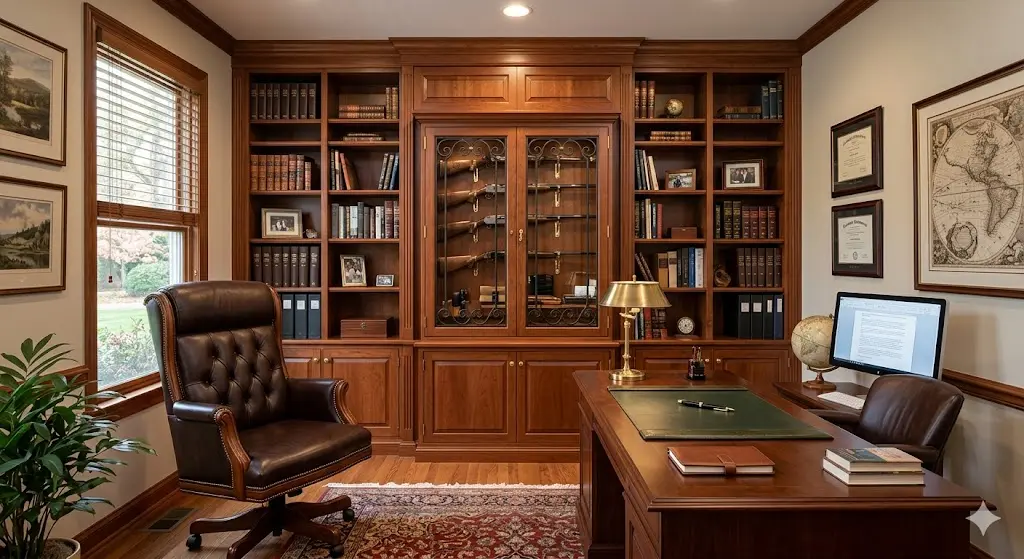
Why the Home Office Is Ideal for a Quality Gun Cabinet
Before addressing what type of storage belongs in a home office, it is worth making the affirmative case for the home office as a gun storage location. This is not a default choice but often the best one available in a given home.
Privacy Without Isolation
The home office is the room in most homes that is most consistently private without being isolated. It is not the master bedroom, which is appropriate for some storage configurations but not for a display collection. It is not the garage or basement, which provide privacy at the cost of poor environmental conditions and aesthetic incompatibility with quality furniture.
The home office is a room the owner occupies regularly, that guests do not typically enter without invitation, and that provides the daily access appropriate for a collection that is part of the owner’s working life rather than something stored away and occasionally retrieved.
Climate Control Compatibility
A home office is virtually always climate-controlled, temperature-regulated, and on an interior wall if it is a dedicated room. This is exactly the environment in which firearm storage pieces perform optimally. As covered in our guide on humidity and wood gun cabinets, the controlled environment of an interior room in a climate-controlled home is the ideal setting for both the wood of the cabinet and the metal of the firearms inside it.
Security Context
The home office has a security profile that is favorable for firearms storage. The room is typically locked when not in use, accessed only by the primary occupant and invited guests, and not part of the household’s common traffic patterns. A cabinet in a home office is not in the path of every family member, visitor, or repair contractor who comes through the house.
For gun owners with children in the household, the home office’s natural access restriction adds a layer of security context that a bedroom or living room cannot provide.
The Aesthetic Challenge: What Makes a Room Feel Coherent
A room feels coherent when its elements share a visual register. A home office or study that has a specific character formal and traditional, contemporary and minimal, warm and eclectic feels like it works when the pieces in it relate to that character.
A large steel gun safe does not relate to most home office visual registers. It comes from the visual language of security hardware, industrial storage, and utility spaces. Regardless of its quality or its function, it introduces a foreign visual element into a room that was composed around different principles.
This visual collision does not always bother gun owners. Many simply accept it as the price of having secure storage in the right room. But for owners who have invested in their home office’s furnishings, who receive clients or colleagues in the space, or who simply care about how the room feels to be in, the collision matters.
A handcrafted wood cabinet in cherry, hickory, or white oak does not create this collision. It comes from the same visual language as the bookcases, the desk, and the other furniture in a well-composed study. The room gains a piece; it does not acquire an intrusion.
Format Options for the Home Office Setting
The right format for a home office gun storage piece depends on three variables: the collection type, the owner’s priorities between display and privacy, and the space available in the room.
The Display Cabinet: When the Collection Is Part of the Room
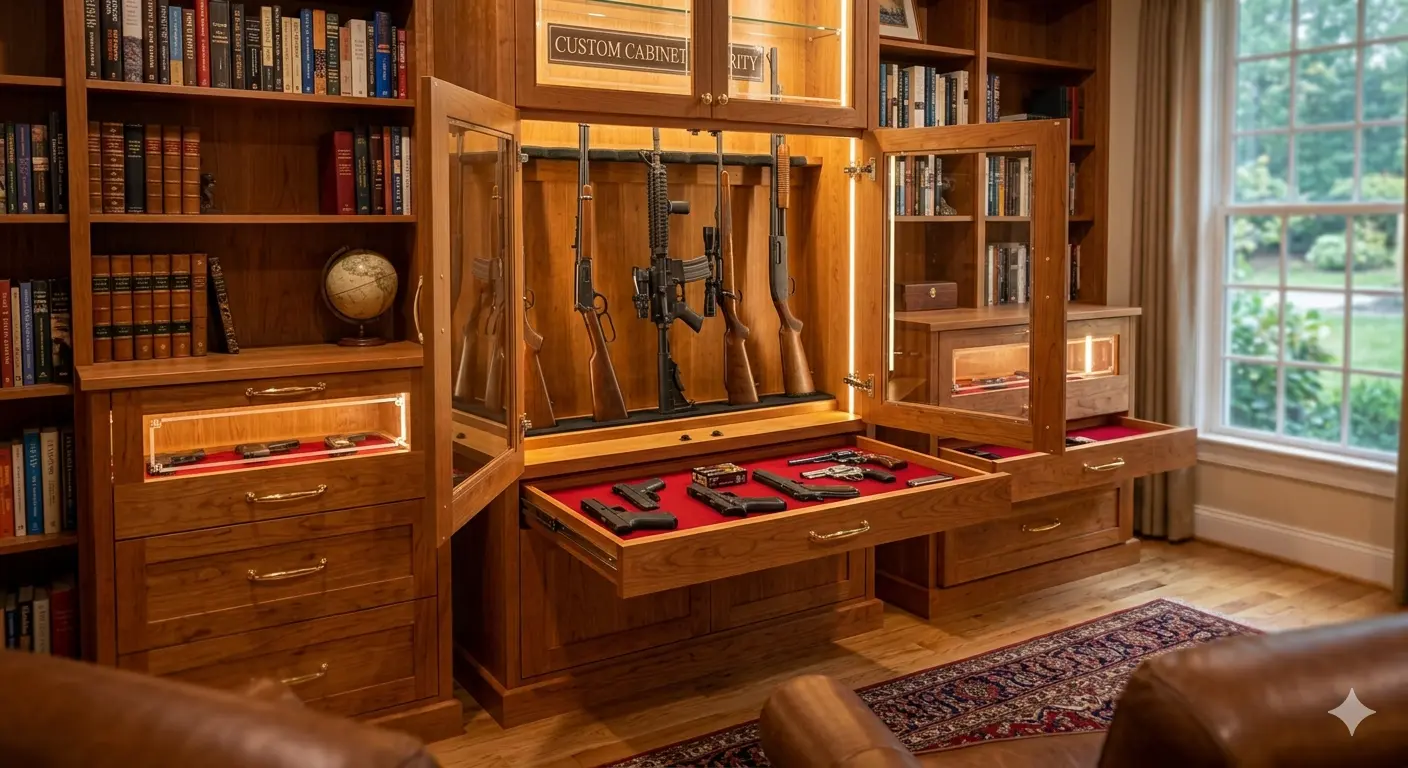
A glass-panel display cabinet in the home office makes sense when the collection is something the owner wants to see and share in that space. A significant collection of historically important rifles, a display of matched pistols that represent years of deliberate acquisition, or a family collection that carries personal history: these are collections that deserve to be seen, and a home office or study is often the most appropriate room in the house for a display of this kind.
The practical case for display in the home office:
The home office is where the owner spends the most intentional, engaged time in the home. It is where they work, read, think, and occasionally receive people whose opinions they respect. A collection displayed in this room is a collection that is present in the owner’s daily life rather than stored away for occasional retrieval.
A display cabinet with glass panels, LED lighting, and red felt-lined interior creates a presentation of the collection that communicates something specific about the owner: that they take their collection seriously, that they curate with intention, and that they value both the objects and the experience of having them present.
For visitors who share the owner’s interests, a display cabinet in the home office is an invitation to a conversation. For visitors who don’t, it is simply furniture.
The display format and professional visitors:
A specific consideration for gun owners who receive professional clients in their home office: a display cabinet that shows a collection to every visitor may not be the right choice in every client relationship. Knowing the client is the judgment call here. For many professionals, a collection display in their home office is consistent with their professional identity. For others, the display format is better reserved for the private study or gun room, and the home office would better served by a solid-door cabinet.
The Solid-Door Cabinet: Security With Discretion
A solid-door cabinet in a quality wood species, positioned as furniture in the home office, provides secure organized storage for the collection without displaying it. To a visitor, it reads as a credenza, a low cabinet, or a storage piece appropriate to the room. There is no reason for a visitor who does not already know what it is to identify it as a gun cabinet.
This format is the choice for:
- Gun owners who receive frequent visitors or professional clients in their home office
- Owners whose primary priority is organized, accessible storage rather than display
- Collections that are primarily working tools (hunting firearms, defensive firearms) rather than display-oriented pieces
- Owners who prefer privacy about their firearms regardless of whether guests would care
The solid-door cabinet does its job without announcing itself. The collection is in the room, accessible when needed, but invisible to anyone who does not specifically know to look.
The Pistol Chest: The Discreet Credenza
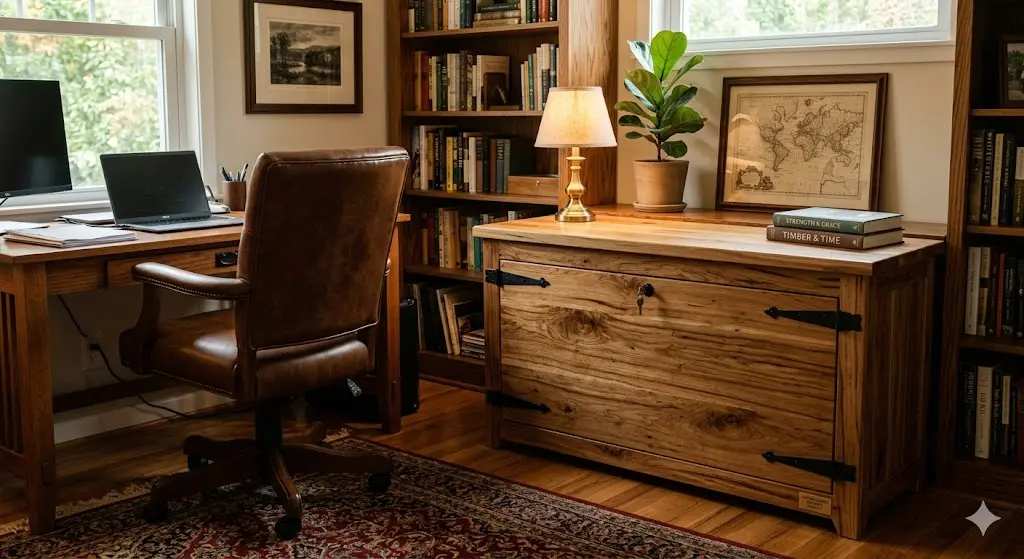
For gun owners whose primary home office storage need is for handguns, a quality pistol chest serves the home office exceptionally well. The chest format, typically 36 to 48 inches wide and 18 to 24 inches tall, sits at credenza height and presents as a horizontal storage piece that belongs in an executive study.
The top surface of a pistol chest is a usable surface: for books, for a small lamp, for accessories appropriate to the room. The drawers below, each with their red felt-lined compartments and fitted positions for each handgun, provide the organized storage that a collection deserves.
A visitor sitting across a desk from the owner has no particular reason to identify the wood piece with the lamp on it as anything other than a credenza. The security and organization it provides are invisible from outside.
The Role of Wood Species in Professional Spaces
The visual character of the wood species chosen affects how the gun storage piece relates to the home office’s aesthetic. This choice is worth making deliberately.
Cherry Wood for Traditional and Formal Studies
Cherry is the wood species most associated with traditional professional furniture: the law library, the executive study, the paneled office that communicates seriousness and permanence. Its warm reddish-brown tone, fine and consistent grain, and the depth it develops over time with light exposure make it the natural companion to leather furniture, dark wood bookshelves, and the kinds of rooms that read as accomplished.
For a home office in a traditional or formal register, cherry is the obvious choice. The gun cabinet or pistol chest in cherry sits naturally alongside a mahogany desk, a leather chair, and a wall of hardbound volumes without any visual tension.
White Oak for Contemporary and Transitional Workspaces
Contemporary home offices often have a cooler, more minimal aesthetic: white or gray walls, clean lines, furniture in lighter woods or mixed materials. A cherry cabinet in this setting would create warmth that might not align with the room’s character.
White oak’s neutral, slightly gray-tan tone and its open grain structure work naturally in contemporary and transitional spaces. It has the same presence and quality as cherry but in a color register that relates to the cooler palettes of modern professional design.
White oak has also become the dominant wood choice in current furniture design, which means a white oak gun cabinet in a recently designed home office feels current rather than traditional.
Hickory for Character-Driven Offices
Some home offices have a deliberately distinctive character: a working ranch owner’s study, a Western-themed room, a space built around personal identity rather than professional convention. For rooms with this kind of intentional individuality, hickory’s dramatic grain variation and natural character make it the natural fit.
Hickory in a home office signals something specific about the person who occupies it: they are not trying to conform to a conventional professional aesthetic, and the room is an authentic expression of who they are.
Security Integration That Doesn’t Compromise the Room
The security features in a Custom Cabinet Security piece are designed to be present without being visible. For a home office placement, this integration is especially important.
The Lock That Doesn’t Look Like a Safe Lock
The lock cylinder on a Custom Cabinet Security piece is a pick-resistant, high-security mechanism housed in a key entry that reads as furniture hardware rather than safe hardware. A visitor looking at the piece sees a wood cabinet with an appropriate lock. The nature of that lock, and its resistance to bypass attempts, is not visible from the exterior.
This is different from a steel safe with a combination dial or a keypad that announces its security function the moment someone looks at it. The wood cabinet’s security is present and meaningful; it is simply not the first thing the piece communicates visually.
The Steel-Reinforced Locking Bar
The locking mechanism that secures the cabinet when locked is a steel-reinforced bar system integrated into the door and cabinet frame from the beginning of the construction process. When the door is closed and locked, the bar engages the frame in a way that requires significant effort to defeat.
This mechanism is entirely internal. The exterior of the cabinet shows a clean wood door with appropriate furniture hardware. The security is real; its presence is invisible.
The Dehumidifier: Invisible Preservation
The Golden Rod dehumidifier rod positioned at the base of the cabinet interior is the element that protects the collection and the cabinet through the climate variations of a home office environment. It requires an electrical outlet and a discreet cable routing, which is addressed during installation.
For a home office placement, the dehumidifier is typically connected to an outlet behind or near the cabinet position with a low-profile cord management approach. The running dehumidifier is not visible from outside the closed cabinet and does not add any visual element to the room.
Practical Placement Considerations for Home Offices
The home office gun storage piece has specific placement requirements that differ from other rooms.
Client-Facing vs. Owner-Facing Positioning
In a home office that receives clients or colleagues, the positioning of the storage piece relative to the primary visitor seating matters. A cabinet positioned behind the owner’s desk, visible to visitors from the front seating position, is presenting the piece to every visitor. A cabinet positioned to the side or behind the visitor’s natural sightline is present in the room without being the first thing visitors see.
Neither position is wrong, but the choice is intentional. In a traditional executive study aesthetic, a bookcase-flanked gun cabinet positioned behind the desk is a deliberate statement of identity. In a more professionally neutral home office setting, a side or flank position maintains the room’s focus on the work rather than the collection.
Bookcase Integration
Many home office studies have built-in or freestanding bookshelves. A gun cabinet positioned between or flanking bookshelves integrates naturally into the wall of storage and reference that defines the traditional study aesthetic. The cabinet reads as one element in a composed storage wall rather than as a standalone object.
This integrated positioning is particularly effective for display cabinets, where the cabinet’s glass-panel doors and LED-lit interior become the visual focal point of the storage wall without disrupting the room’s overall character.
Desk and Chair Relationships
The gun storage piece in a home office is typically accessed by the person who uses the room most. The placement that makes access most natural is the one that allows the owner to move from their primary work position to the cabinet without significant room navigation.
A pistol chest positioned as a credenza perpendicular to the desk, within arm’s reach of the primary chair, is the most accessible configuration for a handgun storage piece. A display cabinet positioned in the primary sightline from the desk keeps the collection present in the owner’s daily experience in the room.
When the Collection Is Also Part of the Professional Identity
For some gun owners, the collection is not separate from their professional identity; it is an expression of it. A gun store owner, a firearms instructor, a writer or historian who focuses on the subject, a veteran whose career involved firearms in a significant way: these are people for whom a gun collection displayed in the home office is a genuine expression of who they are professionally and personally.
For these owners, the home office gun cabinet is not a compromise between security and aesthetics. It is the right statement in the right room. The collection on display in a well-crafted cherry or hickory cabinet is part of what the room communicates about the person who occupies it.
This is different from the owner who wants the firearms accessible and secure but prefers that the room not draw attention to them. Both relationships with the collection are valid. Both have configurations that serve them well.
The consultation process at Custom Cabinet Security begins with understanding which relationship the buyer has with their collection, because that understanding shapes every decision that follows.
The Complete Home Office Gun Room: Combining Formats
For the most serious collectors who have the space for it, the home office or dedicated study can accommodate both a display piece and a discrete storage piece, each doing what it does best.
The display cabinet (glass panels, LED lighting, primary wall position): Houses the pieces the owner wants to see, appreciate, and occasionally show. Historical or significant pieces, matched pairs, or the collection’s centerpieces.
The solid-door cabinet or pistol chest (secondary wall or credenza position): Houses the working collection, the handguns, and any pieces that are accessed regularly for range use or daily carry that do not need to be on display.
Together, the two pieces create a complete gun room within the study: a space where the collection has a proper home, where security is genuine, and where the room continues to function as a professional workspace rather than being defined by its security function.
The collection of standard pieces at Custom Cabinet Security includes both display cabinets and pistol chests that can serve this combined home office configuration, and the custom consultation is the place to design an integrated solution for collections and spaces that require more specific treatment.
The Bottom Line
A gun storage piece in a home office or study is doing two jobs simultaneously: securing the collection and belonging in a room that has been designed with intention. These jobs are not in tension when the storage piece is designed for both.
A handcrafted solid hardwood cabinet in cherry, hickory, or white oak, built with steel-reinforced security integrated from the beginning, belongs in a home office the same way a quality bookcase or credenza belongs there. It does not announce itself as a security device. It simply fits.
For gun owners who spend significant time in a home office or study and want the collection to be part of that space rather than stored somewhere inconvenient, a quality wood cabinet is the solution that serves both the collection and the room.
The right piece for a specific home office depends on the collection, the room’s character, and the owner’s relationship with their firearms. That conversation starts with a consultation. The craftsmen in Arthur build one piece at a time, for the specific room and specific collection it will serve.
Related Posts
View All
Uncategorized
Reading Time: 8 min
The Resale Value of a Custom Gun Cabinet: Does a Handcrafted Amish Safe Hold Its Value Over Time?
If you’ve ever bought a mass-produced gun safe from a big-box retailer, you already know what happens the moment it
Read More
Uncategorized
Reading Time: 11 min
Women Gun Owners: How to Choose a Gun Storage Solution That Fits Your Home’s Style Without Compromise
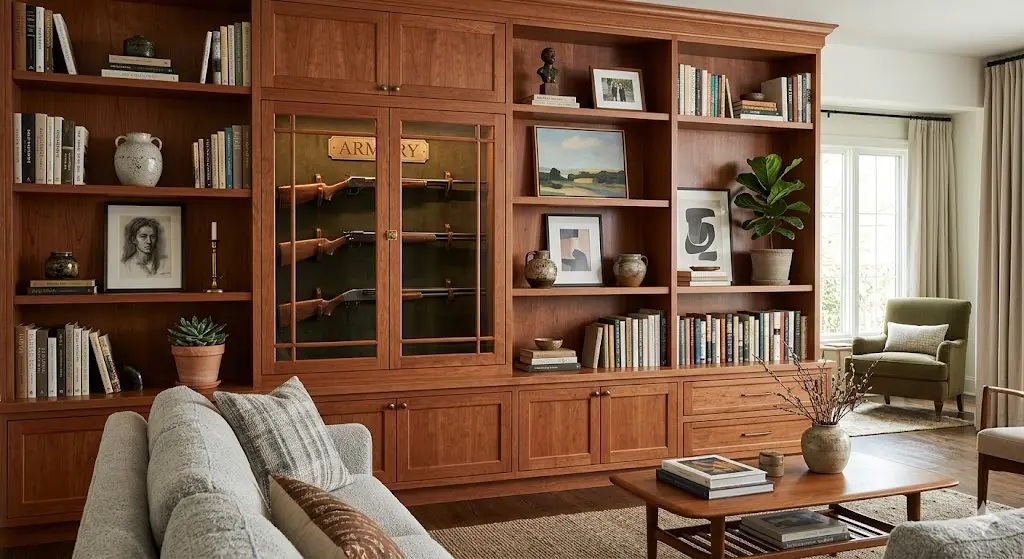
Key Takeaways The Storage Problem Nobody Talks About Walk into almost any sporting goods store and look at the gun
Read More
Uncategorized
Reading Time: 10 min
How to Protect Antique and Vintage Firearms in Wood Storage: What Collectors Need to Know About Climate and Finish
Key Takeaways Why Antique Firearms Demand a Different Standard of Storage Storing a modern production firearm and storing an 1860s
Read More
