20 Mar 2026 • Reading Time: 9 min
Safe and Legal Display of Firearms at Home: What Every Gun Owner Needs to Know
For many gun owners, a firearm collection is a source of genuine pride. Whether you collect historical rifles, competition pistols, or heirloom pieces passed down through your family, your firearms deserve to be displayed with the same care and intention that went into acquiring them. But displaying firearms at home is not simply a matter of taste. It sits at the intersection of personal expression, household safety, and the law.
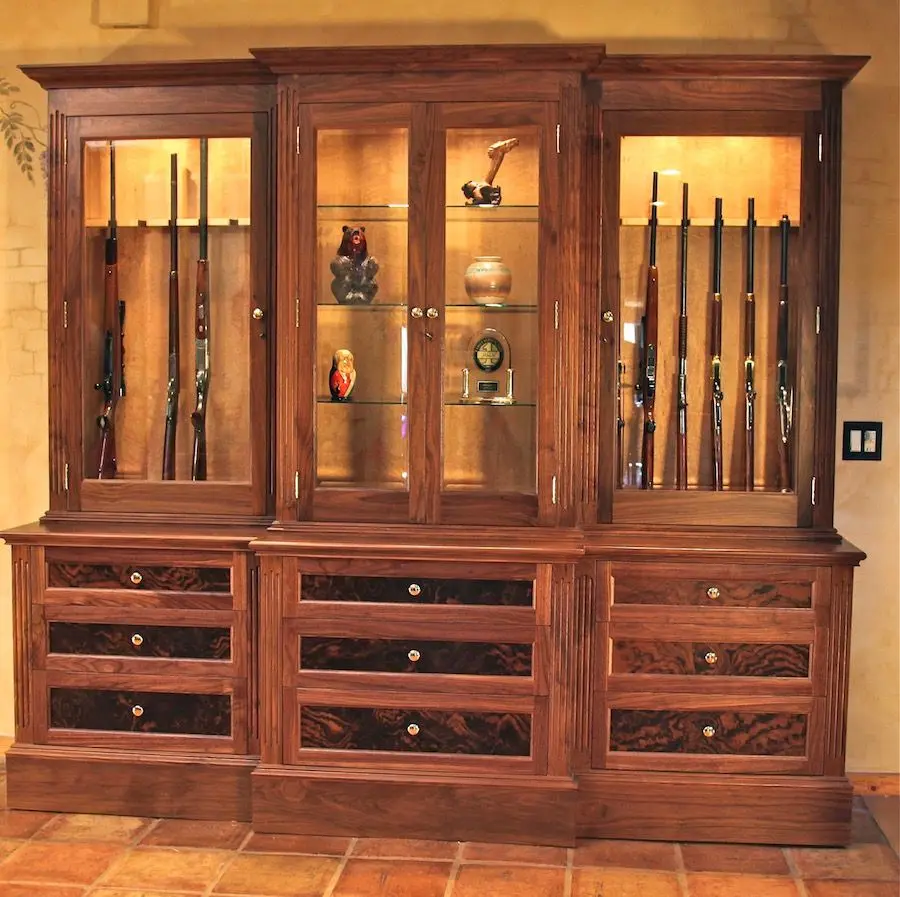
At Custom Cabinet Security, our Amish-built gun display cabinets are designed for collectors who refuse to choose between elegance and security. But before you choose a cabinet, it is equally important to understand the rules that govern how firearms can be displayed in your home. This guide covers the federal framework, state-level considerations, child access prevention, visitor safety protocols, and how the right cabinet ties it all together.
Why the Display Question Is More Complex Than It Looks
Most firearm owners are familiar with storage laws: lock it up, keep it away from children, follow your state’s requirements. But display is a different category. A firearm on display is accessible by definition. That is, in many cases, precisely the point for collectors who want to appreciate and share their pieces. The legal and ethical challenge is making sure that accessibility is controlled, intentional, and compliant.
Federal law under the Gun Control Act of 1968 sets the baseline for firearm ownership across the United States. It prohibits possession by certain categories of persons (convicted felons, those subject to domestic violence restraining orders, and others) and regulates the transfer of firearms. It does not, however, create a single national standard for how firearms must be stored or displayed in private residences. That responsibility falls primarily to the states.
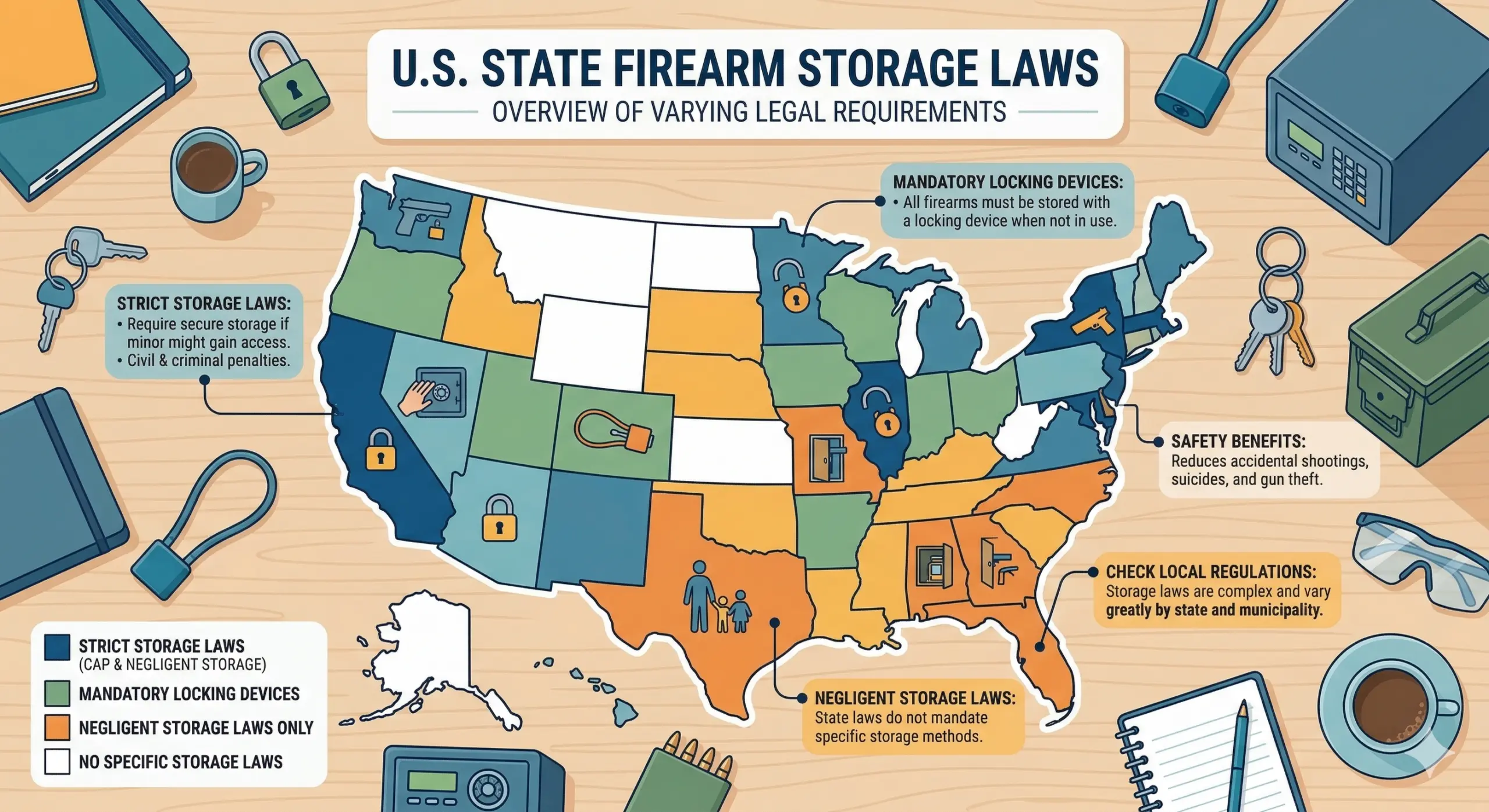
The result is a patchwork of laws that vary significantly depending on where you live. Understanding your state’s requirements is not optional. It is the foundation of responsible and legal firearm display.
The Federal Framework: What the Law Requires
At the federal level, the primary obligations relevant to home display are centered on who can possess a firearm and how transfers must be handled. The Bureau of Alcohol, Tobacco, Firearms and Explosives (ATF) is the federal agency responsible for enforcing these laws.
Key federal obligations every gun owner displaying firearms at home should understand include:
- Prohibited persons must not have access to firearms. If a person living in or regularly visiting your home is prohibited from possessing firearms under federal law, displaying accessible firearms may create legal exposure.
- Transfers must go through a licensed dealer. If a displayed firearm is sold or transferred to another person, federal law requires going through a Federal Firearms Licensee (FFL) unless the transaction is between individuals in the same state and the buyer is not otherwise prohibited.
- NFA items require additional compliance. If your collection includes items regulated under the National Firearms Act (suppressors, short-barreled rifles, or machine guns manufactured before 1986), additional federal registration and compliance rules apply regardless of how or where they are displayed.
The ATF’s Safe Storage Resources are a valuable reference point for understanding federal expectations around firearm accessibility and responsibility.
State Laws on Home Firearm Display: A Critical Variable
Because federal law leaves home display largely unregulated as a standalone issue, state law becomes the controlling authority. Laws vary significantly across the country, and they tend to focus on three key areas: child access prevention, safe storage mandates, and civil liability.
Child Access Prevention Laws
More than 30 states have enacted Child Access Prevention (CAP) laws, which hold adults criminally liable if a child accesses an unsecured firearm. These laws vary in how they define a child (typically under 14, 16, or 18), what constitutes negligence, and the severity of penalties. In states with strong CAP laws, displaying an unsecured firearm within reach of a minor can result in criminal charges regardless of whether any harm occurs.
The Giffords Law Center maintains a detailed, state-by-state guide to child access prevention laws that is an essential reference for any parent or caregiver who displays firearms at home.
Safe Storage Mandate States
A growing number of states now require that firearms be stored in a locked container or rendered inaccessible when not under the direct supervision of the owner. California, Massachusetts, Connecticut, Colorado, and several others have enacted broad safe storage laws that can directly affect how and whether firearms may be displayed in the home.
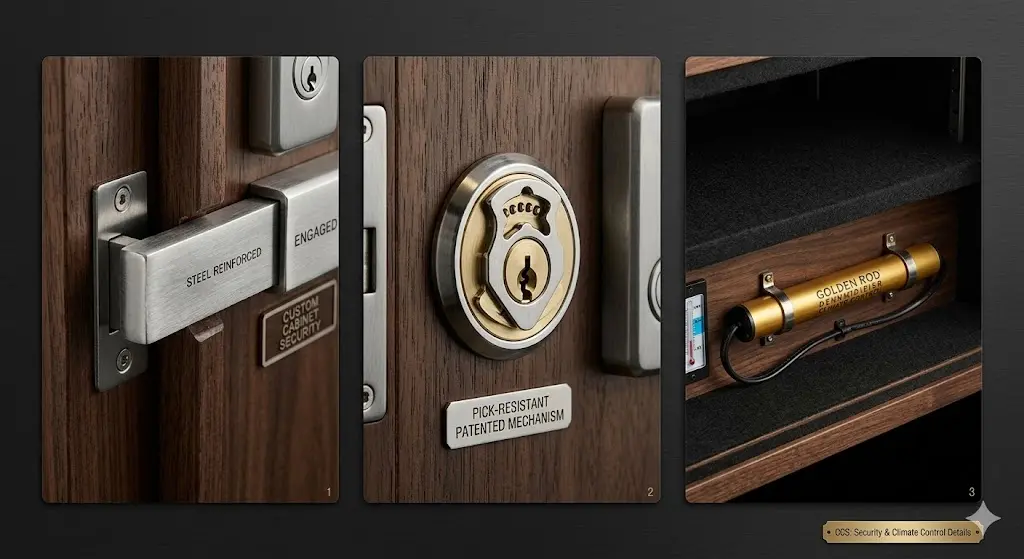
In these jurisdictions, a glass-fronted display cabinet may satisfy the law only if it is locked and the lock meets the state’s specified security standard. This is one reason why the locking systems on Custom Cabinet Security cabinets, including our pick-resistant lock and steel-reinforced bar mechanism, matter not just aesthetically but legally.
Civil Liability Considerations
Beyond criminal law, gun owners can face civil liability if a displayed firearm is accessed by a third party and causes harm. Even in states without explicit safe storage mandates, courts have found gun owners liable under negligence theories when a firearm was left accessible and someone was injured as a result. The legal principle is straightforward: if a reasonable person would have known the firearm posed a risk and failed to secure it, liability may follow.
The Legal Information Institute at Cornell Law School provides a clear explanation of negligence law as it applies to property owners, which is directly relevant to firearm display decisions.
The Five Principles of Safe and Legal Firearm Display
Across jurisdictions and regardless of the specific laws in your state, these five principles define responsible firearm display for the home collector.
1. Secure the Display
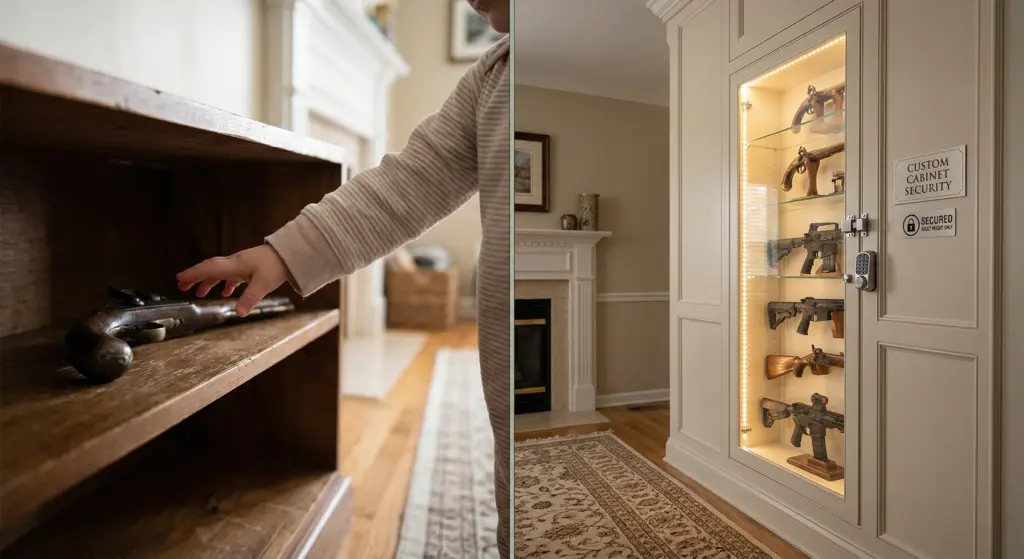
A display cabinet must be locked. This is the foundational principle. An unlocked cabinet, no matter how beautiful or well-placed, provides no legal protection and no barrier to unauthorized access. Every Custom Cabinet Security cabinet features a high-security locking mechanism as standard. Our steel-reinforced bar system secures all display contents behind a single tamper-resistant lock that cannot be bypassed without the key.
2. Control Who Has Access
Beyond the cabinet lock, think carefully about who has access to the key or combination. A displayed firearm that is technically locked away is compromised the moment a prohibited person, a child, or an unauthorized visitor can easily locate and use the key. Treat key management with the same seriousness as the lock itself.
3. Display at Appropriate Height and Location
Where you place a display cabinet in your home affects risk. A locked cabinet at adult eye level in a private study presents a very different profile than one at floor level in a high-traffic family room. Consider who regularly occupies each room, whether children or guests have unsupervised access, and whether the cabinet location creates any unintended visibility or access risk.
4. Know Your Ammunition Storage Rules
Ammunition displayed alongside firearms adds a layer of legal and safety complexity. Some states specify that ammunition must be stored separately from firearms, or in a separate locked container. The NSSF Safe Storage guidelines recommend storing ammunition separately from firearms as a general best practice, and many Custom Cabinet Security cabinets include a dedicated lower lockable compartment for this purpose.
5. Stay Current with Your State’s Law
Firearm laws change. New state legislation, court rulings, and administrative guidance can alter what is legal in your jurisdiction on short notice. Make a habit of reviewing your state’s firearm storage and display requirements at least annually. The NRA Institute for Legislative Action maintains a comprehensive, state-by-state summary of firearms laws that is updated regularly, and is a useful reference alongside official state government sources.
Displaying Firearms Safely When You Have Children at Home
For parents and grandparents, the display question carries additional weight. Children are naturally curious, and a displayed firearm, even behind glass, can become a source of fascination. The safest approach combines physical security with ongoing education.
Specifically recommended practices include:
- Use a cabinet with a keyed or combination lock that children cannot easily defeat.
- Store keys out of reach and out of sight, not on a hook near the cabinet.
- Engage in age-appropriate conversations about firearm safety. The Eddie Eagle GunSafe Program from the NRA is a widely used, educator-endorsed resource for teaching young children what to do if they encounter a firearm.
- Never allow children to handle displayed firearms without direct adult supervision and proper instruction.
- Consider whether glass-fronted display is appropriate in rooms where young children regularly play unsupervised, even with a locked cabinet.
Custom Cabinet Security’s bulletproof glass option adds an additional layer of protection for families with young children. Even if a child manages to make contact with the cabinet, the glass is designed to withstand impact and resist attempts to break through.
Displaying Firearms Safely When You Have Guests
Guests introduce uncertainty. You may know that every adult in your household is a legally eligible firearm owner, but you have no way to know the background, history, or eligibility status of every visitor. This is not a reason to be inhospitable. It is simply a reason to ensure that your display cabinet is always locked when guests are present, and to be thoughtful about the rooms in which your collection is displayed.
If a guest expresses interest in your collection, the appropriate response is to open the cabinet yourself, handle any firearm personally, and share the experience under your direct supervision. Never leave a guest alone with an open display cabinet, regardless of how well you know them.
For collectors who host events or gatherings, this is particularly important. A temporary trigger lock on displayed firearms, available as an accessory from Custom Cabinet Security, provides an additional layer of security for high-traffic occasions without requiring you to remove your collection from display entirely.
Choosing the Right Display Cabinet for Legal Compliance
Not all display cabinets are created equal, and for the purpose of legal compliance, the security features of your cabinet matter as much as its appearance. When evaluating a firearm display cabinet for both aesthetic and legal purposes, look for the following:
| Feature | Why It Matters | Custom Cabinet Security Standard |
| Keyed or combination lock | Required by most safe storage laws | Included on all models |
| Steel-reinforced locking bar | Resists forced entry attempts | Standard on all models |
| Pick-resistant mechanism | Prevents bypass by unauthorized persons | Standard on all models |
| Tempered or bulletproof glass | Barrier even when cabinet is visible | Available upgrade on all models |
| Separate locked ammunition compartment | Satisfies states requiring ammo separation | Available on most models |
| Golden Rod dehumidifier | Protects firearms from moisture damage | Available on all models |
| Solid hardwood construction | Structural integrity and longevity | Amish-crafted hardwood, all models |
Every cabinet in our Custom Cabinet Security collection is built to meet these standards while also serving as a genuine piece of home furniture. Our craftsmen in Arthur, IL, build each cabinet by hand from responsibly sourced hardwoods, with security features that are integrated into the construction rather than added as an afterthought.
A Note on Antique and Collector Firearms
Collectors of antique firearms should be aware that federal law treats antique firearms differently from modern ones. Under the Gun Control Act, firearms manufactured before 1899 and certain muzzleloading replicas are classified as antiques and are generally exempt from federal transfer and background check requirements. However, state laws may still apply to how they are stored and displayed.
The ATF definition of antique firearms is the authoritative federal reference on this topic. If your collection includes pre-1899 pieces or replicas, confirming their status under both federal and state law before displaying them is a sound precaution.
Display as a Statement of Responsible Ownership
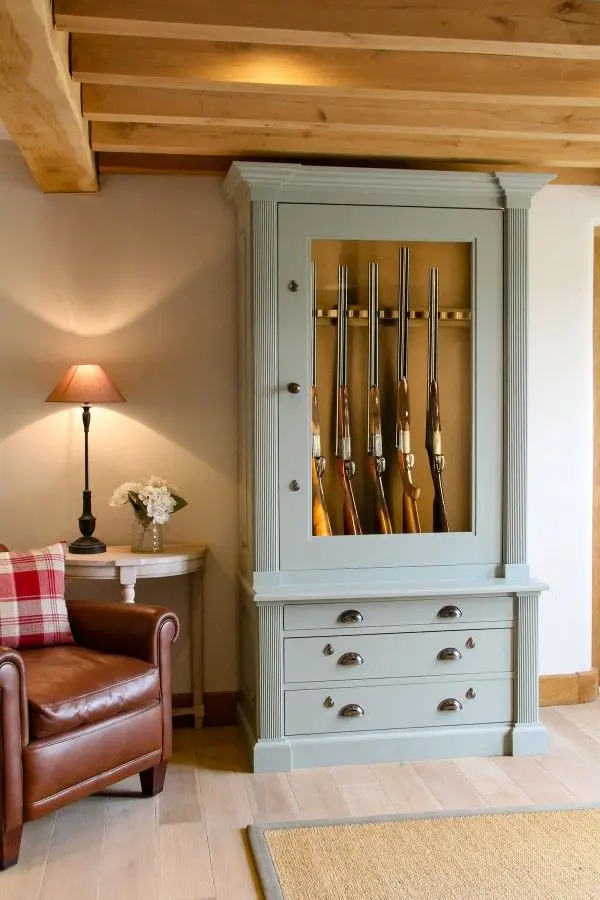
There is a powerful argument to be made that displaying firearms responsibly is itself an act of advocacy. When a collection is presented with care, behind a quality locked cabinet, in a well-maintained home environment, it communicates something important: that the owner takes both the privilege and the responsibility of firearm ownership seriously.
The National Shooting Sports Foundation has long championed the idea that safe storage and responsible display are not in tension with Second Amendment rights but are expressions of them. A firearm displayed safely is a firearm that belongs to a responsible owner.
Custom Cabinet Security was built on exactly this philosophy. Our Amish craftsmen approach each cabinet as a piece of heirloom furniture with a serious security purpose. The result is a product line that honors the tradition and pride of firearm collecting while taking the safety and legal responsibilities of that collecting seriously.
Secure Your Collection. Display It Proudly.
The right display cabinet makes it possible to showcase your firearms with pride while satisfying your legal obligations and protecting everyone in your home. Custom Cabinet Security offers a full range of handcrafted display cabinets designed for serious collectors who understand that security and beauty are not competing values.
Explore our full collection of firearm display cabinets, or contact our team to request a custom consultation. Every cabinet can be built to your specifications, in your choice of hardwood, with the security features your state’s laws and your household require. Call us at 217-439-3790 or visit us at 160 E Cr 240 N, Arthur, IL 61911.
| Legal DisclaimerThis blog post is intended for informational purposes only and does not constitute legal advice. Firearm laws vary significantly by state and locality and are subject to change. Always consult a licensed attorney in your jurisdiction and review your state’s current statutes before making decisions about firearm display, storage, or transfer. |
Related Articles
• How Secure Are Wood Gun Safes and What Features Matter
• LED Lighting Options for Gun Display Safes
• Museum-Grade Security: Why Collectors Prefer Custom Display Safes
• Explore All Custom Cabinet Security Products
Authoritative External Resources
• ATF: Gun Control Act Overview
• ATF: Safe Storage Options for Firearms
• NSSF: Safe Storage Recommendations
• Giffords Law Center: Child Access Prevention Laws by State
• NRA Eddie Eagle GunSafe Program for Children
Related Posts
View All
Uncategorized
Reading Time: 12 min
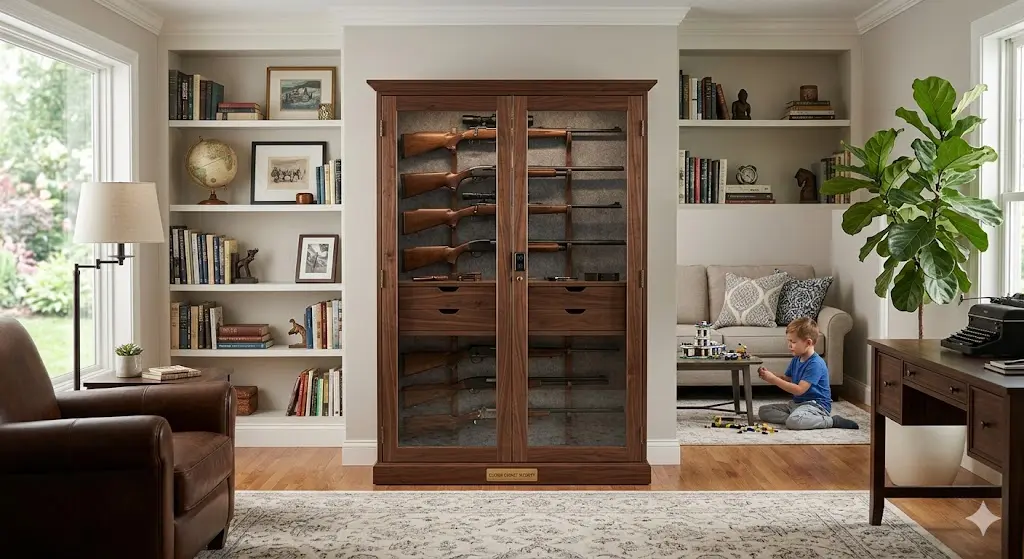
How to Childproof Your Gun Storage Without Sacrificing Display or Quick Access
Key Takeaways A note on this topic: Child gun safety is a serious subject that deserves honest, specific treatment rather
Read More
Uncategorized
Reading Time: 12 min
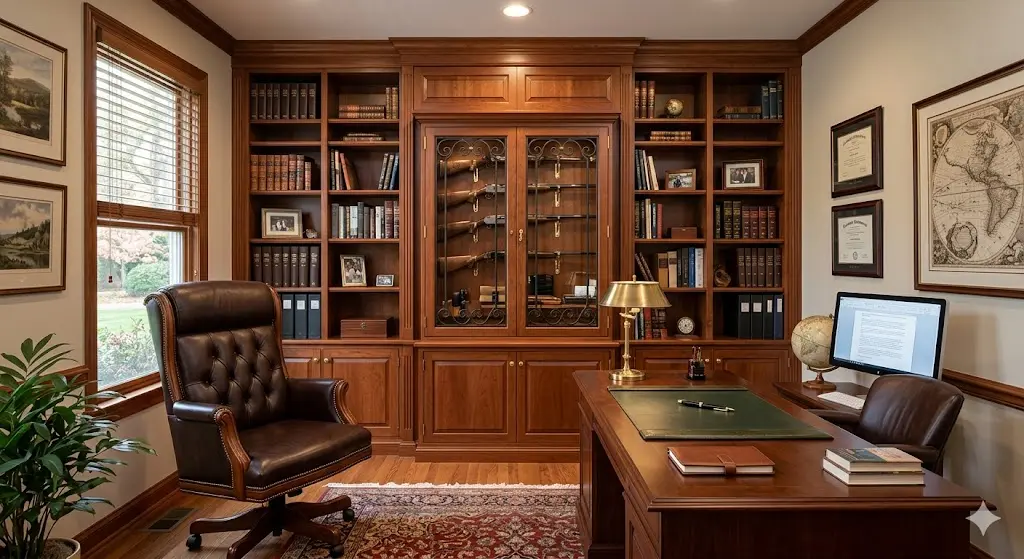
Gun Safes for Home Offices and Studies: How to Blend Security Into a Professional Space
Key Takeaways The Problem With the Standard Approach Most gun owners who have a dedicated home office or study eventually
Read More
Uncategorized
Reading Time: 10 min
What the Custom Order Process Actually Looks Like: From Consultation to Delivery of Your Amish Gun Cabinet
Key Takeaways The Uncertainty Most Buyers Feel Before They Reach Out A significant number of people who spend time on
Read More
