15 May 2026 • Reading Time: 14 min
Key Takeaways
- The right placement for a gun cabinet is determined by four factors: security considerations, environmental conditions, access needs, and how the cabinet integrates with the room’s purpose and aesthetic.
- No single room is universally correct. The best location is the one that satisfies all four factors for your specific home, household composition, and collection.
- Temperature and humidity stability vary significantly between rooms. Basements, garages, and exterior-facing walls can expose a cabinet’s contents to conditions that accelerate corrosion and damage wood finishes over time.
- Visibility is a legitimate security consideration. A cabinet in a publicly visible location creates different risks than one in a private room. The presence of children in the home affects this calculation significantly.
- A handcrafted wood gun cabinet is furniture as well as storage. Its placement should reflect both its security function and its quality as a piece that belongs in a well-furnished room.
- Anchoring and floor load capacity are practical considerations that many buyers overlook until placement day. Knowing the weight of a fully loaded cabinet and the load capacity of your floors matters before selecting a location.
Why Placement Matters More Than Most Buyers Expect
Most buyers think about gun cabinet placement as a practical afterthought: find a wall with enough clearance, position the cabinet so the door swings freely, done.
The location of a gun cabinet actually affects its function in several ways that become apparent over time but are rarely obvious at the point of purchase.
Environmental exposure varies between rooms and between positions within the same room. A cabinet against an exterior wall in a climate with harsh winters experiences humidity fluctuations that an interior wall in a climate-controlled room does not. A garage location exposes the cabinet to temperature swings that accelerate corrosion in ways that a climate-controlled study does not.
Security dynamics change with location. A cabinet in a room that visitors pass through frequently is more visible than one in a private area of the home. For households with children, the location of a cabinet and the behavior patterns around that space affect how reliably the security protocols are maintained.
Access practicality shapes daily ownership habits. A cabinet located inconveniently far from where a firearm is typically used is a cabinet that generates the impulse to leave things unsecured for convenience. A cabinet positioned logically within the owner’s daily movement through the home integrates security into natural behavior rather than fighting against it.
Aesthetic integration matters more for a handcrafted wood cabinet than for a utilitarian steel safe. A beautifully crafted cherry wood or hickory cabinet placed in a garage is a mismatch between the quality of the piece and the quality of the environment. The right room makes the cabinet part of the home’s character rather than an afterthought stored in an unsuitable space.
This guide works through each major room type with honest assessments of what works well and what creates problems, so buyers can make a placement decision they will be satisfied with for the life of the cabinet.
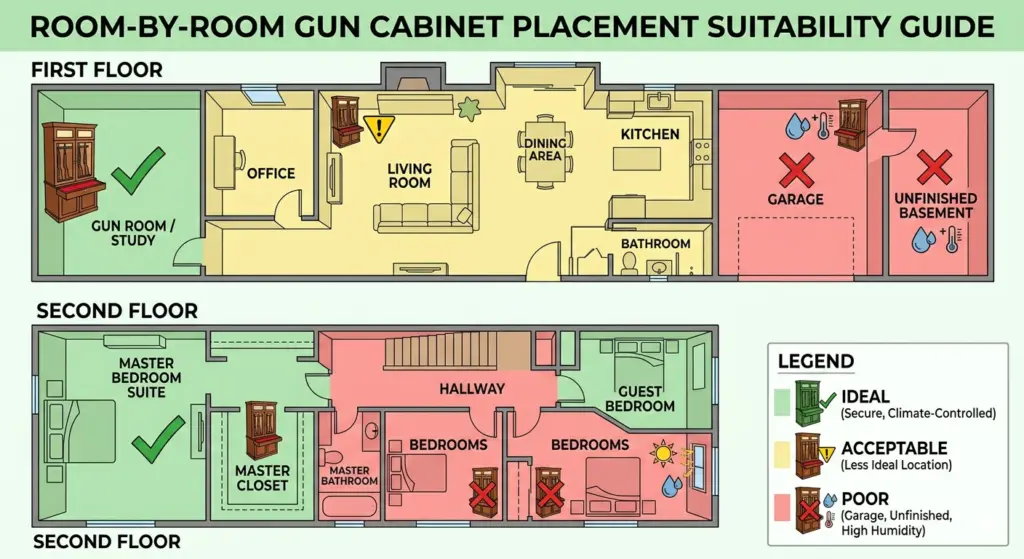
The Four Placement Criteria to Evaluate Every Room Against
Before walking through specific rooms, establishing the evaluation framework makes each assessment more useful.
Criterion 1: Environmental Stability
The interior of a gun cabinet needs to maintain relatively stable temperature and humidity to protect both the wood of the cabinet itself and the metal and wood of the firearms stored inside. The ideal relative humidity range for firearm storage is between 45 and 55 percent. Outside this range, metal begins to rust at the low end and corrode faster at the high end, while wood stocks expand, contract, and potentially warp.
What creates environmental instability:
- Exterior walls, especially in climates with significant seasonal temperature variation
- Below-grade spaces (basements) in areas with high groundwater or poor drainage
- Garages and outbuildings that are not climate-controlled
- Rooms with significant moisture sources: bathrooms adjacent, kitchens, laundry rooms
What creates environmental stability:
- Interior walls in climate-controlled living spaces
- Rooms that are occupied and temperature-regulated year-round
- Locations away from HVAC vents that create repeated moisture cycling
A Golden Rod dehumidifier inside the cabinet, standard in Custom Cabinet Security’s designs, provides an important layer of protection against humidity. But it is a supplemental control, not a substitute for reasonable environmental placement. Placing a cabinet in an inherently problematic environment and relying entirely on a dehumidifier rod to compensate is not the same as placing the cabinet in a stable environment in the first place.
Criterion 2: Security Context
The physical security of a locked cabinet is fixed by the cabinet’s construction. What varies with location is the security context: who can see the cabinet, who passes near it, and what behavioral patterns the location creates or disrupts.
Security considerations by location type:
- High-traffic household areas: Visitors see the cabinet. Children interact with the space frequently. The location creates more opportunities for curiosity and access attempts.
- Private household areas: Fewer visitors, more controlled access, less visibility to people outside the household.
- Publicly visible locations: A cabinet visible through a window from outside a home creates a different risk profile than one invisible to anyone who is not inside the home.
Households without children have different security context considerations than households with children present or regularly visiting. This distinction affects which rooms are appropriate placements in ways that matter practically.
Criterion 3: Access Practicality
A cabinet that is difficult to access on a regular basis generates the impulse to leave the practical decision of whether to lock up today or not. In homes where firearms are used regularly for range practice, hunting, or home defense, access practicality shapes daily behavior.
Questions to evaluate a potential location:
- Is this location in a part of the home you pass through regularly?
- Can you access the cabinet comfortably with both hands?
- Is the lighting adequate for accessing the cabinet in the evening?
- Does the door swing freely in the available space without hitting adjacent furniture or walls?
Criterion 4: Aesthetic Fit
A handcrafted wood gun cabinet is a furniture piece. It belongs in a room that matches its quality and purpose. A cherry wood pistol chest designed for a study is out of place in a garage. A display cabinet with glass panels and LED lighting is a statement piece that rewards placement in a room where it can be appreciated.
The aesthetic fit question is not purely about personal taste. It is about putting a quality piece where it will be maintained, appreciated, and used in ways that reflect the investment it represents.
Room-by-Room Assessment
The Study or Home Office
Overall assessment: Ideal for most collectors
A dedicated study or home office is the most natural environment for a handcrafted gun cabinet for several reasons operating simultaneously.
The study is a private room. Visitors rarely enter without invitation. It is typically occupied by the owner alone, which means the security context is as controlled as any room in the home outside a dedicated safe room.
A study is climate-controlled, occupied regularly, and maintained as a living space. Temperature and humidity are stable. The room is not subject to the environmental cycling of an exterior or utility space.
A cherry wood or hickory gun cabinet integrates naturally into a study environment furnished with quality pieces. The combination of solid wood, fine joinery, and handcrafted detail reads as consistent with bookcases, desks, and other furniture typically found in a well-appointed study.
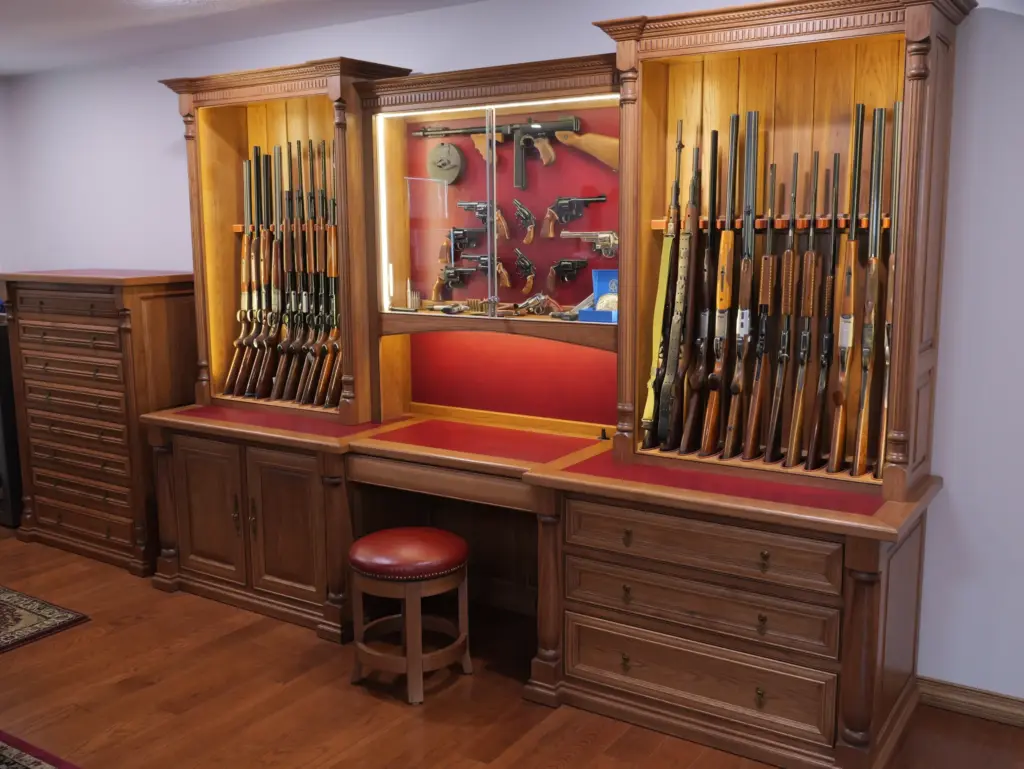
For collectors who own both display cabinets and pistol chests, a study accommodates both formats. The display cabinet occupies wall space and presents the collection as part of the room’s character. The pistol chest sits alongside other furniture as a natural element of the space.
What to watch for: Studies are sometimes located in less-trafficked areas of the home, which is good for security but can mean less frequent monitoring of the storage environment. Ensure the room is heated and cooled consistently rather than left unregulated during extended absences.
The Master Bedroom
Overall assessment: Excellent for handgun storage, requires thoughtful placement for long gun cabinets
The master bedroom is the most common location for handgun storage, particularly quick-access units for home defense purposes. For collectors with a pistol chest or a smaller pistol display cabinet, it is one of the strongest placement options available.
Why the master bedroom works well:
The room is private. Outside of family members and invited guests, no one enters the master bedroom. The security context is highly controlled.
The room is climate-controlled and regularly occupied, providing stable temperature and humidity.
For home defense purposes, storage in the master bedroom means the firearm is in the same space as the person who may need to access it. This alignment between where you sleep and where your firearm is stored is a practical consideration that affects the effectiveness of any home defense planning.
A pistol chest placed in a master bedroom, sized appropriately for the room’s dimensions, functions as bedroom furniture. The 8-Drawer Cherry Wood Pistol Chest in Custom Cabinet Security’s collection is a piece that belongs at the foot of a bed, against a bedroom wall, or in a walk-in closet as easily as it belongs in a study.
What to watch for: Long gun cabinets in a master bedroom can feel oversized depending on the room’s dimensions. A tall rifle cabinet that dominates a bedroom wall may create a visual imbalance that does not suit the space. For long gun collections, a dedicated room or study typically works better than a master bedroom. For handgun-focused collections, the bedroom is often the ideal choice.
The Living Room or Family Room
Overall assessment: Suitable for display cabinets with careful consideration; less suitable for chests or utilitarian storage
A living room or family room placement for a gun cabinet requires more consideration than a private room placement, but it is not necessarily inappropriate.
When a living room works:
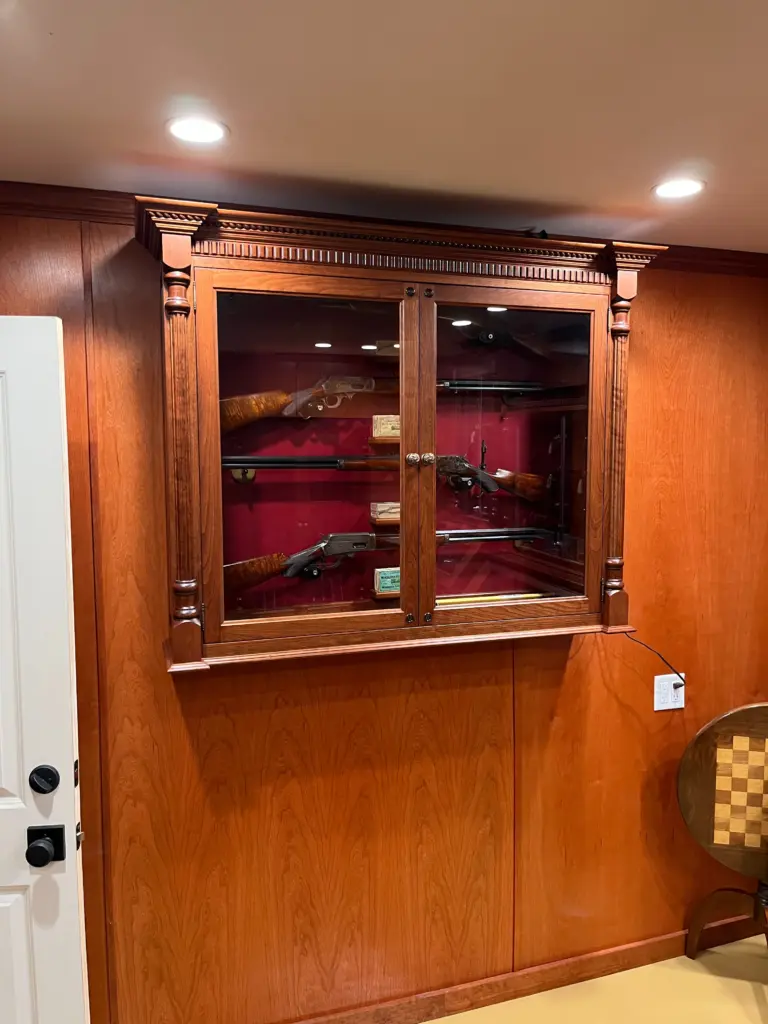
A display cabinet with glass panels and LED lighting, positioned as a statement piece in a living room, is visually appropriate in a home where the collection is part of the owner’s identity and the household composition makes visible display reasonable. A collector who lives alone, or who has adult-only household members and guests, and who wants to display a meaningful collection as part of their living space, can make this placement work well.
The craftsmanship quality of a custom Amish-built cabinet matters more in a public room than it does in a private one. A piece that would look out of place next to quality living room furniture does not belong in a living room. A piece that reads as furniture first and storage second does.
When a living room does not work:
Households with children require careful evaluation. A display cabinet in a room children pass through and occupy daily creates a different dynamic than one in a private adult space. The lock quality becomes more critical when children have repeated access to the room, and the visibility of the collection may create conversations or curiosity that would not exist with storage in a private room.
High-traffic areas with frequent visitors of unknown background change the risk profile of visible firearm storage. A cabinet visible to every dinner guest, repairman, or neighbor who stops by creates exposure that a private room placement does not.
What to watch for: Living rooms are often designed around a focal point (fireplace, television, window view). A gun cabinet placed as a secondary piece competes with the room’s existing visual structure. A display cabinet works best when it occupies a wall that can anchor it as an intentional element rather than a piece inserted into an already-composed room.
The Dedicated Gun Room
Overall assessment: Ideal in every respect for serious collectors
A dedicated gun room is the premium solution for a collector who has the space to designate it. It addresses every placement criterion simultaneously.
Why a dedicated gun room is the ideal solution:
Security context is completely controlled. No one who is not specifically authorized enters the space. The room itself functions as an outer layer of security before the cabinet lock is ever engaged.
The environment can be specifically regulated for optimal storage conditions. A dedicated gun room with a dehumidifier, a stable HVAC connection, and proper insulation from exterior temperature variation creates the best possible storage environment for any collection.
Aesthetic integration is not a constraint. A dedicated gun room can be designed around the collection rather than requiring the collection to integrate with the room’s existing character.
Multiple cabinets, a pistol chest alongside a long gun cabinet alongside a display cabinet for specific pieces, can coexist in a dedicated room in ways that would be impractical in any multipurpose room.
Practical considerations:
A dedicated gun room requires a room to dedicate. Not every home has this space. For collectors building a home or renovating, allocating a room or a portion of a room to a dedicated gun space is worth planning for. For collectors in existing homes, a larger walk-in closet, a finished basement room, or a bonus room are often candidates for conversion.
The room should be on an interior wall when possible, away from exterior temperature variation. It should have dedicated climate control or be on a zone that is regulated consistently.
The Finished Basement
Overall assessment: Good for security, requires attention to humidity management
A finished basement offers genuine advantages for gun cabinet placement alongside one consistent challenge.
What works well:
Basements are typically below the main living areas visited by guests, which creates a high degree of privacy and security context. A cabinet in a finished basement rec room, home office, or hobby room is in a space that most visitors to the home never see.
Below-grade construction provides natural insulation from exterior temperature variation. Summer heat and winter cold affect a finished basement less dramatically than above-grade rooms with windows and exterior walls.
The humidity challenge:
Basements are the most common location for elevated humidity problems in residential homes, even in finished and climate-controlled examples. Groundwater infiltration, condensation from concrete walls, and the below-grade position of the space all contribute to baseline humidity levels that can be higher than above-grade rooms.
A well-finished basement with dedicated climate control, vapor barriers, and drainage management can achieve humidity stability comparable to any room in the home. A basement with any history of moisture infiltration, condensation, or flooding is not an appropriate location for a quality gun cabinet without addressing those underlying conditions first.
If the basement has always been dry and consistently climate-controlled, it is a strong placement option. If it has ever had water issues, resolve those before placing a handcrafted wood cabinet or a collection of valuable firearms in the space.
What to watch for: Check relative humidity in the basement at different times of year before committing to placement. A hygrometer placed in the proposed location for a few weeks across a seasonal transition will reveal whether the space is genuinely stable.
The Garage
Overall assessment: Not recommended for quality handcrafted cabinets or valuable collections
The garage is the most common location that buyers consider and one of the least appropriate for a quality gun cabinet.
Why garages are problematic:
Garages are rarely climate-controlled in the way that living spaces are. They experience the full range of exterior temperature variation with added thermal mass from the structure. In summer, an uninsulated garage can reach temperatures that stress both the wood finish and any ammunition stored inside. In winter, temperatures at or below freezing affect metal components and the dimensional stability of wood.
Humidity in garages follows exterior conditions more closely than finished living spaces. Seasonal humidity swings in many climates create exactly the conditions that corrode metal and stress wood joinery over time.
Security context is also weaker in a garage than in a living space. Garages are often accessed by people who would not enter the main home: contractors, delivery drivers, neighbors borrowing tools. A cabinet in a garage is visible to a wider range of people than one in a private room.
When a garage might be acceptable:
A climate-controlled garage, fully insulated, heated and cooled to the same standard as the living space, with controlled access and an appropriate security context, addresses the major objections. But this describes a garage that is essentially an extension of the living space rather than a typical attached garage.
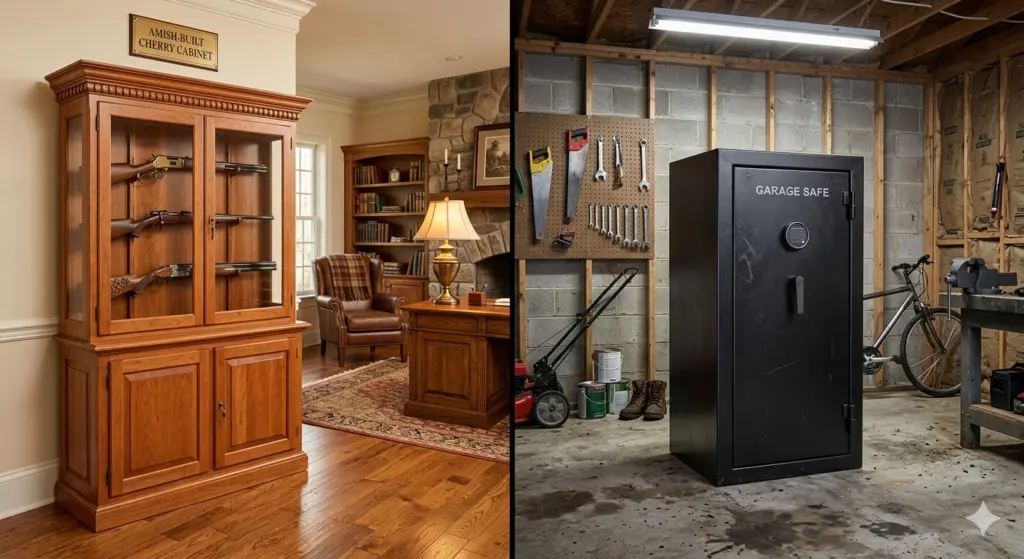
For a factory steel safe without furniture value, a properly conditioned garage can work. For a handcrafted solid wood cabinet representing a meaningful investment, placing it in a garage is inconsistent with the quality of the piece.
The bottom line on garages: If garage storage is the only option, the right storage for that environment is a steel safe with environmental controls, not a handcrafted wood cabinet.
Closets and Dedicated Storage Spaces
Overall assessment: Practical for access-focused storage; limits display function
A large closet, walk-in wardrobe, or dedicated storage room can be a strong placement for a gun cabinet that is used primarily for secure storage rather than display.
What works well:
Closets in climate-controlled areas of the home provide stable, private storage. A cabinet in a master closet or a dedicated storage room is completely invisible to visitors and creates a high-security context.
A pistol chest in a walk-in closet is consistent with the way similar pieces (jewelry chests, watch storage) are stored in private spaces adjacent to the master bedroom.
What the closet format limits:
Display cabinets with glass panels and LED lighting are not serving their design purpose in a closed closet. The display function requires a room where the cabinet can be seen. A closet placement is appropriate for a chest or for basic secure storage but does not leverage the display quality of a piece designed to be appreciated.
Practical considerations:
Ensure the closet is on an interior wall rather than an exterior wall, especially in climates with significant temperature variation. Closets against exterior walls in bedrooms can have temperature differentials that affect the interior environment.
Check that the door swing of the cabinet is compatible with the closet dimensions. A cabinet that requires a door swing wider than the closet allows creates practical access problems.
Practical Considerations Before You Choose a Location
Floor Load Capacity
A fully loaded handcrafted wood gun cabinet can weigh between 150 and 400 pounds or more depending on size and configuration. Residential floor systems are typically engineered for 40 pounds per square foot of live load in bedroom areas and 50 pounds per square foot in common areas.
A heavy cabinet on a small footprint concentrates load in ways that a distributed floor load does not. Placing a heavy cabinet on a solid floor over a basement or on a concrete slab creates no concern. Placing a heavy cabinet on a wood-framed second floor requires checking that the floor framing can support the concentrated load at the specific location.
If the intended placement is on an upper floor, the safest approach is to position the cabinet near a bearing wall, where the structural support is greatest, rather than in the middle of a floor span.
Anchoring Options
Even a heavy cabinet benefits from anchoring to the wall structure. Anchoring prevents tipping in earthquake-prone areas, removes the possibility of a cabinet being physically moved by an unauthorized person, and addresses safety concerns in households with children who might climb on or against furniture.
Most wood cabinets can be anchored through the back panel to the wall studs using appropriate fasteners. Ensure the wall location allows access to studs or blocking for secure anchoring.
Door Swing and Clearance
Cabinet doors require clearance to open fully. Measure the door swing of the specific cabinet being placed and ensure the intended location has adequate clearance with furniture, adjacent walls, and traffic paths accounted for.
A display cabinet with glass panel doors that cannot swing fully open without hitting a wall is a cabinet that will be difficult to access and may sustain damage to the door mechanism or glass over time.
Lighting
A cabinet accessed in low-light conditions, such as a master bedroom at night, benefits from either the cabinet’s own integrated LED lighting or adequate ambient room lighting. The LED touch-control lighting in Custom Cabinet Security’s display cabinets addresses this within the piece itself.
For chests and other storage without external lighting, ensure the room has adequate lighting at the cabinet location for the access conditions you anticipate.
What to Do When No Room Is Perfect
Most homes have a placement that is good rather than ideal. The right approach when no room checks every box is to prioritize the criteria that matter most for the specific household.
For households with children: Security context is the highest-priority criterion. A room that provides the most controlled access and least visibility to children should be prioritized over environmental or aesthetic considerations.
For collections with high-value or antique pieces: Environmental stability is the highest-priority criterion. The room with the most consistent temperature and humidity, closest to ideal storage conditions, should be prioritized.
For home defense-oriented storage: Access practicality is the highest-priority criterion. The location most naturally integrated with where the owner sleeps and moves should be prioritized.
For collectors with display as a primary value: Aesthetic integration is the highest-priority criterion. The room that allows the cabinet to be appreciated as a piece of furniture and a display of the collection should be prioritized.
The custom consultation process at Custom Cabinet Security can include a discussion of placement considerations for the specific piece being ordered. The craftsmen who build these cabinets have helped collectors across a range of home types think through placement decisions, and that experience is part of what a consultation makes available.
A Final Word on Placement and Dehumidification
Wherever a gun cabinet ends up, the humidity control provided by an integrated dehumidifier rod is an essential layer of protection that works in every environment. In a stable, climate-controlled study, it provides a margin of protection against the humidity spikes that occur even in well-regulated spaces. In a finished basement with generally higher baseline humidity, it works harder and provides more meaningful protection.
Custom Cabinet Security builds dehumidifier integration into their cabinets as a standard design element, not an afterthought. Wherever the cabinet lives, the contents benefit from consistent humidity management.
No placement decision removes the need for this feature. A good placement reduces how hard it has to work.
The Bottom Line
Gun cabinet placement is a decision that affects every aspect of what the cabinet does: how well it protects its contents, how secure it remains against unauthorized access, how long it retains its structural and aesthetic quality, and how naturally it integrates into the daily life of the household it serves.
The room-by-room guide above provides an honest assessment of every major placement option most buyers consider. The right answer for a specific household comes from evaluating the four criteria against the rooms actually available, prioritizing the criteria most relevant to that household, and making a placement decision that will hold up well across years of daily ownership.
A handcrafted wood cabinet placed in the right room is a piece that grows into the space over time. The wood develops character. The finish acquires the small signs of daily use that fine furniture accumulates. The collection it houses becomes part of the household in a way that a steel box in a corner never does.
That outcome begins with choosing the right room.
Related Posts
View All
Uncategorized
Reading Time: 8 min
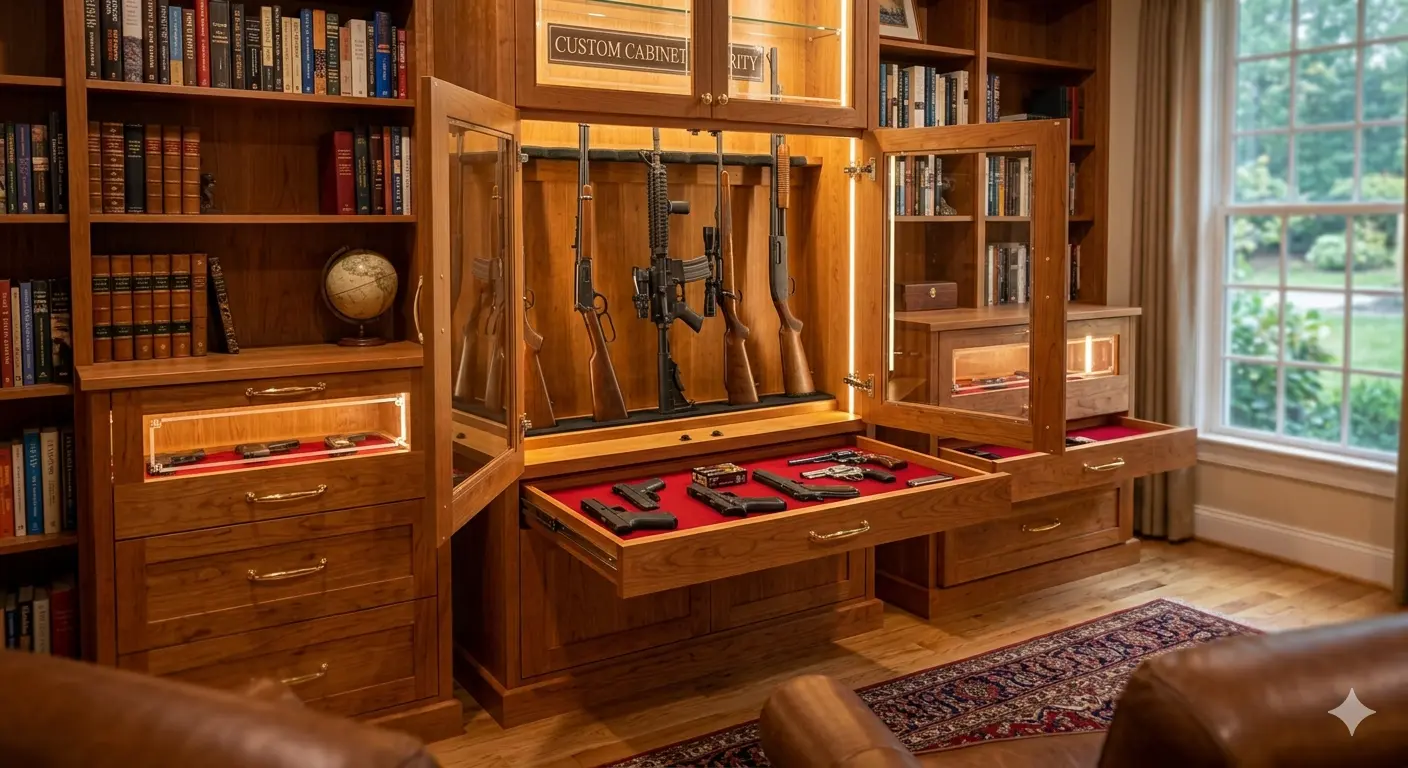
The Resale Value of a Custom Gun Cabinet: Does a Handcrafted Amish Safe Hold Its Value Over Time?
If you’ve ever bought a mass-produced gun safe from a big-box retailer, you already know what happens the moment it
Read More
Uncategorized
Reading Time: 11 min
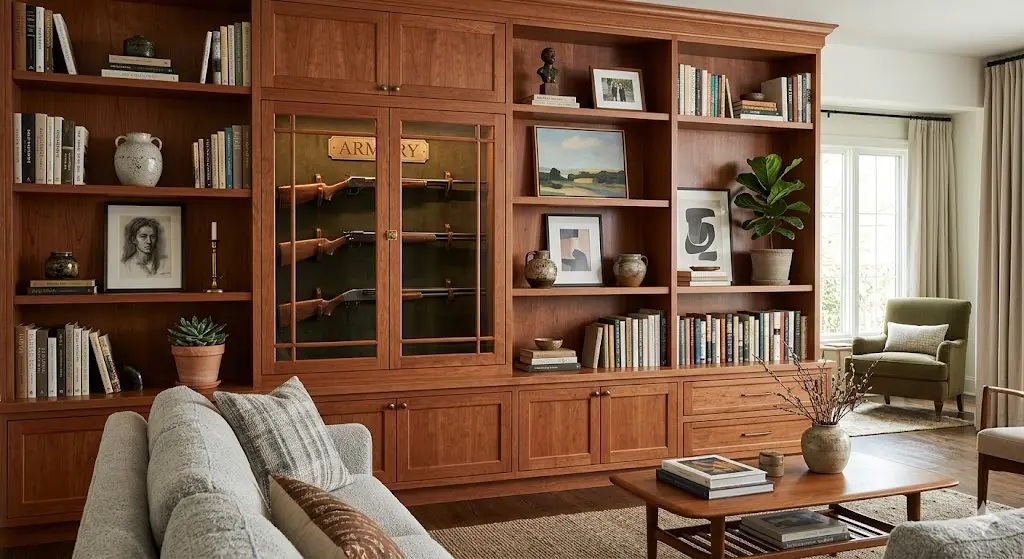
Women Gun Owners: How to Choose a Gun Storage Solution That Fits Your Home’s Style Without Compromise
Key Takeaways The Storage Problem Nobody Talks About Walk into almost any sporting goods store and look at the gun
Read More
Uncategorized
Reading Time: 10 min
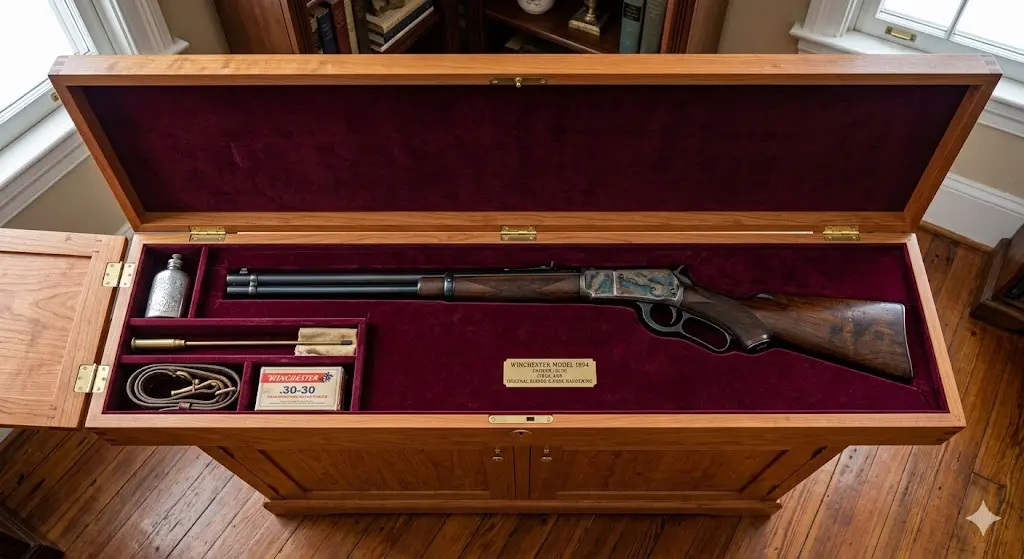
How to Protect Antique and Vintage Firearms in Wood Storage: What Collectors Need to Know About Climate and Finish
Key Takeaways Why Antique Firearms Demand a Different Standard of Storage Storing a modern production firearm and storing an 1860s
Read More
