01 May 2026 • Reading Time: 13 min
Key Takeaways
- Safe firearm storage is not optional equipment for a gun owner. It is the first responsibility that comes with ownership, and it needs to be in place before the firearm ever enters your home.
- The storage solution that is right for you depends on four variables: the number and type of firearms you own, your household composition, the space available, and how you intend to use and display your collection over time.
- There is a meaningful difference between a cheap trigger lock, a basic gun safe, and a handcrafted wooden gun cabinet with integrated security. Each serves a different buyer at a different stage of ownership.
- Children in the home change every calculation about firearm storage. If children are present or regularly visit, the security standard must be higher, not a compromise.
- Humidity and temperature control inside storage are as important for protecting your firearms as the lock on the door. A dehumidifier is not a luxury feature. It is a corrosion prevention tool.
- The best storage solution you will ever own is the one that is both secure enough to prevent unauthorized access and accessible enough that you actually use it properly every day.
Why Storage Is the First Decision, Not the Last
Most new gun owners think about storage the way most people think about homeowner’s insurance: something to sort out eventually, after the more immediate questions are handled.
This is the wrong order of operations.
A firearm without adequate storage is a liability the moment it enters your home. Not a hypothetical one. A concrete one. According to the most recent available data, the majority of firearms used in crimes, accidents involving children, and incidents of theft were not stored in locked security.
The good news is that solving this problem is not complicated. It requires understanding what you actually need, what the options genuinely offer, and how to match storage to your specific household before you ever need it to do its job.
This guide is built for the buyer who is new to firearm ownership and wants to get this decision right from the beginning. It covers the full range of storage options in plain language, explains what matters and what does not, and helps you identify the level of security and quality that matches your specific situation.
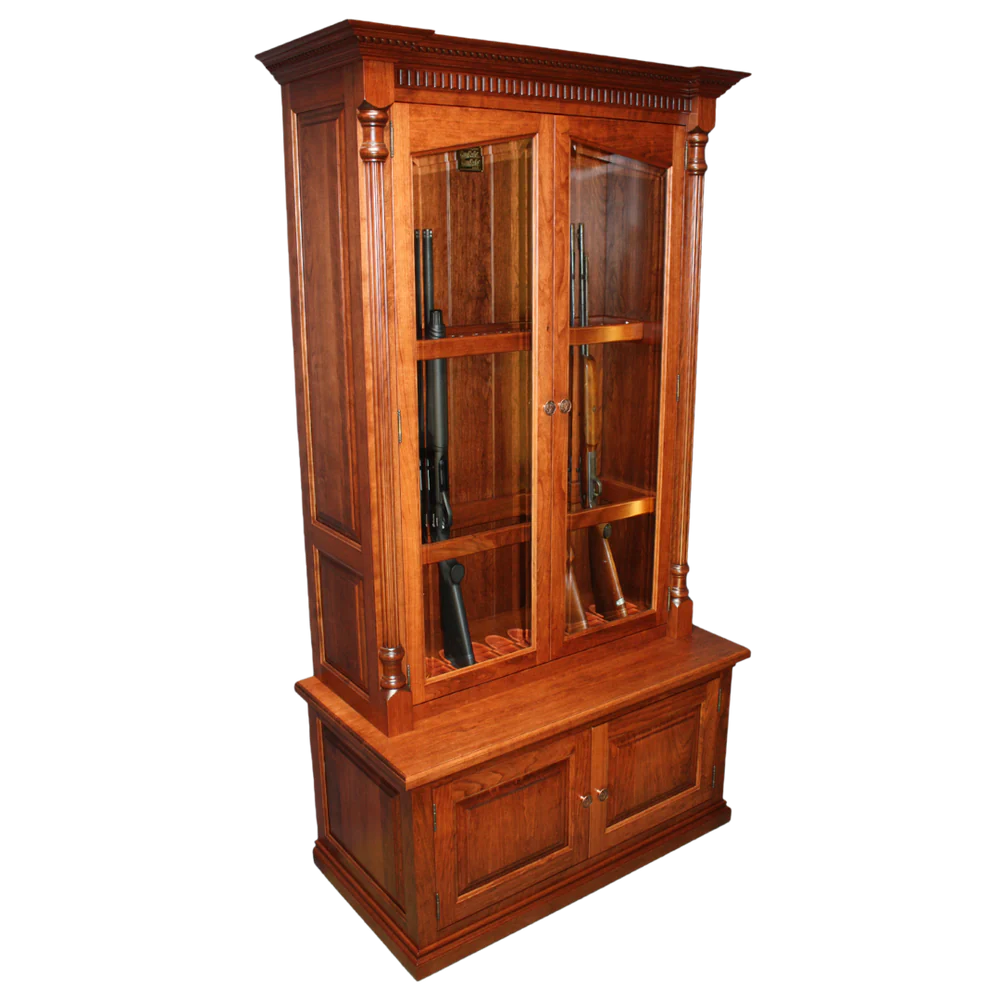
The Three Non-Negotiable Principles of Firearm Storage
Before getting into product categories and specifications, three principles should govern every storage decision a first-time gun owner makes. These are not preferences. They are the foundation.
Principle 1: Unauthorized Access Must Be Impossible
The lock on your storage must be one that a child cannot defeat and that a casual thief cannot bypass quickly. A cable lock looped through a trigger guard provides minimal protection. A keyed cabinet that a determined adult could defeat in under a minute is not adequate for a home with children or in a neighborhood with any meaningful theft risk.
The standard is not “harder to access than nothing.” The standard is “not accessible to anyone who should not have access.”
Principle 2: Your Firearm Must Be Protected From the Environment
Steel corrodes. Wooden stocks warp. Mechanisms fail when exposed to humidity over time. A firearm stored in an uncontrolled environment, even one that is adequately secured against unauthorized access, can be damaged to the point of unreliability or permanent degradation.
Storage that controls humidity protects both your investment and the firearm’s function.
Principle 3: Responsible Access Must Be Practical
A storage solution that is so difficult or time-consuming to access that you leave your firearm unsecured because it is more convenient is not solving the problem. It is creating a different version of it.
The best storage is the one you actually use correctly, every time. This means the right balance between security and accessibility for your specific situation.
Understanding the Storage Spectrum
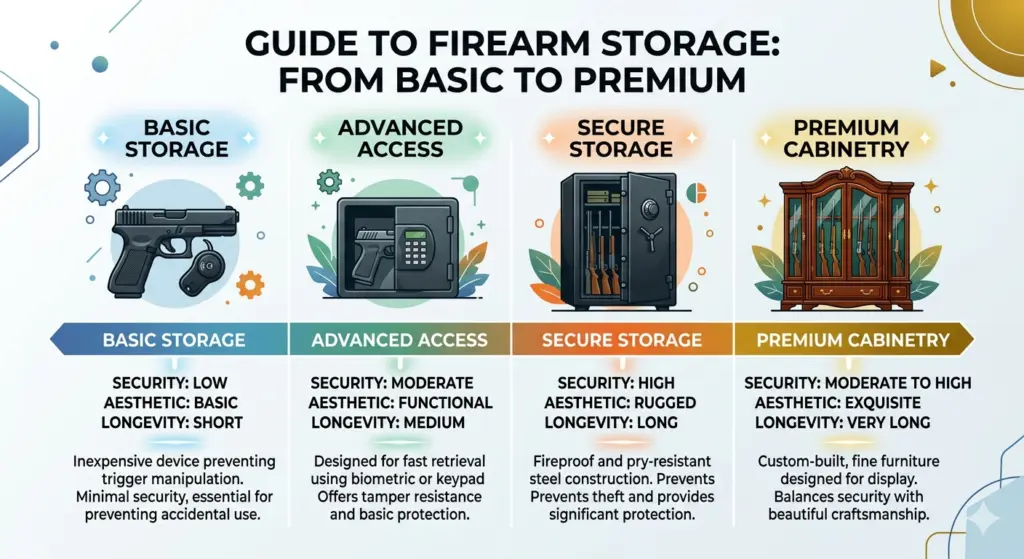
Gun storage products range from very basic trigger locks to high-security custom cabinets. Understanding where each category sits on the spectrum helps you identify what your situation actually requires.
Level 1: Trigger Locks and Cable Locks
What they are: Devices that attach directly to the firearm to prevent the trigger from being pulled or the action from being operated. Cable locks thread through the action and prevent loading.
What they do well: Provide a basic deterrent against casual or accidental discharge. Easy to use. Inexpensive. Portable.
What they do not do: Prevent the firearm from being taken. A trigger lock on a rifle in a closet prevents someone from firing it in that moment but does nothing to prevent the rifle from being carried out of the house. They provide no environmental protection.
Who they are appropriate for: Adults living alone with no children present who need a basic safety measure while a longer-term storage solution is put in place. Not adequate as a permanent solution for most households.
Level 2: Quick-Access Pistol Safes
What they are: Small, lockable cases designed for single handguns or a small number of pistols. Typically feature biometric, keypad, or key access. Designed to be accessible quickly in an emergency.
What they do well: Keep a single handgun secure while allowing rapid access when needed. Can be bolted to furniture or a nightstand. Reasonably priced.
What they do not do: Accommodate long guns. Do not provide meaningful fire protection. Basic models offer limited resistance to determined forced entry.
Who they are appropriate for: Homeowners who have a single handgun for home defense and need bedside-accessible storage combined with security against unauthorized access by children or visitors.
Level 3: Standard Steel Gun Safes
What they are: The most familiar category to most buyers. Steel construction with a combination lock or electronic keypad, internal shelving, and typically a felt-lined interior. Available in a wide range of capacities and security ratings.
What they do well: Provide genuine deterrence against most theft and unauthorized access. Many are rated for fire resistance. Available with high-capacity storage for large collections. More resistant to forced entry than lower-tier options.
What they do not do: Function as furniture. Factory steel safes are utilitarian objects designed for function, not form. The interior materials are typically MDF and vinyl, not solid wood. They sit in corners, closets, and garages and announce themselves as security devices. They are not something most homeowners want in a living room or study.
Who they are appropriate for: Buyers whose primary concern is maximum security at the lowest price point, who have no interest in display or aesthetic integration, and who have storage space that does not need to function as part of their living area.
Level 4: Custom Handcrafted Gun Cabinets with Integrated Security
What they are: Solid hardwood gun cabinets built by skilled craftsmen, with security features integrated into the design from the beginning rather than applied as afterthoughts. Examples include the cabinets built by Amish craftsmen at Custom Cabinet Security in Arthur, Illinois.
What they do well: Combine genuine security with furniture-quality construction and aesthetics. Protect firearms from both unauthorized access and environmental damage. Function as display pieces for collectors. Can be fully customized to the buyer’s collection, space, and interior design. Built to last generations.
What they do not do: Compete on price with entry-level factory safes. They are not the right choice for a buyer who needs basic storage at the lowest possible cost.
Who they are appropriate for: Buyers who want a permanent, high-quality solution that reflects the value and significance of their collection, integrates into their home rather than disrupting it, and will still be functional and beautiful decades from now.
What to Consider Before You Buy Anything
Choosing storage before you research products puts the decision in the right order. These are the questions to answer before you look at a single product listing.
How Many Firearms Do You Own, and What Types?
A handgun stored in a bedside quick-access safe has different requirements than a rifle collection stored in a dedicated cabinet. A mixed collection of long guns and handguns requires storage configured to accommodate both.
Be realistic about where your collection is likely to go. Many first-time gun owners start with one handgun and build a collection over several years. Buying storage that fits only your current collection may mean buying again in two years. Buying storage sized for the collection you are building toward is a better long-term investment.
Who Lives in Your Home and Who Visits It?
Children present in a home, whether as residents or regular visitors, change the security standard required. A cabinet that relies on a key that could be found is not adequate when children are present. A cabinet with a high-security pick-resistant lock or a combination lock that a child cannot easily defeat is the appropriate baseline.
Adults who should not have access to firearms, whether due to legal status or other considerations, are also a factor. Know your household and design your storage accordingly.
Where Will the Storage Live in Your Home?
A steel gun safe that weighs 500 pounds needs a floor that can support it and a location that does not require moving it frequently. A handcrafted gun cabinet sized for a living room or study has different placement considerations than a utilitarian safe destined for the garage.
Think about access frequency as well. A safe you will access weekly has different placement logic than emergency storage you hope you never need to open.
What Is Your Budget, and What Are You Optimizing For?
This is the honest question that most product guides avoid. Entry-level secure storage is inexpensive. Premium, heirloom-quality storage is a meaningful investment.
Neither category is wrong. They serve different buyers at different stages of ownership with different priorities. Be clear about what you are optimizing for: maximum security per dollar, long-term quality and aesthetics, or the fastest path to adequate protection.
The Humidity Question Most First-Time Buyers Miss
Environmental protection inside gun storage is one of the most consistently overlooked considerations for new gun owners, and one of the most practically significant.
Steel corrodes in humid conditions. Metal components develop rust that affects function and finish. Wood stocks warp or crack when exposed to humidity swings over time. A firearm stored in an uncontrolled interior environment can be degraded by corrosion and moisture damage long before any security failure occurs.
The solution is straightforward: controlled humidity inside the storage unit.
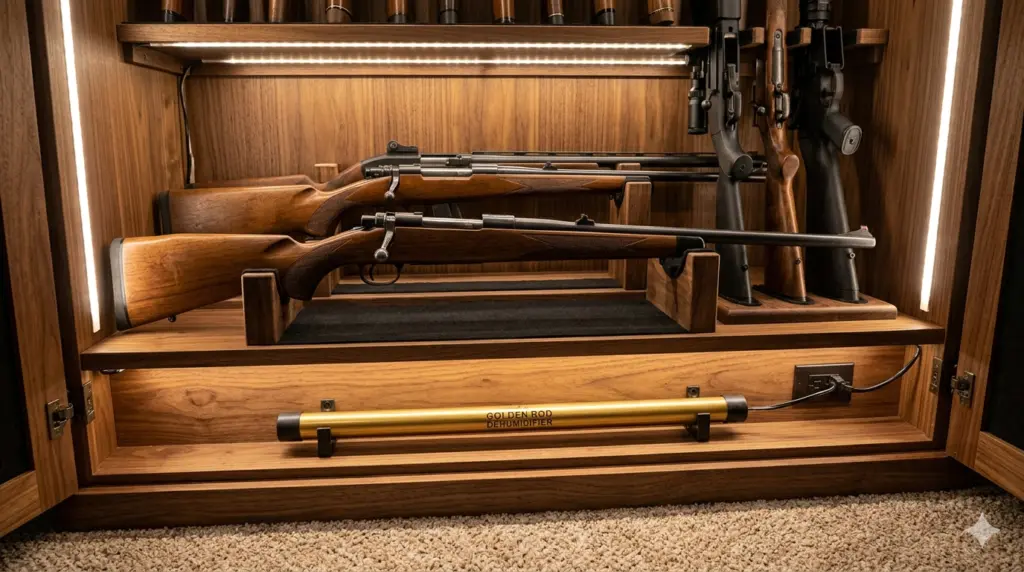
The Golden Rod dehumidifier rod is the most common and effective tool for this purpose. It is a low-wattage heating element that gently raises the temperature inside the safe or cabinet by a few degrees, which prevents condensation and maintains a relative humidity level below the threshold where corrosion begins. It requires an electrical outlet nearby and no maintenance beyond an occasional wipe down.
At Custom Cabinet Security, a Golden Rod dehumidifier is integrated into the cabinet design as a standard feature, not an add-on. It is positioned at the base of the interior and designed to work with the cabinet’s internal volume.
For buyers looking at factory safes, a dehumidifier rod can be purchased separately and placed inside any lockable storage. It is an inexpensive addition that meaningfully extends the lifespan of every firearm stored inside.
Do not evaluate storage options based on security features alone. Humidity control is equally important for protecting the investment the storage is supposed to safeguard.
Understanding Gun Cabinet Security Features: What Actually Matters
When you start reading product specifications for gun storage, you will encounter a range of security feature descriptions that range from genuinely meaningful to marketing language with limited practical significance. Here is how to read them.
Lock Types
Keyed locks: Simple, reliable, and widely used. The security level depends entirely on the quality of the lock cylinder. A cheap keyed lock on a consumer gun cabinet offers minimal protection. A high-security, pick-resistant lock cylinder changes the calculation significantly. Ask specifically about the lock grade and pick resistance, not just the presence of a key lock.
Electronic keypad locks: Convenient for quick access. Battery-dependent, which means they can fail at inopportune moments if the battery is not maintained. The code should not be shared and should be changed periodically.
Biometric locks: Fingerprint-based access that is fast and does not require remembering a combination. Quality varies considerably. High-quality biometric scanners are reliable. Budget biometric locks have meaningful false rejection rates that make them frustrating under stress.
Combination dials: The traditional choice for high-security safes. No batteries to fail. Slower to open than electronic options but highly reliable over the long term.
Steel Gauge (for Metal Safes)
The thickness of steel in a gun safe is measured in gauge: the lower the number, the thicker the steel. 7-gauge steel (about 3/16 inch) is genuinely tough. 12-gauge steel (about 1/8 inch) is adequate for most residential purposes. 16-gauge or thinner begins to offer limited resistance to determined forced entry with basic tools.
Marketing language for factory safes often emphasizes “reinforced steel” without specifying gauge. Ask or look for the specification before purchasing.
Locking Bolts
The bolts that extend from a safe’s door into the frame when locked are a meaningful security feature. More bolts and larger bolt diameter increase pry resistance. Three or four one-inch locking bolts are a reasonable baseline for a residential gun safe.
Wood Cabinets with Steel Reinforcement
A handcrafted wood cabinet with a steel-reinforced bar locking system, such as those built by Custom Cabinet Security, combines the structural properties of solid hardwood with steel security elements engineered into the design. This is not a contradiction between aesthetics and security. It is an integration of both.
The solid hardwood structure itself provides meaningful resistance to forced entry, particularly when the joinery is traditional rather than assembled. A well-built mortise and tenon frame in solid cherry or white oak is not easy to defeat with improvised tools.
The Specific Situation: Homes with Children
If there are children in your home, or if children regularly visit, the entire approach to gun storage must account for this as the primary design constraint, not a secondary consideration.
Children are curious, resourceful, and unpredictable in ways that even attentive parents do not always anticipate. The only truly safe approach when children are present is physical impossibility of access, not reliance on rules, conversations, or supervision.
What this means in practical terms:
- The storage must be locked at all times when it is not in active use by an authorized adult. Not most of the time. Every time.
- The location of keys or combination codes must be genuinely inaccessible to children, not just in a place they are unlikely to look.
- A high-quality lock on a well-built cabinet provides meaningful protection. A simple keyed lock on a lightweight cabinet that could be moved or tipped does not.
- Quick-access handgun safes kept in bedrooms should be bolted to fixed furniture or a floor-mounted anchoring point so they cannot be carried away.
The trigger lock and cable lock category provides essentially no protection in a home with children, because these devices secure the firearm itself but do not prevent it from being found, picked up, or removed from the home.
If a first-time gun owner with children in the home asks for the single most important piece of storage advice, it is this: do not delay proper secure storage by a single day after the firearm enters the home.
How to Think About Display vs. Pure Storage
A question many first-time gun owners do not expect to face is whether they want to display their firearms or simply store them securely.
The answer matters for storage selection because display and pure secure storage are served by different products.
Pure secure storage prioritizes unauthorized access prevention above all else. A steel safe in a closet or a gun room serves this purpose well. The firearm is secured, inaccessible, and protected from environmental damage. It is not seen.
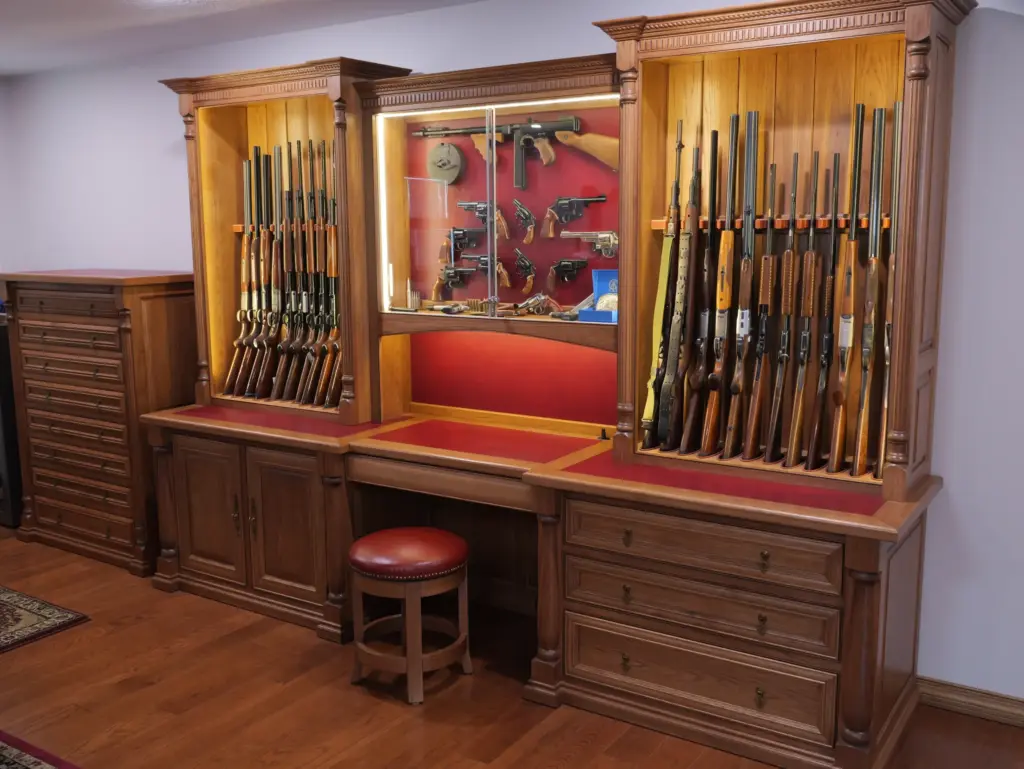
Display storage combines security with the ability to view and appreciate the collection without going through a full access procedure. A handcrafted wood cabinet with glass doors, LED lighting, and a fitted interior allows a collection to be displayed in a room while remaining secure.
For collectors who have invested meaningfully in their collection, display storage makes those investments visible and enjoyable without compromising security. For a first-time owner with a single handgun, a lockbox serves the practical need adequately.
The question worth asking yourself early is whether your relationship with your collection is likely to develop into something you will want to display, or whether secure storage that keeps firearms out of sight and out of mind is the right long-term fit.
If display is part of the vision, the handcrafted gun cabinet collections at Custom Cabinet Security represent the point at which security, craftsmanship, and display capability converge in a single piece.
Common First-Time Buyer Mistakes (And How to Avoid Them)
Buying Storage After the Firearm Instead of With It
The window between purchasing a firearm and having secure storage in place is the highest-risk period of firearm ownership. Make storage acquisition simultaneous with or prior to firearm acquisition, not a follow-up item.
Underestimating the Collection You Will Build
Most first-time gun owners start with one firearm and add to their collection over time. Storage sized only for what you have today is likely to become inadequate within a few years. Sizing up slightly from your current need is almost always the better long-term decision.
Prioritizing Quick Access Over Security in Households with Children
The convenience of rapid access to a firearm in an emergency is a legitimate consideration. In a home without children, it is a straightforward calculation. In a home with children, it requires more careful thought. A quick-access safe that is genuinely fast for an adult but genuinely inaccessible to a child requires quality, proper mounting, and thoughtful placement.
Ignoring Humidity
As covered above: corrosion protection inside storage is not optional for anyone who expects their firearms to maintain their function and finish over years of ownership.
Buying the Cheapest Option Available and Planning to Upgrade Later
Entry-level gun storage products are better than nothing, but they are not always a sensible intermediate step. If the ultimate goal is a quality cabinet that will last for decades, buying a cheap intermediate option and then a quality permanent solution means spending money twice. In many cases, investing in the right solution from the beginning is the more economical approach over any meaningful time horizon.
Trigger Locks as a Supplemental Tool
Trigger locks and cable locks serve a legitimate supplemental role even for gun owners who have invested in proper primary storage. They are appropriate for:
- Firearms kept in vehicles for legitimate purposes, as a deterrent against smash-and-grab theft
- Temporary transport between secure locations
- As an additional safety layer on firearms within a larger collection when the primary storage allows unobstructed access to individual pieces
Custom Cabinet Security offers trigger locks as part of their security accessory lineup. Used as a supplemental measure alongside a properly secured cabinet, they add a second layer of protection for any piece that an unauthorized person might reach if the primary lock were defeated.
They are not, however, adequate as the primary or sole security measure for any firearm stored in a residential setting.
Starting the Conversation About Custom Storage
For a first-time gun owner who is starting with a single firearm, the practical path is straightforward: get adequate basic storage in place immediately, then evaluate what the right long-term solution looks like as the collection grows and the relationship with it develops.
For a buyer who is already thinking beyond basic storage, who owns a meaningful collection or anticipates building one, and who wants a permanent solution rather than an intermediate one, the custom consultation process at Custom Cabinet Security is the appropriate starting point.
Every cabinet built in Arthur, Illinois begins with understanding what the buyer actually needs: the number and type of firearms, the room where the cabinet will live, the level of display versus pure storage, the wood species and finish that will integrate with the existing interior, and the security specifications required by the household.
The custom consultation process is the place to start that conversation.
The Bottom Line
Firearm storage is the first responsibility of firearm ownership, not a follow-up item for later. Getting it right means understanding what your household actually requires, choosing a solution that meets that standard without compromising on the principles of secure storage, and putting that solution in place before it is needed.
The range of storage available to first-time gun owners spans from basic trigger locks to handcrafted heirloom-quality cabinets with integrated security, humidity control, and display capability. The right choice for you sits somewhere on that spectrum based on your collection, your household, your space, and your intentions as a collector.
Whatever you choose, choose it before the firearm arrives. That is the one decision that cannot be made retroactively.
Related Posts
View All
Uncategorized
Reading Time: 12 min
How to Childproof Your Gun Storage Without Sacrificing Display or Quick Access
Key Takeaways A note on this topic: Child gun safety is a serious subject that deserves honest, specific treatment rather
Read More
Uncategorized
Reading Time: 12 min
Gun Safes for Home Offices and Studies: How to Blend Security Into a Professional Space
Key Takeaways The Problem With the Standard Approach Most gun owners who have a dedicated home office or study eventually
Read More
Uncategorized
Reading Time: 10 min
What the Custom Order Process Actually Looks Like: From Consultation to Delivery of Your Amish Gun Cabinet
Key Takeaways The Uncertainty Most Buyers Feel Before They Reach Out A significant number of people who spend time on
Read More
