08 May 2026 • Reading Time: 13 min
Key Takeaways
- Handguns have distinct storage requirements that differ from long gun storage in several important ways: smaller profiles, higher quantities per collector, more frequent access needs, and a greater variety of sizes within a single collection.
- A pistol chest with fitted drawers is a fundamentally different product from a long gun cabinet, and understanding that distinction is the starting point for choosing storage that actually works for your collection.
- The configuration of the interior matters as much as the security of the exterior. Pistols stored in an unconfigured interior shift, scratch, and get harder to access as the collection grows.
- Drawer construction quality directly determines how long the storage will function properly. Drawers built with traditional dovetail joinery in solid hardwood will outlast drawers assembled from MDF with metal slides.
- Humidity control inside handgun storage is particularly important for collectors who own metal-framed pistols, antiques, or any piece with blued or polished finishes that corrode faster than matte or Cerakoted surfaces.
- The right pistol storage is the piece that fits your current collection, anticipates where the collection is going, integrates with the space where it will live, and maintains security without making daily access a frustrating process.
Why Handgun Storage Deserves Its Own Conversation
Most discussions of gun storage begin and end with long guns. Rifle cabinets, shotgun racks, long gun safes with vertical barrel rests. The visual shorthand for firearm storage is almost always a tall cabinet with a collection of rifles standing upright.
For handgun collectors, this default framing leaves a significant gap.
Handguns require a different kind of storage logic. They are smaller individually but often accumulated in larger numbers than long guns. They are handled more frequently in collections where regular practice and range use are part of ownership. They have specific orientation and display needs that vertical barrel rests do not address. And they vary in size in ways that make a one-size-fits-all interior configuration work poorly in practice.
A pistol collector who stores a full-size duty pistol, a compact carry gun, a 1911, and a revolver in the same drawer without fitted configuration is dealing with a jumbled tray that makes access difficult and creates friction and movement that affects the finishes of every piece in the drawer.
Getting handgun storage right means choosing a product specifically designed for the way handguns are owned, accessed, and displayed, not adapting a long gun solution to a different kind of collection.
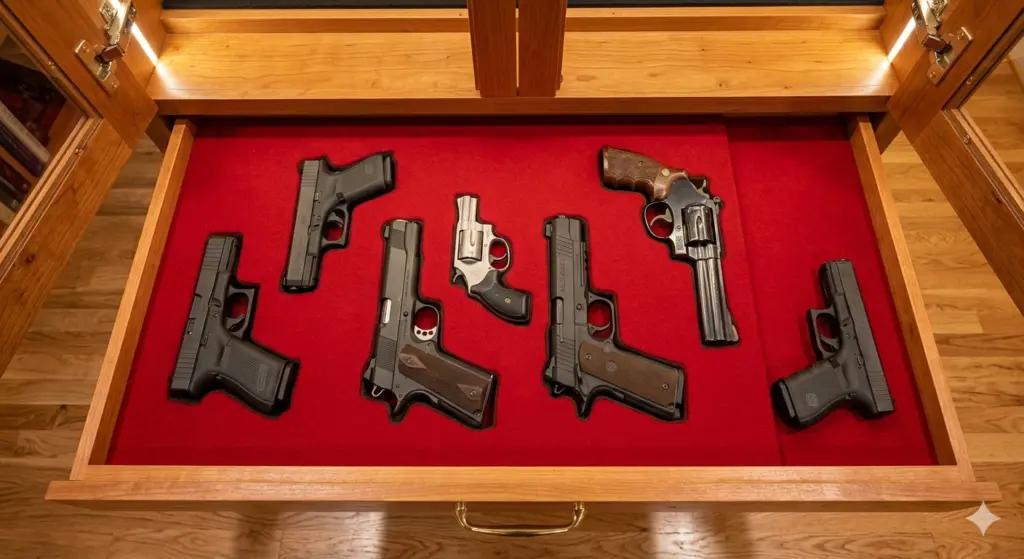
The Two Primary Categories of Handgun Storage
Understanding what you are choosing between is the first step. Handgun storage products fall into two primary categories, each serving a different type of collector.
Pistol Chests
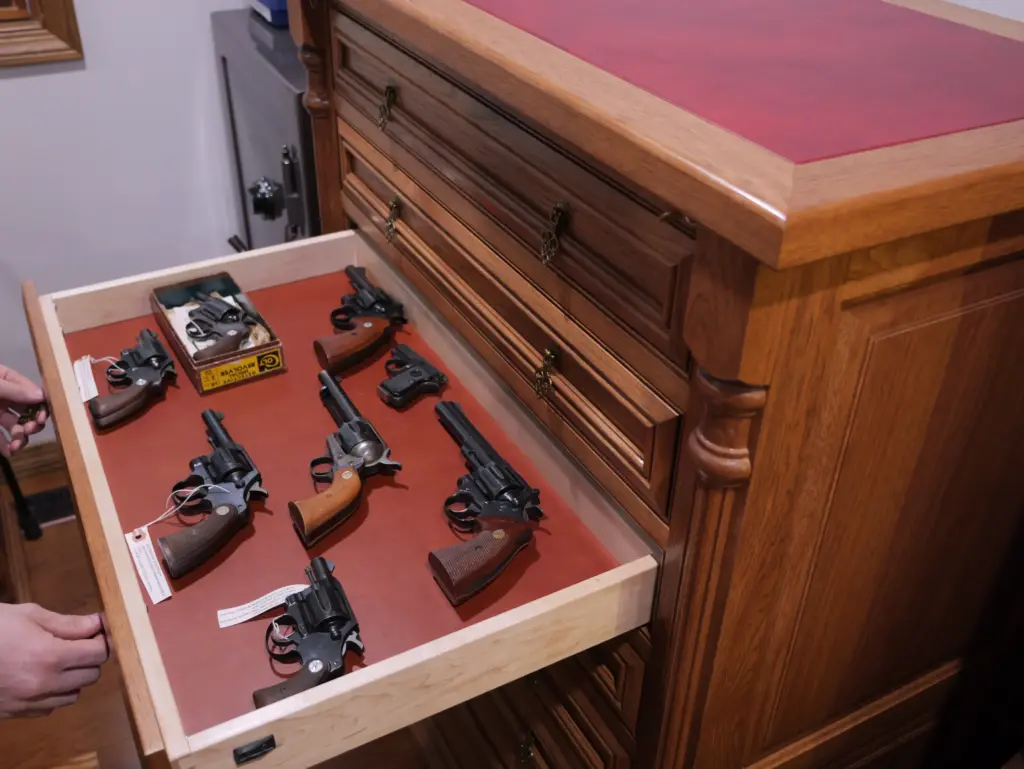
A pistol chest is a storage piece built around drawers. Each drawer is designed to hold one or more handguns in a fitted, organized configuration. The drawers typically feature felt or leather lining to protect finishes, and the best examples are configured so each pistol has a defined space rather than sharing an open tray.
Pistol chests are designed for collectors who own multiple handguns and want organized, accessible storage where each piece can be located and retrieved without disturbing the others. They are also a natural display piece: a well-built chest opened to reveal an organized collection of handguns is a piece that speaks to serious, organized ownership.
At Custom Cabinet Security, the 8-Drawer Cherry Wood or Hickory Pistol Chest represents the high end of this category: solid hardwood construction, eight full drawers with individually configured interiors, red felt lining throughout, and the kind of joinery quality that produces drawers that open and close with precision for decades of use.
Pistol Display Cabinets
A pistol display cabinet uses glass-panel doors to display handguns in a way that combines security with visual presentation. Pistols are typically stored in fitted trays or racks that hold each piece in an upright or angled display position, allowing the collection to be seen without opening the cabinet.
This format suits collectors who want their collection visible as part of a room rather than stored out of sight, while maintaining security against unauthorized access. The display cabinet format is also well suited to pieces with decorative or historical significance where the visual presentation of the firearm is part of the ownership experience.
The 14-Gun Pistol Cherry Wood Gun Safe in Custom Cabinet Security’s collection addresses this need: a cabinet designed specifically to display a significant handgun collection behind glass while providing the security features that genuine protection requires.
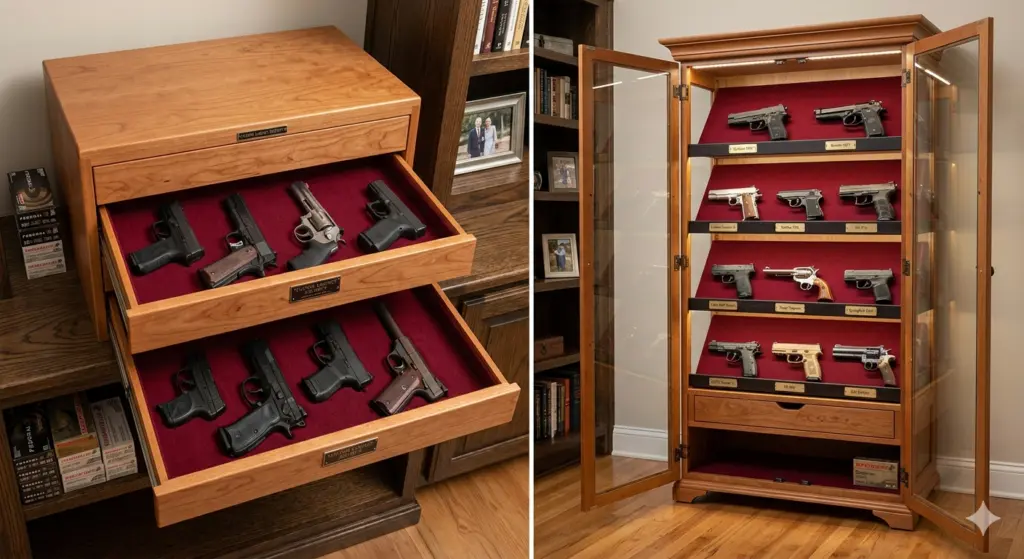
What Distinguishes Serious Pistol Storage From Basic Options
The handgun storage category spans a wide quality range, from inexpensive lockboxes and basic metal cabinets to handcrafted solid hardwood pieces with integrated security. Understanding what separates the serious end of the market from the basic end helps buyers invest in the right place.
Interior Configuration
The interior of a pistol storage piece does work that the exterior cannot. An unconfigured interior, whether a flat metal shelf in a basic safe or an unfitted felt tray, forces pistols to share space in ways that lead to contact between pieces, difficulty locating specific firearms, and the gradual accumulation of friction, scratches, and disorder that affects both the collection and the storage experience.
A properly configured interior treats each pistol as an individual piece with its own defined space. The configuration accounts for the size and orientation of each firearm, allows the grip to be accessed cleanly without disturbing adjacent pieces, and uses a lining material that protects finishes rather than abrading them over time.
Red felt lining, as used in Custom Cabinet Security’s pistol pieces, provides soft contact protection that does not react with metal finishes the way some synthetic materials do. It also provides a visual background that makes individual pieces easy to distinguish and examine.
Drawer Construction Quality
In a pistol chest, the drawers are the primary functional element. They open and close dozens or hundreds of times per year over the life of the piece. The quality of their construction directly determines how long they continue to function precisely.
What poor drawer construction looks like in practice: Drawers built from MDF on basic metal slides begin to show play and misalignment within a few years of regular use. The MDF substrate is not dimensionally stable over long time periods in varied humidity conditions. The slides wear. The drawers that once closed flush begin to sit slightly off, require additional force to open, or develop a subtle rattle.
What quality drawer construction produces: Drawers built in solid hardwood with dovetail joinery at the corners develop tighter mechanical connections over time as the wood fibers compress and settle. Traditional wooden drawer runners, properly fitted and waxed, operate with a precision that metal ball-bearing slides do not match in a piece that is used regularly over years. A drawer built this way does not deteriorate. It improves.
This is the practical consequence of the craftsmanship difference between a handcrafted Amish-built piece and a factory-produced one. It is not primarily aesthetic. It is structural and functional, and it becomes visible over a five-to-ten year time horizon.
Lock Quality and Access Design
Handguns in a collection are typically accessed more frequently than long guns stored for occasional use or emergencies. A collector who takes pieces to the range regularly, or who rotates display configurations, is opening their storage several times per week.
The lock and access mechanism on pistol storage must perform reliably under this kind of regular use without becoming a source of frustration. A cheap keyed lock with a poorly fitted cylinder develops slop and difficulty over time. A high-quality pick-resistant lock operates consistently for the life of the piece.
Beyond the lock itself, the design of access matters. Drawers that require both hands to open, or that do not stay open reliably while both hands are occupied with a firearm, create practical problems in daily use. The best pistol chest designs account for the mechanics of actual use, not just the mechanics of security.
Choosing Between a Pistol Chest and a Display Cabinet
For a collector trying to decide between these two primary formats, the decision usually comes down to three questions.
Question 1: Do You Want Your Collection Visible?
A pistol chest stores handguns in drawers. When the drawers are closed, the collection is not visible. This is the right choice for collectors who prefer secure, organized storage with privacy, or who have household considerations that make visible firearm storage less appropriate.
A display cabinet presents the collection behind glass. The pieces are visible from outside the cabinet without requiring the cabinet to be opened. This is the right choice for collectors who have invested in pieces they want to appreciate daily, who have a dedicated room or space where the display is contextually appropriate, and who want to present their collection as part of the character of the room.
Neither is objectively better. They serve different relationships with a collection.
Question 2: How Often Do You Need Access to Individual Pieces?
A pistol chest with individual drawers provides excellent access to specific pieces without disturbing the rest of the collection. Opening the relevant drawer gives immediate access to the target firearm while every other piece remains in place.
A display cabinet, depending on configuration, may require more manipulation to access a specific piece from a display tray. For collectors who primarily display and occasionally access, this is not a meaningful limitation. For collectors who rotate pieces in and out of regular use frequently, the drawer format may be more practical.
Question 3: What Role Will This Piece Play in Your Space?
A pistol chest with a flat top surface functions as furniture in addition to storage. The top surface is available for display, for a lamp, for accessories, or simply as a surface in the room. It sits at a height that integrates with other furniture.
A display cabinet is a statement piece. It occupies a wall, draws the eye, and functions as both storage and display in a way that a chest does not. In a room designed around a collection, a display cabinet has a different visual weight and presence than a chest.
Thinking about both pieces in the context of the room they will occupy helps clarify which format serves the space as well as the collection.
Wood Species and What They Mean for Pistol Storage
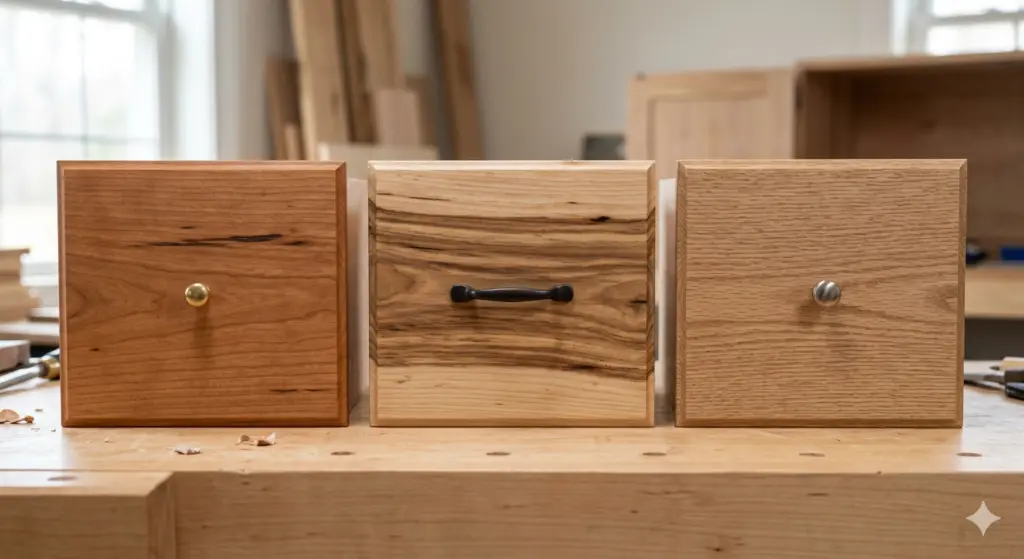
The wood species used in a handcrafted pistol cabinet or chest affects both the appearance of the finished piece and its practical characteristics over time. Custom Cabinet Security works with cherry wood, hickory, and white oak, each of which produces a distinct result.
Cherry Wood
Cherry is a fine-grained, straight-grained hardwood that begins with a warm pinkish tone and deepens to a rich reddish brown over time when exposed to light. It is one of the most traditional and prized American cabinetmaking woods, associated with formal furniture and high-quality interior work.
In a pistol chest or cabinet, cherry wood produces a finished piece that reads as serious, elegant, and appropriate for formal or library-style spaces. The grain is consistent enough to work well with hand-rubbed or hand-applied oil finishes that emphasize the wood’s natural character.
For collectors who want a piece that will develop character and depth over decades, cherry is often the natural choice.
Hickory
Hickory is a denser, harder wood than cherry, with more dramatic grain variation and streaking that makes each piece visually distinct. Its toughness and figure give it a different character than cherry: less formal, more individualistic, suited to spaces with a natural or rustic character.
A hickory pistol chest is a piece that will not look like any other. The grain variation means the finished surface tells the story of the wood in a way that more uniform species do not.
White Oak
White oak has an open, pronounced grain with a ray figure that creates a distinctive pattern in the surface. It is dense, durable, and associated with a range of traditional and contemporary furniture styles. White oak’s neutral, slightly grayish tone works well in spaces with modern or transitional design sensibilities.
For collectors whose home interiors lean contemporary, white oak produces a pistol chest or cabinet that integrates naturally where cherry might feel too traditional.
Choosing among these species is not just an aesthetic decision. It is a decision about the long-term character of a piece that will develop differently over time depending on the wood. A consultation with the craftsmen at Custom Cabinet Security can help clarify which species serves your specific space and vision.
Security Features That Matter Specifically for Handgun Storage
Security considerations for handgun storage have some overlap with general firearm storage but also some specific dimensions worth addressing separately.
Drawer Lock vs. Cabinet Lock
A pistol chest that secures with a single external lock on the chest body is a different security proposition than one where individual drawers can be locked independently. For most residential applications, a single high-security lock that secures the entire chest is adequate and more practical than managing multiple locks.
The lock cylinder quality is the critical variable. A pick-resistant, high-security lock that requires a controlled key is meaningful protection. A basic wafer tumbler lock that came with the furniture does not provide serious security regardless of how nice the chest looks.
Steel Reinforcement in Wood Cabinets
A well-built solid hardwood cabinet with steel-reinforced bar locking, such as those produced by Custom Cabinet Security, integrates steel into the security design without making the piece look or feel like a steel safe. The reinforcement works within the wooden structure rather than replacing it.
This integration is important because the structural properties of solid hardwood are more substantial than they are often given credit for. A thick cherry wood frame with traditional joinery is not easy to defeat with improvised tools. Adding steel reinforcement at the critical securing points produces a piece that is both visually a furniture item and genuinely resistant to unauthorized access.
Visibility as a Security Consideration
A display cabinet that makes handguns visible through glass raises a question that does not exist for a chest with closed drawers: does visibility itself create a risk?
The answer depends on context. A display cabinet in a private room, visible only to household members and invited guests, creates minimal additional risk beyond what a locked chest represents. A display cabinet in a publicly visible location, or in a home with frequent visitors whose relationship to firearm ownership is unknown, requires more careful consideration of placement.
Bulletproof glass in display cabinets, such as that used in Custom Cabinet Security’s designs, addresses the physical security of the glass panels themselves. Whether the display format is appropriate for a given household context is a judgment call the owner must make based on their specific situation.
Sizing Your Storage to Your Collection
One of the most common practical mistakes in pistol storage selection is buying for the current collection rather than the collection the buyer is building.
A collector who currently owns four handguns and buys a four-pistol chest will need new storage within a year or two if the collection continues to develop. The cost of buying storage twice, and the practical disruption of transitioning an organized collection from one piece to another, is rarely worth the initial savings of buying a smaller unit.
Thinking about where a collection is realistically headed over a three-to-five year horizon and sizing storage to that projection is almost always the better approach.
Practical sizing guidance:
- If you currently own two to four handguns and are actively collecting, consider storage that comfortably holds eight to twelve pieces.
- If you own five to eight pieces and have slowed acquisition, storage sized for ten to fourteen pieces allows growth without excess.
- If you own more than ten handguns and the collection is defined, custom configuration to the specific collection makes more sense than buying to a standard size.
The custom consultation process at Custom Cabinet Security is particularly valuable for collectors in the last category. A cabinet or chest built to the exact configuration of a defined collection, with drawer layouts and interior fitting designed for the specific pieces it will hold, is a different category of ownership experience than fitting a collection into a standard product.
What a Pistol Chest Looks Like in a Home Setting
One consideration that first-time buyers of pistol chests sometimes underestimate is how the piece will integrate into the room where it lives.
A standard steel gun safe communicates its function immediately and without ambiguity. It is a safe. It belongs in a utility space, a closet, or a dedicated gun room.
A handcrafted cherry wood or hickory pistol chest is a piece of furniture. It belongs on a credenza, in a study, at the foot of a bed in a master bedroom, or in any room where quality furniture is appropriate. The piece does not announce its function to a visitor who does not already know what it is. It simply looks like a well-made chest of drawers.
This integration is not a trivial consideration for collectors who own spaces where aesthetics matter. A piece that fits naturally into a room’s furniture program, that the inhabitants pass by daily and find visually satisfying, and that does not interrupt the character of the room it occupies is a different kind of ownership experience than a utilitarian safe in a corner.
Custom Cabinet Security’s pistol chests and display cabinets are designed with this integration in mind. The craftsmanship standards applied to the exterior of the piece are the same standards applied to fine residential furniture. A cherry wood pistol chest from Arthur, Illinois is a piece a collector will still find aesthetically satisfying in thirty years.
Accessories That Complete a Handgun Storage Setup
The cabinet or chest is the primary investment. Several supplemental accessories complete the setup for serious collectors.
Trigger Locks
Trigger locks applied to individual pieces within a locked cabinet provide a second layer of security. If the primary lock were defeated, individual trigger locks create additional friction for unauthorized access to each firearm. Custom Cabinet Security offers trigger locks as part of their security accessory lineup.
For collectors with particularly valuable or significant pieces in a mixed collection, applying trigger locks to specific pieces provides differentiated security within a single cabinet.
Humidity Control
As addressed in the broader gun storage context, a Golden Rod dehumidifier rod inside a pistol chest or cabinet protects metal-framed handguns, blued finishes, and wooden grips from humidity-related degradation. It is particularly important for antique or collectible pieces where original finish preservation is part of the ownership priority.
Custom Cabinet Security integrates humidity control as a standard design element in their cabinets. For collectors who are evaluating storage options, the presence or absence of humidity management should be a consideration in every comparison.
Cleaning and Maintenance Supplies
A pistol chest that includes a dedicated drawer or compartment for cleaning supplies, oils, and maintenance tools organizes the entire ownership experience rather than treating storage as separate from maintenance. Some custom cabinet configurations can incorporate this functionality into the overall design.
How to Start the Conversation About Custom Pistol Storage
Standard product configurations serve a large portion of handgun collectors well. The 8-Drawer Pistol Chest and the 14-Gun Pistol Cabinet in Custom Cabinet Security’s current collection address the most common collector configurations with Amish craftsmanship and integrated security.
For collectors whose needs fall outside standard configurations, or who want a piece designed specifically for their collection and their space, the custom consultation pathway is the right starting point. The craftsmen in Arthur, Illinois build one cabinet at a time to the specifications of the person who commissioned it. A collector with fifteen specific handguns in varied sizes, who wants a chest with custom drawer depths configured for those particular pieces, is describing exactly the kind of problem a custom build solves.
The consultation process begins with understanding the collection: what it contains, where it is going, how it is used, and what the space it will live in looks like. From that conversation, a configuration emerges that standard products cannot match.
The Bottom Line
Handgun storage done right is not a small steel box or a generic safe shelf. It is a piece specifically designed for the way handguns are owned, accessed, organized, and displayed. Getting the configuration right, the quality right, and the integration with the room right produces an ownership experience that serious collectors find meaningful for the entire life of the collection.
The decision between a pistol chest and a display cabinet comes down to how a collector relates to their collection: whether it lives in drawers or behind glass, whether access is a daily activity or an occasional one, and whether the room where it lives calls for a statement piece or a quiet, well-made chest.
Both are better answered by a craftsman who builds each piece to order than by a factory floor that builds each piece to a price point.
Related Posts
View All
Uncategorized
Reading Time: 8 min
The Resale Value of a Custom Gun Cabinet: Does a Handcrafted Amish Safe Hold Its Value Over Time?
If you’ve ever bought a mass-produced gun safe from a big-box retailer, you already know what happens the moment it
Read More
Uncategorized
Reading Time: 11 min
Women Gun Owners: How to Choose a Gun Storage Solution That Fits Your Home’s Style Without Compromise
Key Takeaways The Storage Problem Nobody Talks About Walk into almost any sporting goods store and look at the gun
Read More
Uncategorized
Reading Time: 10 min
How to Protect Antique and Vintage Firearms in Wood Storage: What Collectors Need to Know About Climate and Finish
Key Takeaways Why Antique Firearms Demand a Different Standard of Storage Storing a modern production firearm and storing an 1860s
Read More
