11 Sep 2026 • Reading Time: 12 min
Key Takeaways
- The presence of children in a home is the single variable that most transforms the gun storage question. Every other priority display, aesthetics, convenience becomes secondary to genuine physical impossibility of unauthorized access.
- “Child-safe” and “childproof” are not the same thing. Child-safe measures add friction; childproof measures make access genuinely impossible for a child regardless of motivation, curiosity, or time available.
- A quality handcrafted wood cabinet with a pick-resistant high-security lock provides a level of access control for children that a basic keyed cabinet lock does not. The difference between nominal security and meaningful security is the quality and resistance rating of the lock cylinder.
- Quick access and child safety are not mutually exclusive, but they require deliberate design rather than a compromise. The specific mechanism and placement of quick-access storage for a defensive firearm can be genuinely secure for children and genuinely accessible for an authorized adult.
- Display cabinets in homes with children require specific attention to glass quality. Standard float glass that can be broken by a moderate impact is not appropriate in a room where children play; bullet-resistant laminated glass raises the threshold significantly.
- The most reliable child-safety standard for any gun storage is this: a child who discovers the cabinet, unsupervised, with unlimited time and motivation, should not be able to access the contents. If that standard is not met, the storage is inadequate regardless of what it looks like or how it functions otherwise.
A note on this topic: Child gun safety is a serious subject that deserves honest, specific treatment rather than reassurances. This post takes the question seriously and gives direct, actionable guidance based on how children actually interact with objects rather than how adults hope they will.
Why This Tension Is Real and Worth Addressing Honestly
Gun owners with children face a genuine tension that does not have a simple resolution. On one side is the responsibility to store firearms securely, with access genuinely impossible for children in the household. On the other side is the legitimate desire to display a meaningful collection, maintain access for defensive purposes, and not reduce every gun storage decision to the lowest common denominator of “lock it in a closet and never think about it.”
The tension is real because the two objectives pull in different directions. A firearm that is accessible for quick defensive use is more accessible than one that requires three steps to retrieve. A collection displayed behind glass is more visible than one stored in a solid-door cabinet. Each of these legitimate ownership priorities creates a security consideration that must be specifically addressed rather than assumed away.
This post takes both sides of the tension seriously. The child safety standard is not softened or qualified. The display and access goals are not dismissed as less important than they are. The goal is a framework that serves both without pretending the tension does not exist.
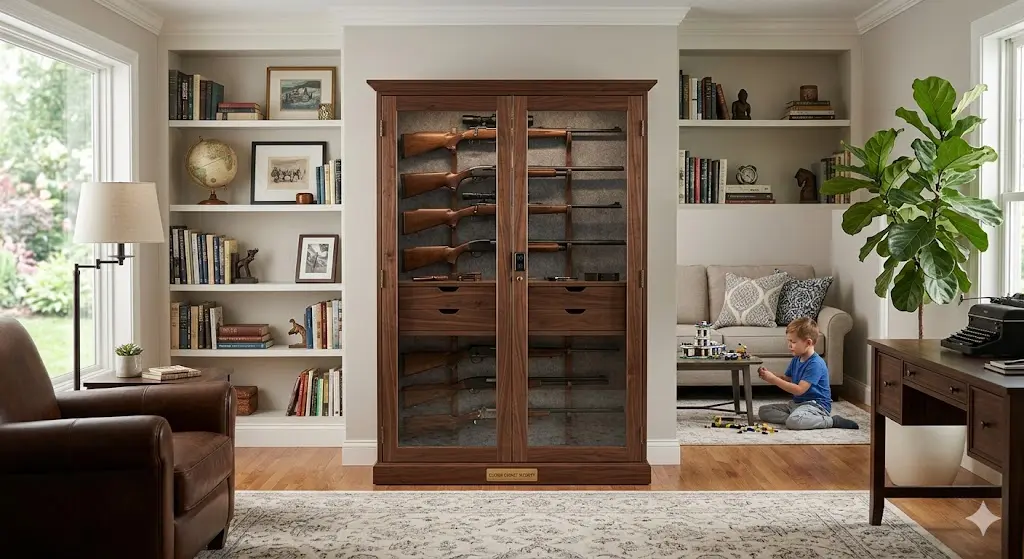
Understanding How Children Interact With Security
The starting point for designing child-appropriate gun storage is an honest assessment of how children actually behave with locked objects, not how adults hope they will behave.
The Curiosity Problem
Children are more curious, persistent, and resourceful than adults typically expect. A child who discovers something interesting in an adult’s room and is told not to touch it does not simply stop being curious. They may stop in the moment, but the object has been identified as worth returning to.
A child who discovers a key in a predictable location (the hook inside the nightstand drawer, the top of the bookshelf, the key on the same keychain as the car keys) will at some point use that key. The inevitability of this is not a failure of the child’s character; it is a fundamental property of how children interact with their world.
The “Some Friction Is Enough” Fallacy
Many gun storage approaches add friction without adding genuine security. A trigger lock adds friction: a child cannot fire the gun while the lock is in place. But a trigger-locked gun in an accessible location is a gun that can be removed from the home, shown to other children, and potentially used by an older teenager who understands the mechanism.
A cabinet with a basic keyed lock adds friction: the child cannot open the cabinet without a key. But a key that is findable by a motivated, searching child is eventually found.
The distinction between friction and genuine security is the difference between “harder to access” and “impossible to access for a child.”
What Genuine Child Security Requires
For a gun storage solution to be genuinely child-secure, it must meet the standard described in the Key Takeaways: a child who discovers the cabinet, unsupervised, with unlimited time and motivation, cannot access the contents.
This standard requires:
- A lock mechanism that a child cannot bypass by picking, finding the key, or using force available to a child
- A cabinet structure that a child cannot compromise by pulling, prying, or sustained effort with child-accessible tools
- A key or combination management practice that does not rely on the key or code remaining unknown to a motivated, searching child
Meeting this standard is achievable. It requires specific choices rather than assumptions.
The Lock: The Most Critical Child Safety Variable
The lock mechanism is the single most important variable in child safety for a gun cabinet. Its quality, resistance characteristics, and the way it is managed determine whether the cabinet is genuinely child-secure or merely child-resistant.
The Spectrum of Lock Quality
Basic keyed locks (wafer tumbler): The lock type found on most standard wood furniture, including basic gun cabinets. Wafer tumbler locks can be picked by an experienced adult with minimal tools and are not rated for resistance to bypass attempts. A teenager who has seen a YouTube tutorial can pick a standard wafer tumbler lock. This lock type provides friction for young children and nominal security for older ones.
Disc detainer and pin tumbler locks: Better than wafer tumbler but still not at the level of high-security lock cylinders. These locks provide more resistance than the entry-level furniture lock and are appropriate in lower-risk contexts. They are not specified for gun storage in homes with children who have reached the age where lock manipulation is a relevant concern.
High-security, pick-resistant cylinders: Locks specifically designed and tested for resistance to picking, drilling, and bypass attacks. These cylinders use high-tolerance pin configurations, anti-pick features, and in some cases anti-drill plates to make bypass significantly more difficult than a standard lock. They are rated by their manufacturer for resistance characteristics that standard locks are not.
The pick-resistant lock cylinders specified in Custom Cabinet Security pieces fall into this category. The selection is intentional: a furniture piece housing a firearm collection in a home with children needs a lock that provides genuine resistance, not a lock that serves the visual function of a lock while providing nominal security.
Key Management in a Household With Children
Even a high-quality lock cylinder can be bypassed if the key is accessible to children. Key management is an independent variable from lock quality.
What key management in a household with children requires:
- The key should not be on a commonly used keychain that children encounter
- The key should not be stored in predictable accessible locations (nightstand drawer, kitchen hook, desk organizer)
- The key should be on the owner’s person or in a location that is inaccessible to children
- If a second key exists, it should be stored with the same level of access control as the primary key
This sounds obvious. It is, in principle. In practice, a key that is inconvenient to manage tends to end up in a predictable accessible location over time. The gun owner who fully intends to carry the key on their person but finds this annoying, and who over months leaves it on the dresser “just this once,” has introduced a key management vulnerability that the quality of the lock cannot compensate for.
The discipline of key management is part of child-safe gun storage in a way that hardware alone cannot replace.
Combination and Electronic Locks
Combination and electronic keypad locks eliminate the physical key management problem by requiring knowledge of a code rather than possession of a physical key. For households with children, this can be an advantage: there is no key to be found.
The corresponding requirement is code management: the combination or PIN must not be discoverable by children. A combination written on a notepad in the desk, or a PIN that is the same as the home security code or the child’s birthday, defeats the security advantage of the keyless mechanism.
For children old enough to observe adults entering codes (approximately six and up), the code should be entered discreetly and changed periodically to account for the possibility of observation-based discovery.
Display Cabinets in Households With Children: The Glass Question
A display cabinet with glass panels in a home with children raises a specific security question that does not arise for solid-door cabinets: can a child break the glass?
Why Standard Glass Is Insufficient
Standard float glass in a display cabinet can be broken with a single moderate impact from a common object. A child who knows what is in the cabinet and is motivated to access it has access to objects capable of breaking standard glass. A rock, a heavy toy, a hammer from a household tool collection: any of these would break standard float glass with a single strike.
Once the glass is broken, the cabinet’s lock is bypassed entirely. The breaking event is noisy and obvious, which may limit the realistic risk window. But “limited” is not the same as “eliminated,” and in the specific window when a motivated child is unsupervised and willing to break the glass, standard glass provides no meaningful barrier.
Bullet-Resistant Laminated Glass: The Appropriate Specification
Bullet-resistant laminated glass, as used in Custom Cabinet Security display pieces, addresses the child access question through the glass’s specific properties. As covered in our post on bulletproof glass in gun cabinets, laminated safety glass holds together under impact because the glass layers are bonded to polymer interlayers that prevent fracture propagation and maintain the panel’s structural integrity.
A child striking bullet-resistant laminated glass with a moderate impact does not break it. The deformation is visible at the impact point but the panel remains intact and in position. Creating an opening in bullet-resistant glass requires sustained deliberate effort with effective tools, at a level that significantly exceeds what a child’s capability and a typical unsupervised window makes realistic.
For display cabinets in homes with children, bullet-resistant glass is not an upgrade. It is the baseline specification for a genuinely child-secure display piece.
Solid-Door Cabinets as the Conservative Choice
For gun owners who want to be certain the glass vulnerability is completely eliminated rather than mitigated, a solid-door cabinet in the same quality solid hardwood construction provides no glass panel to compromise. The cabinet’s security depends entirely on the lock, the hinge hardware, and the frame construction, all of which are meaningfully more resistant to child-level attack than any glass specification.
For households with younger children, or for collections in rooms where children spend significant time, a solid-door cabinet may be the most conservative and appropriate choice.
Quick Access and Child Safety: Making Both Work
The defensive firearms question is one of the most practically challenging intersections of quick access and child safety. A gun stored for home defense is stored specifically to be retrieved quickly under stress. A gun that requires the same access procedure as a display cabinet is a gun that may not serve its defensive purpose adequately.
The Quick-Access Safe as the Appropriate Tool
A dedicated quick-access safe for the primary defensive firearm is the appropriate solution for households with children. These small, single-gun safes are designed specifically for rapid authorized access combined with genuine unauthorized access prevention.
Quality quick-access safes use:
- Biometric (fingerprint) access that requires a registered fingerprint to open
- Electronic PIN access with a short-entry keypad
- RFID access requiring a registered tag
These mechanisms allow an authorized adult to access the firearm in two to five seconds under normal conditions while providing a significantly higher access barrier for a child than a standard key lock.
The mounting requirement: A quick-access safe that is not fixed to a permanent surface can be physically removed by a child and taken to a location where it can be worked on over time. Quick-access safes used in households with children must be bolted to a fixed surface, typically a nightstand, bedframe, floor, or wall. Unbolted quick-access safes provide a false sense of security in homes with children.
The biometric reliability question: Biometric quick-access safes vary significantly in quality. Lower-quality biometrics have meaningful false rejection rates (the authorized adult’s fingerprint is not recognized) that create problems under stress. For the specific use case of accessing a defensive firearm rapidly, quality biometric reliability is important. Test any biometric mechanism frequently under varying conditions (different light levels, slightly different finger angles) before depending on it.
The Collection Storage and Quick-Access Integration
For gun owners with both a collection storage piece and a defensive firearm quick-access safe, the integration of both in a single room is straightforward. The collection cabinet houses the long guns and the broader collection with full lock security. The quick-access safe, bolted to a fixed surface, houses the specific firearm intended for immediate access.
This configuration is not a compromise of either purpose. It is a design that gives each firearm the storage format appropriate to its role.
Room Placement and Child Access Patterns
Beyond the cabinet itself, the room where the cabinet is located affects the real-world child access risk. As covered in our room-by-room gun cabinet placement guide, different rooms in a home have different access profiles for children.
Private Rooms Provide Structural Access Control
A cabinet in a room that children do not routinely access, or that is routinely locked when not in use, benefits from the room’s own access control as a first layer before the cabinet’s security is engaged.
A dedicated gun room or a private study that is kept locked provides a structural barrier beyond the cabinet itself. A child who cannot access the room cannot access the cabinet. This layered approach, room security plus cabinet security, creates the most robust child-safe configuration available in a residence.
Shared Living Spaces Require Stricter Cabinet Security
A display cabinet in a living room, family room, or other shared space that children regularly occupy has no room-level access control. Every child in the household, and every child who visits, has regular proximity to the cabinet.
For this placement, the cabinet security must meet the full child-safe standard on its own, without any room-level supplement:
- High-security lock cylinder with disciplined key management
- Bullet-resistant glass for any glass panels
- Frame construction that resists the physical attacks available to a child
This combination is exactly the specification that Custom Cabinet Security builds into their display pieces: not because it is required in every household, but because it represents the standard that any serious gun owner with children in the home should be working toward.
Active Safety Conversations Alongside Physical Security
Physical security is the primary and non-negotiable component of child-safe gun storage. Education is the secondary component that works with physical security but cannot replace it.
Age-appropriate conversations about firearms, with specific messaging appropriate to different developmental stages, build the long-term safety culture in the household. Young children benefit from simple, clear instructions: firearms are not toys, they are only used by adults, if you see a gun anywhere tell an adult immediately. Older children and teenagers benefit from more complete discussions of how and why firearms are stored the way they are, including the specific risks that motivate the precautions.
These conversations do not replace the physical security standards described in this post. A child who was told clearly that guns are only for adults and who sees an opportunity to access the cabinet is a child whose curiosity and judgment in that specific moment are under pressure from the same forces that affect all children. Physical security is what matters when the conversation is not present.
The Standard No Storage Piece Can Meet Alone
This post has focused on what gun storage pieces can do to address child safety. It is worth ending with the one element that physical hardware cannot address: the gun owner’s consistent practice.
The highest-security lock provides no protection when the door is left unlocked because it is inconvenient to lock after each access. The best key management system does not work if the key is left accessible during one moment of inattention. The most thoughtfully chosen placement provides no benefit if another household member stores a firearm in a location outside the security system.
Child-safe gun storage is a practice as much as it is a hardware specification. The hardware creates the capability for consistent practice. The practice is what creates the safety.
For gun owners who are serious about this, the questions to ask regularly are:
- Is every firearm in the household in its designated secured storage right now?
- Is the key or code for every storage piece appropriately managed right now?
- Is every adult in the household who handles firearms consistent with the same practices?
The combination of quality hardware, appropriate specification for the household context, and consistent practice is what genuinely child-safe gun storage looks like.
Choosing the Right Piece for a Household With Children
For gun owners with children in the home who are evaluating their current storage or selecting new storage, the decision framework is straightforward:
For display collections in shared spaces: A Custom Cabinet Security display cabinet with bullet-resistant laminated glass, pick-resistant lock cylinder, and steel-reinforced locking mechanism meets the child-safe standard for display use. The full collection of display and storage pieces includes configurations appropriate for different collection types and room settings.
For private room placement: The same security specifications are appropriate, with the additional benefit of the room’s own access control as a first layer. The display or solid-door format choice can be made based on the owner’s display preference rather than driven by security considerations.
For defensive firearms: A dedicated quick-access safe bolted to a fixed surface, with biometric or PIN access, is the appropriate solution for the primary defensive firearm in a household with children. This piece works alongside the collection cabinet rather than being replaced by it.
For any uncertainty about the right configuration: The consultation process at Custom Cabinet Security is the place to describe the specific household, collection, and space and receive specific recommendations for what configuration meets the standard.
The Bottom Line
Child-safe gun storage is not primarily an aesthetic challenge. It is a security engineering challenge that requires specific hardware choices, consistent management practices, and honest assessment of how children actually behave with interesting objects.
The display and access goals of serious gun ownership are achievable in households with children. They require deliberate design rather than assumptions, and the deliberate design produces storage that serves both purposes without pretending the tension between them does not exist.
Quality handcrafted cabinets with pick-resistant locks, bullet-resistant glass, and steel-reinforced security meet the child-safe standard for display collections. Dedicated quick-access safes meet the child-safe standard for defensive firearms. Consistent practice with both ensures the hardware does its job.
This standard is achievable. It is worth achieving. And it does not require giving up the collection display, the room aesthetics, or the accessibility that makes firearm ownership what it is for serious owners.
Related Posts
View All
Uncategorized
Reading Time: 8 min
The Resale Value of a Custom Gun Cabinet: Does a Handcrafted Amish Safe Hold Its Value Over Time?
If you’ve ever bought a mass-produced gun safe from a big-box retailer, you already know what happens the moment it
Read More
Uncategorized
Reading Time: 11 min
Women Gun Owners: How to Choose a Gun Storage Solution That Fits Your Home’s Style Without Compromise
Key Takeaways The Storage Problem Nobody Talks About Walk into almost any sporting goods store and look at the gun
Read More
Uncategorized
Reading Time: 10 min
How to Protect Antique and Vintage Firearms in Wood Storage: What Collectors Need to Know About Climate and Finish
Key Takeaways Why Antique Firearms Demand a Different Standard of Storage Storing a modern production firearm and storing an 1860s
Read More
