17 Jul 2026 • Reading Time: 16 min
Key Takeaways
- The ideal relative humidity range for a gun cabinet interior is 45 to 55 percent. Below 40 percent, wood stocks crack and dry out. Above 60 percent, metal surfaces begin to corrode at a measurable rate.
- A wood gun cabinet presents a dual humidity challenge that a steel safe does not: the cabinet structure itself is wood, which means humidity affects both what is stored inside and the piece that stores it.
- A Golden Rod dehumidifier rod is the most effective, lowest-maintenance solution for maintaining correct humidity inside a closed wood cabinet. It requires no consumables, runs continuously, and is sized to the specific interior volume of the cabinet.
- Silica gel desiccants are a supplemental tool, not a primary solution. They have finite capacity, require active monitoring and regeneration, and are not appropriate as the sole humidity control in a closed cabinet.
- Placement of the cabinet affects the humidity challenge significantly. Exterior walls, unfinished basements, garages, and spaces with significant temperature fluctuation create harder humidity control problems than interior walls in climate-controlled living spaces.
- Regular inspection of the cabinet interior, including a hygrometer reading and a visual scan of firearm surfaces for any indication of corrosion initiation, is the monitoring practice that catches problems before they become irreversible.
The Problem That Never Announces Itself
The most damaging thing that happens inside an improperly maintained gun cabinet is invisible.
It does not announce itself with a mechanical failure or a visible crack. It accumulates quietly over weeks, months, and years in the form of micro-changes to metal surfaces and wood structure that individually seem insignificant and collectively represent the kind of slow degradation that is difficult to reverse once it becomes visible.
This is the nature of humidity-related damage. It is patient. It does not hurry. And it is operating inside every closed storage environment that does not have active humidity management, regardless of the quality of the construction.
For a collector who has invested significantly in the firearms stored inside a cabinet, and for a collector who has invested in a custom-built solid hardwood cabinet to house them, understanding how humidity works and how to control it is not optional maintenance knowledge. It is the difference between a collection and cabinet that remain in excellent condition for generations and ones that gradually deteriorate in storage.
Understanding Relative Humidity: The Number That Controls Everything
Relative humidity (RH) is the percentage of moisture present in air relative to the maximum amount that air could hold at that temperature. Air at 60 percent relative humidity contains 60 percent of the maximum moisture possible for its current temperature.
The critical relationship to understand is how temperature and relative humidity interact. As temperature decreases, the air’s capacity to hold moisture decreases. Air that is at 55 percent RH at 70 degrees Fahrenheit may be at 75 percent RH at 55 degrees Fahrenheit, even though no additional moisture has entered the air. The same absolute amount of water in the air represents a higher relative humidity at lower temperatures.
This relationship is why a cabinet in a room that cools at night, or in a space that cycles between warm and cool temperatures seasonally, creates a more difficult humidity control problem than a cabinet in a consistently climate-controlled room. The same air, cooling down, approaches or reaches its moisture saturation point against the cooler surfaces inside the cabinet.
When air reaches 100 percent relative humidity at a surface, it deposits liquid water on that surface. This is condensation, and it is the mechanism that initiates the most dramatic humidity-related damage.
The Critical Threshold Numbers
Below 35 to 40 percent RH: The wood environment becomes too dry. Wood stocks on firearms lose moisture and contract. Checking (surface cracks) develops in older stocks with period finishing products. The joints and interfaces between wood and metal in the cabinet structure may show stress as the wood shrinks. Synthetic materials in the cabinet (rubber seals, foam) may become brittle at the extreme low end of this range.
40 to 55 percent RH: The ideal zone. Metal surfaces do not corrode at this humidity level under normal conditions. Wood is dimensionally stable. The cabinet structure maintains its joinery integrity without stress from excessive movement.
55 to 60 percent RH: An acceptable range with caution. Metal surfaces in this range are at the edge of the zone where surface corrosion can begin, particularly for bare steel or lightly finished metals. Wood at this humidity level absorbs slightly more moisture than at the ideal range but remains stable in most settings.
Above 60 percent RH: Corrosion begins. The rate at which it operates increases with humidity level. At 65 percent RH, blued steel surfaces will show the beginning of oxidation within weeks to months of consistent exposure. At 70 percent and above, the timeline compresses and the damage begins to operate at a rate that becomes visible within weeks.
Above 80 percent RH: Significant risk. Mold growth on organic materials becomes possible. Corrosion accelerates across all metal surfaces. Wood absorbs moisture to the point where dimensional changes stress the cabinet’s joinery.
What Humidity Does to Firearms: The Specific Damage Mechanisms
Different firearm finishes and components respond to humidity in different ways. Understanding these mechanisms helps prioritize protection for the most vulnerable pieces in a collection.
Blued Steel: The Most Vulnerable Common Finish
Hot-bluing is one of the most common firearm finishes in traditional American gun manufacturing. It is a controlled oxidation process that converts the surface of the steel into a thin layer of magnetite (iron oxide), which provides moderate corrosion resistance and the characteristic blue-black color.
The problem is that bluing, while providing more corrosion resistance than bare steel, is still steel oxide. It is not impermeable to moisture. In elevated humidity conditions, oxygen and moisture pass through the bluing and reach the underlying steel, initiating further oxidation that appears as surface rust.
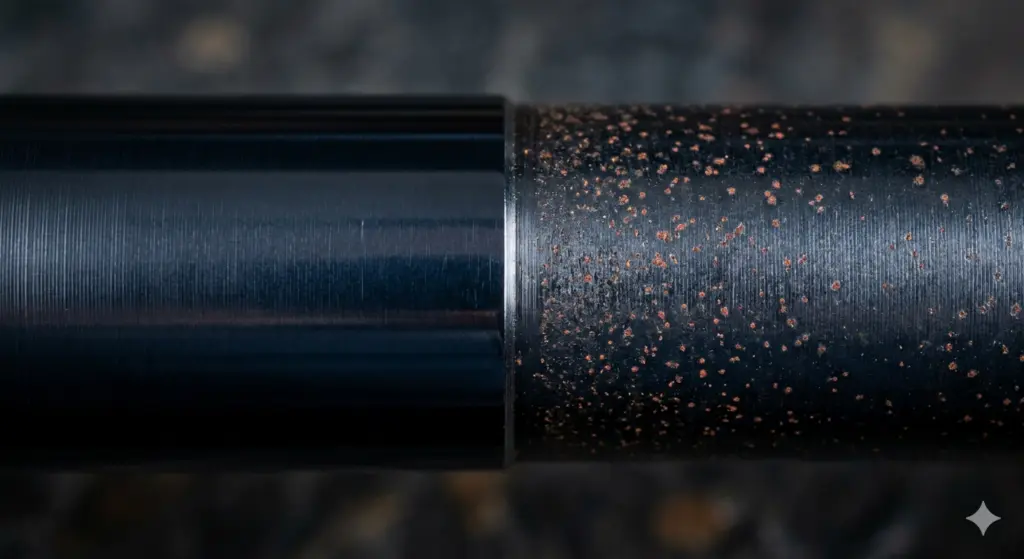
Early-stage rust on a blued surface appears as small reddish-orange spots or a general reddish cast to areas where the bluing is thinnest, typically at machined edges, the bore interior, and areas where mechanical contact has worn the surface finish. Left untreated, this progresses to active corrosion that deepens into the surface metal and becomes genuine pitting.
Pitting is the threshold beyond which damage is permanent. Surface rust that has not reached the pitting stage can be addressed with careful cleaning and protective oil application without permanent loss of surface condition. Pitted steel has lost metal, and that loss is irreversible without refinishing.
Case-Hardened Surfaces
Case hardening produces one of the most visually distinctive and historically significant surface treatments in firearms, creating the iridescent color patterns visible on older shotgun receivers and some rifle actions. The surface color pattern is a function of the carbon migration during the case-hardening process and cannot be recreated once lost.
Case-hardened surfaces are extremely sensitive to moisture because the thin hardened layer, while mechanically very hard, provides limited corrosion resistance. The surface color pattern begins to fade and gray with relatively modest humidity exposure over time. Once the original case-hardened surface has been oxidized away, the color pattern is gone permanently.
For any collection that includes original case-hardened pieces, humidity control is among the most critical preservation measures available.
Stainless Steel and Modern Finishes
Stainless steel alloys provide significantly better corrosion resistance than carbon steel with traditional finishes. Stainless steel is not immune to corrosion in extremely high humidity conditions (particularly in salt-air environments), but in normal residential storage conditions, it is much less vulnerable than blued steel.
Polymer-coated finishes such as Cerakote provide good moisture resistance and are the current standard for duty-grade and tactical firearms. These finishes do not corrode in the same way as metal finishes.
Even for firearms with modern, corrosion-resistant finishes, humidity control protects the barrel bore and internal components that may not be coated to the same standard as the exterior surfaces.
Wood Stocks and Grips
Wood stocks and grips are affected by humidity through the natural behavior of wood as a hygroscopic material. Wood absorbs and releases moisture to achieve equilibrium with the surrounding air, expanding when it gains moisture and contracting when it loses it.
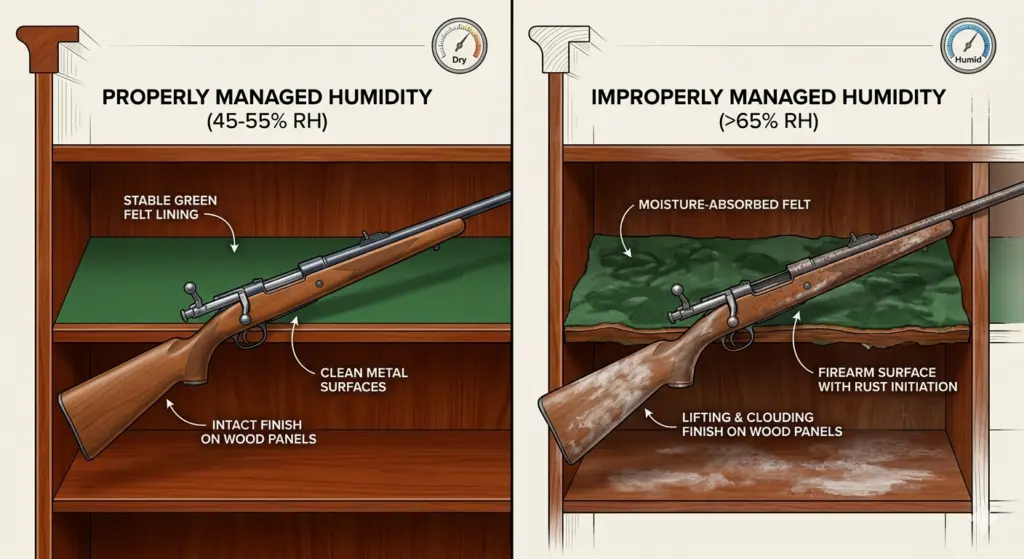
In high humidity: Wood swells. The stock may contact adjacent metal components more tightly than when dry, creating stress at the wood-to-metal interface. In extreme cases, swelling can crack the stock at points where expansion is constrained.
In low humidity: Wood shrinks. In finished stocks, the surface finish may crack as the wood beneath contracts. The wood-to-metal fit loosens, and the action fit within the stock changes dimensionally in ways that affect the rifle’s accuracy and function.
For antique stocks with period finishing products: Shellac, linseed oil, and similar historical finish products respond more dramatically to humidity variation than modern synthetic finishes. Older stock finishes may craze (develop a network of fine cracks) or lift from the wood surface in high humidity conditions. In very low humidity, they may pull away from the wood as the wood contracts beneath them.
What Humidity Does to the Wood Cabinet Itself
The humidity question has a second dimension that is unique to wood cabinets: the cabinet structure itself is wood, and it responds to humidity in the same ways as the wood stocks on the firearms inside.
Movement and Joinery Stress
A solid hardwood cabinet in a stable humidity environment is a dimensionally stable structure. The joinery maintains its precision; the panels fit their frames correctly; the drawers slide with the same resistance they had when new.
The same cabinet in an environment with significant humidity variation moves. The solid wood panels expand and contract with the seasons. The frame members change dimension. In a well-constructed frame-and-panel cabinet built with traditional methods, this movement is anticipated and accommodated: the panels are allowed to float within the frame grooves, and the wood movement does not stress the joinery.
In a poorly constructed cabinet, or in one exposed to extreme humidity swings, the dimensional changes can stress the joinery to the point of failure: glue joints open, panels crack at the center rather than the frame edges where they would crack cleanly, and the structure becomes less rigid over time.
Finish Behavior
The hand-applied finish on a Custom Cabinet Security piece is designed to protect the wood from direct moisture contact while allowing the wood to breathe. This finish performs its function correctly within the normal humidity range. In extreme humidity conditions, any finish can fail:
Very high humidity: Finish can lift from the wood surface if moisture penetrates from the end grain or from the back surface of a panel. White clouding or blushing in the finish is a sign of moisture interference with the finish film.
Very low humidity: The wood beneath the finish contracts while the finish, being less affected by humidity, does not contract proportionally. This creates internal stress that can crack the finish, particularly at corners and edges where the stress is concentrated.
Maintaining the interior humidity in the correct range protects the finish as well as the wood beneath it.
The Felt Lining
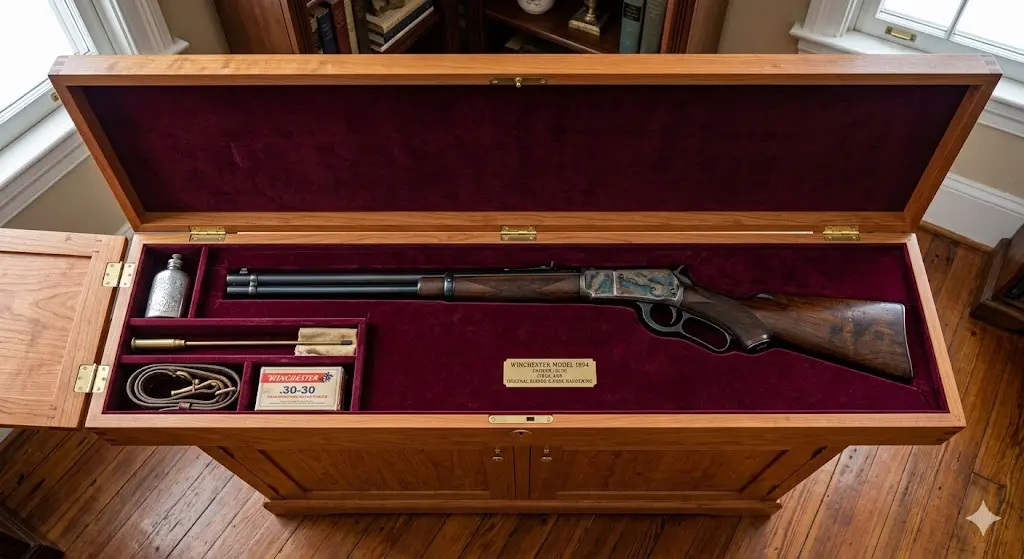
The red felt lining inside a Custom Cabinet Security piece protects the surfaces of the firearms it contacts. In elevated humidity conditions, felt can absorb and retain moisture, creating a humid microenvironment in direct contact with the firearm’s surface. This is one reason why the dehumidifier must be the primary humidity control rather than a supplemental measure: the felt itself can become a moisture source if the overall interior humidity is not managed.
The Golden Rod Dehumidifier: How It Works and Why It Is the Right Solution
A Golden Rod dehumidifier rod is an electrically powered resistance heating element designed for use inside enclosed storage spaces. It draws 10 to 20 watts of continuous power (depending on the length of the rod), operates at a surface temperature well below the threshold for any fire or material risk, and functions by a simple and reliable mechanism.
The Physics of Why It Works
When the rod gently warms the air inside the cabinet, two things happen simultaneously that are both beneficial.
First, the warmer air holds more moisture at the same relative humidity. This reduces the relative humidity of the air inside the cabinet without removing any moisture from the system. Air that was at 65 percent RH at 65 degrees Fahrenheit is at approximately 55 percent RH at 72 degrees Fahrenheit, all other things equal. This is a meaningful reduction in humidity driven by a modest temperature increase.
Second, the slightly warmer interior air means the cabinet’s surfaces are less likely to fall below the dew point. The dew point is the temperature at which air becomes saturated and deposits moisture on surfaces. By keeping the interior warmer than ambient, the rod reduces the risk of condensation on the metal surfaces of the stored firearms.
Sizing the Rod Correctly
Golden Rod dehumidifier rods are available in multiple lengths, and the appropriate length is determined by the cubic footage of the enclosed space. An undersized rod in a large cabinet does not warm the air sufficiently to provide meaningful humidity reduction. An oversized rod warms the air more than necessary and is more expensive to run without additional benefit.
The manufacturer’s sizing guidance matches rod length to cubic footage of storage space. For a Custom Cabinet Security cabinet, the rod is selected and integrated into the design at the appropriate size for the specific cabinet’s interior volume. The rod’s position at the base of the interior allows warm air to rise naturally through the storage space, distributing the effect throughout the cabinet.
The Operational Advantages of the Golden Rod
No consumables. Unlike desiccant products that absorb moisture and must be regenerated or replaced, the Golden Rod requires no maintenance input. It runs continuously on a small electrical draw.
Long service life. Golden Rod rods have service lives measured in decades, not months. There is no material fatigue, no chemical saturation, and no degradation that requires replacement under normal operating conditions.
Passive operation. Once installed and connected to power, the rod operates without attention. There is no monitoring schedule, no schedule-dependent regeneration, and no failure mode that requires the owner to notice and respond promptly.
Effective humidity maintenance. For a sealed or semi-sealed cabinet interior in a climate-controlled room, a properly sized Golden Rod maintains the interior humidity within the target range consistently.
What the Golden Rod Does Not Do
The Golden Rod is not a dehumidifier in the mechanical sense. It does not remove moisture from the air or from the cabinet. It raises the temperature of the interior air slightly, which reduces the relative humidity as a consequence of the physics described above.
This means the rod’s effectiveness depends on two conditions: the cabinet must be reasonably sealed, and the surrounding room must be in a humidity range that the rod can manage. A rod in a cabinet that is in a basement with 80 percent ambient humidity is working against a larger challenge than the same rod in a cabinet in a climate-controlled study with 50 percent ambient humidity.
Silica Gel Desiccants: Supplemental, Not Primary
Silica gel desiccant products are widely sold for use in gun safes and cabinets, and they are a legitimate supplemental tool in humidity management. They are not, however, an adequate primary solution for a wood gun cabinet.
How Silica Gel Works
Silica gel consists of a porous form of silicon dioxide that adsorbs moisture from the surrounding air. When the ambient humidity is high, the gel draws moisture in. When the ambient humidity is lower, the gel releases moisture. This bidirectional behavior is marketed as “two-way humidity control” by some products.
In a tightly sealed container of fixed volume, a properly sized silica gel product can maintain humidity within a target range by absorbing moisture when humidity rises and releasing it when humidity falls. In gun safes with rubber door seals, this approach can work reasonably well.
In a wood gun cabinet, where the wood structure itself participates in the humidity exchange, the behavior is more complex. The wood panels absorb and release moisture as conditions change, the felt lining participates similarly, and the resulting humidity environment is harder for a fixed-capacity desiccant to manage.
The Finite Capacity Problem
Silica gel desiccant has a finite moisture absorption capacity. When fully saturated, it stops absorbing and may begin releasing moisture back into the environment. The time to saturation depends on the cabinet’s interior volume, the ambient humidity, and the amount of desiccant present.
In a humid environment, desiccant may saturate in days to weeks. Once saturated, it provides no protection and requires regeneration (typically by heating in an oven) before it is effective again.
This creates an active management requirement: monitoring the desiccant’s saturation state, scheduling regeneration before saturation occurs, and ensuring the regeneration process is completed correctly. In practice, many owners allow desiccant to saturate and remain saturated without noticing, because the cabinet interior looks the same regardless of whether the desiccant is functioning.
When Desiccant Is Useful
Supplemental desiccant in addition to a Golden Rod provides a backup against humidity spikes that the rod alone might not fully suppress in high-humidity environments. For a cabinet in a room where ambient humidity regularly exceeds 65 percent, the combination of a properly sized rod and supplemental desiccant provides greater confidence in the interior humidity remaining in range.
For a cabinet without access to power (and therefore without a Golden Rod option), indicating silica gel (the type that changes color when saturated, providing a visual saturation indicator) is better than non-indicating products and allows more reliable monitoring of the desiccant’s functional state.
Using a Hygrometer to Monitor Cabinet Interior Humidity
A hygrometer is the tool that converts humidity management from guesswork to measurement. It provides the actual relative humidity reading inside the cabinet, which is the only reliable basis for knowing whether the humidity control is functioning correctly.
Types of Hygrometers for Gun Cabinet Use
Digital hygrometers are available in small, compact formats suited to placement inside a gun cabinet. Most display both temperature and relative humidity, typically accurate to within 2 to 3 percent. They require battery power, which means periodic battery replacement. Good digital hygrometers also include a min/max memory function that records the highest and lowest readings over a period, which is useful for identifying humidity spikes that occur at specific times (typically overnight when room temperatures drop) without requiring continuous monitoring.
Analog hygrometers use a mechanical sensing element and require no battery. They tend to drift over time and are generally less accurate than quality digital units. They can serve as a visual reference if calibrated against a known standard, but are not adequate for precise humidity monitoring.
Calibrating a Digital Hygrometer
The salt test is a reliable calibration method for digital hygrometers. Dissolve a small amount of salt in water and place it in a sealed container with the hygrometer. After several hours at a stable temperature, the air inside the sealed container reaches a stable relative humidity of 75 percent. If the hygrometer reads significantly above or below 75 percent, the offset can be applied to all subsequent readings or corrected via the hygrometer’s calibration adjustment feature.
A calibrated hygrometer placed in the center of the cabinet interior, away from the dehumidifier rod and away from the door seal where air exchange is highest, provides representative readings for the overall cabinet interior.
Reading the Hygrometer as a Routine Practice
Checking the hygrometer reading at regular intervals, along with a brief visual inspection of the cabinet interior, is the monitoring practice that catches humidity management problems before they cause damage.
A consistent reading of 45 to 55 percent RH indicates the system is functioning correctly. A reading above 60 percent indicates the humidity control is insufficient and requires investigation: the rod may be undersized, the cabinet may have an air gap allowing high-humidity air to enter, or the room environment may be more humid than the rod can manage alone.
A reading below 35 percent indicates the interior is too dry, which is possible in climates with very dry winters and high heating loads. In this situation, a small in-cabinet humidifier or a targeted room humidifier may be appropriate.
Cabinet Placement and Its Effect on Humidity Management
The location of the cabinet in the home is not independent of the humidity management question. Some placements create inherently harder humidity control challenges than others.
Best Placement for Humidity Stability
Interior walls in climate-controlled rooms: An interior wall is insulated from exterior temperature fluctuation on both sides by conditioned space. A cabinet on an interior wall in a heated and cooled room experiences the most stable temperature and humidity environment available in a residential setting.
Dedicated gun rooms or studies with consistent climate control: A room that is heated and cooled consistently, with no significant temperature swings overnight or during extended absences, provides a stable surrounding environment that the dehumidifier rod can manage with minimal demand.
Challenging Placements and What They Create
Exterior walls, particularly in basements: An exterior wall is subject to temperature gradients between the heated interior and the cold exterior. In winter, the wall surface behind the cabinet may be significantly cooler than the room air, creating a cold zone near the cabinet that increases relative humidity at those surfaces.
Unfinished or partially conditioned basements: Basement environments in most parts of the country are more humid than above-grade living spaces due to moisture migration through the concrete floor and walls. A cabinet in an unfinished basement is working against a fundamentally more challenging humidity environment than one in a finished, climate-controlled living space.
Garages: Garages are typically not climate-controlled and experience the full seasonal temperature range of the exterior climate. A wood gun cabinet in a garage is exposed to summer humidity at its seasonal peak, winter temperature extremes, and the condensation cycles that occur during rapid temperature changes. This is the most challenging placement for any high-quality gun storage.
For cabinets in challenging placements, the combination of a properly sized Golden Rod and supplemental desiccant provides the best available in-cabinet humidity management. But the most effective solution for a valuable collection and a quality cabinet is placement in a properly climate-controlled living space.
The placement guidance in our room-by-room guide to gun cabinet placement addresses this question in detail, including how to evaluate different rooms in the home for the factors that affect humidity stability alongside the other placement considerations.
Protective Oil as a Complement to Humidity Control
Interior cabinet humidity management is the foundational protection against corrosion. Protective oil applied to firearm surfaces adds a secondary layer of protection that works with the controlled environment rather than substituting for it.
Light protective oils applied to metal surfaces create a thin barrier that interrupts the moisture-to-metal contact even at the micro level. Appropriate products include quality gun oils designed for storage (Rem Oil, Break-Free CLP, Eezox, and similar products), applied as a thin, even wipe across all metal surfaces before the firearm is stored.
For antique and collector-grade pieces with original finishes: Renaissance Wax, a microcrystalline wax product used in museum conservation, provides stable, inert surface protection without affecting original patinas or finish character. This is the appropriate product for historically significant firearms where oil would discolor the original finish or where the oil’s long-term chemical interaction with period surface treatments is a concern.
Application frequency: In a properly humidity-controlled environment, a light application of protective oil before initial storage and refreshed annually during the regular inspection is sufficient. In a challenging humidity environment where the cabinet is working harder to maintain the target range, more frequent oil application provides additional insurance.
The Standard That Custom Cabinet Security Builds To
Custom Cabinet Security integrates the Golden Rod dehumidifier into every cabinet as a standard design element rather than as an optional add-on. This integration reflects a recognition that humidity control is not supplementary to the cabinet’s function. It is part of what makes the cabinet an appropriate home for a serious firearm collection.
The rod is sized for the specific cabinet’s interior volume, positioned at the base of the interior for optimal air circulation, and wired for the power connection at a location that does not interrupt the cabinet’s appearance or function.
This design approach means the collector who purchases any piece from the current collection receives a cabinet that is ready to maintain correct interior humidity from the first day it is connected. The conversation about adding humidity management later does not need to happen.
For collectors with specific questions about how a particular cabinet’s dehumidifier configuration works, or for buyers considering a custom piece where the cabinet’s interior volume and placement will affect the rod selection, the consultation process is the context for those specific technical discussions.
The Complete Routine: What Regular Maintenance Looks Like
For a collector who has a properly equipped cabinet in a reasonable placement, the ongoing maintenance routine for humidity management is not time-consuming. Here is what it looks like in practice.
Daily (or during each access): Note the hygrometer reading while the cabinet is open. A glance is sufficient if the reading is in range. A reading outside the target range warrants follow-up.
Monthly: Check the hygrometer more carefully. Review the min/max memory if the hygrometer has this feature to identify any periods outside the target range that occurred overnight or during any other time the cabinet was closed. Remove any desiccant for saturation check if supplemental desiccant is in use.
Annually: Conduct a full inspection. Check each firearm for any indication of surface corrosion, beginning at the bore (inspect with a bore light) and then the external surfaces. Check wood stocks for any checking, cracking, or finish lifting. Apply protective oil to all metal surfaces and refresh any stock oil or wax. Inspect the felt lining for any areas of damage or deterioration. Verify the Golden Rod is functioning by confirming the rod is warm to touch when the cabinet is opened.
This routine, maintained consistently, is what keeps a well-built cabinet and a serious collection in excellent condition through the years of ownership and into the generation that receives them.
The Bottom Line
Humidity management inside a wood gun cabinet protects two things simultaneously: the firearms stored inside and the solid hardwood cabinet that stores them. Both are affected by humidity in ways that accumulate invisibly until the damage is significant enough to see, and both are best protected by maintaining the interior in the 45 to 55 percent relative humidity range consistently.
The Golden Rod dehumidifier, sized correctly and integrated into the cabinet design, is the primary tool for achieving this. A calibrated hygrometer provides the monitoring to confirm it is working. Protective oil on firearm surfaces adds the secondary layer. Cabinet placement in a stable, climate-controlled room reduces the humidity challenge that the system must manage.
These are not complex requirements. They are the consistent practices that determine whether a significant investment in a collection and in a quality cabinet holds its value and condition across the years and decades of ownership they deserve.
Related Posts
View All
Uncategorized
Reading Time: 8 min
The Resale Value of a Custom Gun Cabinet: Does a Handcrafted Amish Safe Hold Its Value Over Time?
If you’ve ever bought a mass-produced gun safe from a big-box retailer, you already know what happens the moment it
Read More
Uncategorized
Reading Time: 11 min
Women Gun Owners: How to Choose a Gun Storage Solution That Fits Your Home’s Style Without Compromise
Key Takeaways The Storage Problem Nobody Talks About Walk into almost any sporting goods store and look at the gun
Read More
Uncategorized
Reading Time: 10 min
How to Protect Antique and Vintage Firearms in Wood Storage: What Collectors Need to Know About Climate and Finish
Key Takeaways Why Antique Firearms Demand a Different Standard of Storage Storing a modern production firearm and storing an 1860s
Read More
