31 Jul 2026 • Reading Time: 14 min
Key Takeaways
- Museum display design follows principles that private collectors can apply directly: controlled sightlines, intentional lighting, negative space, and organized grouping by theme or period all work at the residential scale with the right furniture and planning.
- Lighting is the single highest-impact variable in how a firearm display reads. The difference between a collection that looks flat and one that looks three-dimensional and significant is almost always lighting.
- Negative space, the empty area around and between displayed pieces, is not wasted space. It is what allows each piece to be seen individually rather than as part of a visual jumble.
- A firearm collection displayed with the same intentionality as museum objects communicates something specific to the viewer: these pieces matter, they were acquired with knowledge and care, and they deserve to be understood individually.
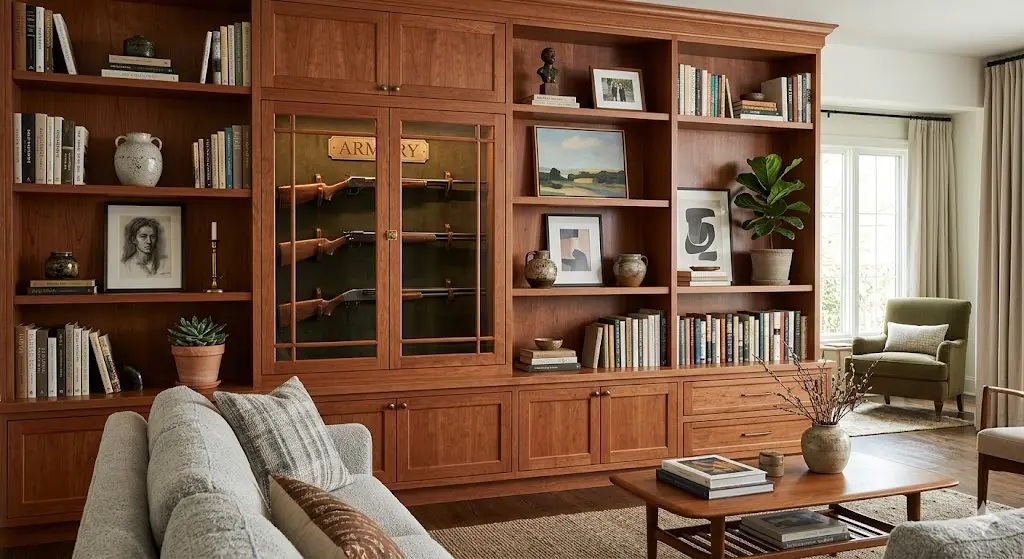
- The cabinet that houses the collection is part of the display, not a backdrop to it. A quality handcrafted cabinet in solid hardwood contributes to the presentation of the collection in the same way that a quality frame contributes to the presentation of a painting.
- Organization by theme, period, manufacturer, or acquisition story creates a legible narrative that guests can follow, turning a display into a guided experience rather than a wall of guns.
Why Collection Display Matters
A firearm collection that has been assembled with knowledge and care over years contains objects worth understanding individually. A pre-war Winchester lever-action with original case hardening. A matched pair of Colt single-action revolvers. A military surplus rifle with documented provenance from a specific conflict. Each of these pieces has a specific history, a specific aesthetic character, and a specific reason for being in the collection.
When these pieces are stored upright in a generic safe with foam barrel rests and no lighting, none of that specificity is visible. The collection exists but cannot be experienced.
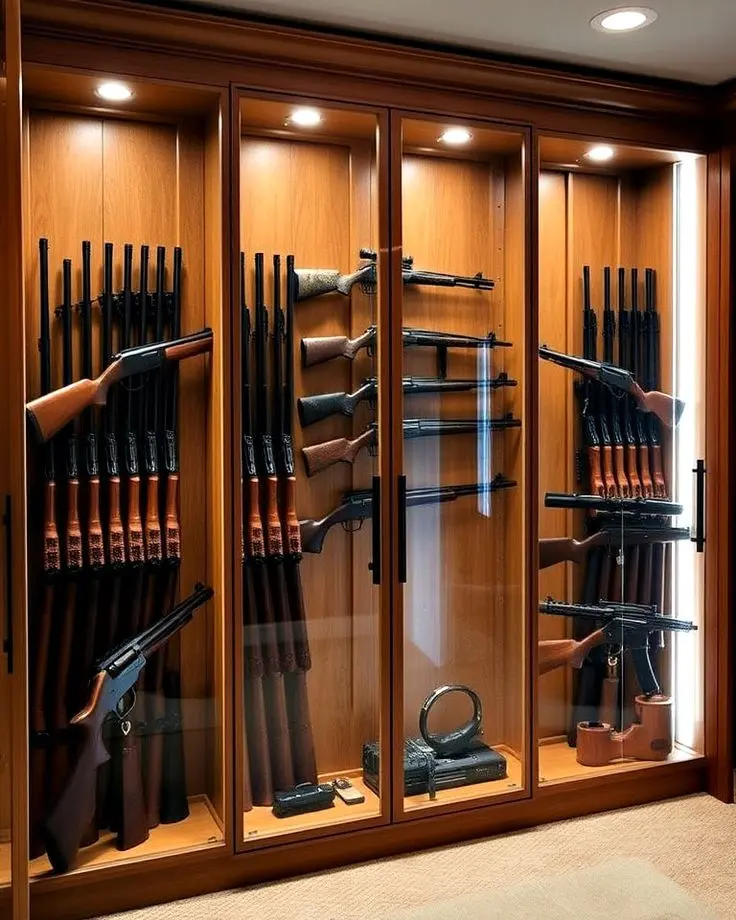
When the same pieces are displayed in a quality glass-front cabinet with intentional lighting, organized by a discernible logic, with appropriate spacing that allows each piece to be seen clearly, the collection becomes something that can be shared, appreciated, and understood by anyone the collector chooses to show it to.
This is the difference between storage and display, and it is a distinction that matters deeply to collectors who have spent years building something that deserves to be seen.
This post applies the principles that museum curators use to design compelling displays of historical objects to the private residential context of a serious firearm collection. These are not abstract ideas. They are specific, actionable decisions about lighting, spacing, organization, placement, and the cabinet itself.
Principle 1: Controlled Sightlines Begin With the Room
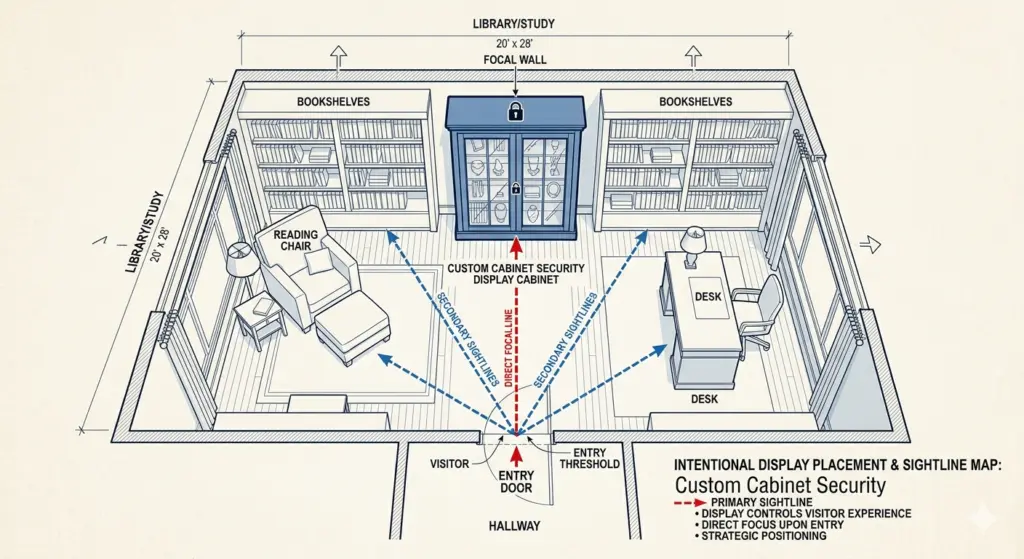
Before a single firearm is placed in a cabinet, the larger question is where the cabinet lives in the room and how visitors will encounter it. Museum curators call this the sightline problem: how do you control what the viewer sees, in what order, and from what distance?
Positioning the Cabinet as a Destination
A display cabinet positioned at the end of a natural sightline in a room draws the eye toward it intentionally. When someone enters the room, the cabinet is the first significant object they register. This is the effect museums achieve by placing major display cases at the end of gallery sightlines, drawing visitors through the space.
Practical applications:
- Position the cabinet on the wall directly opposite the room’s primary entry point when possible. A viewer entering the room sees the display immediately and the full cabinet is visible without turning.
- If the room has a natural focal point (a fireplace, a significant window), consider whether the cabinet should compete for focal status or relate to the existing focal point. A cabinet flanking a fireplace with symmetrical flanking bookshelves gives the fireplace its primacy while making the cabinet part of the room’s visual composition.
- Avoid positioning the cabinet where it is only visible from one specific angle or when standing in one specific location. A display that requires the viewer to find it is one that rewards curiosity but fails to announce itself.
Distance and Scale
Museums scale their cases to the objects displayed and to the viewing distance they expect. A case that holds large objects is typically larger, creating scale appropriate to what it contains. A case for small, fine objects may be smaller and positioned closer to the viewer.
For a mixed collection, the cabinet size should relate to the collection’s actual dimensions. A large collection in a modest cabinet looks crowded. A small collection in an oversized cabinet looks sparse. The right scale is the one that gives the collection appropriate presence in the room without overwhelming or underwhelming the space.
Principle 2: Lighting Is the Display
In museum design, the rule is that objects illuminate the room, not the room illuminates the objects. The gallery may be relatively dark in ambient light while the display case is brilliantly lit, which draws attention to the objects and creates the impression that the objects themselves are the light source.
This principle translates directly and powerfully to a residential firearm display.
The Effect of Interior Cabinet Lighting
A glass-front cabinet with no interior lighting reflects ambient room light inconsistently. Metal surfaces pick up whatever light happens to fall on them. Wood stocks are difficult to read in detail. The overall impression is of a collection behind glass rather than a collection presented for viewing.
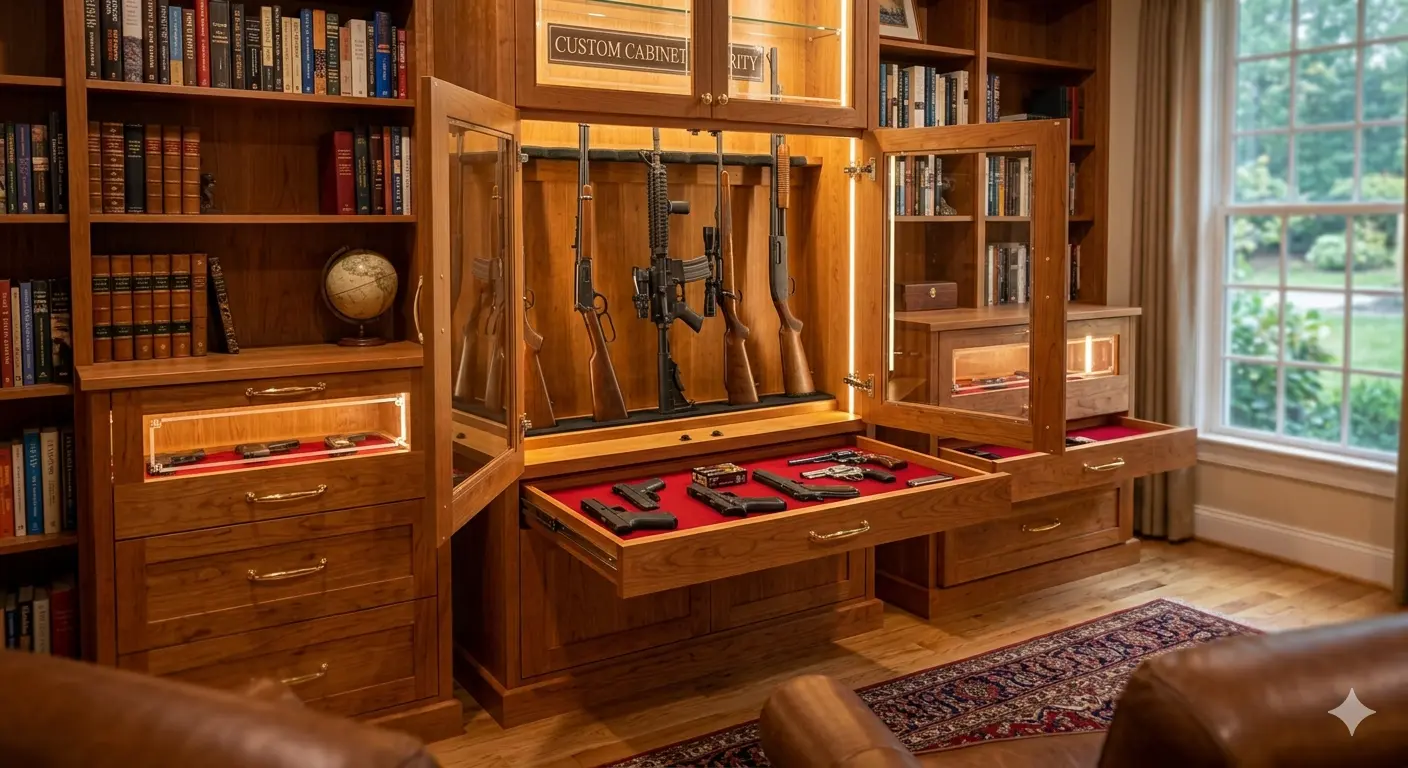
The same cabinet with LED lighting positioned above the display and aimed downward creates a completely different visual environment. Metal surfaces reflect the directed light source, revealing bluing depth, polished flats, and the dimensional character of machined surfaces. Stock wood reflects warmly, showing grain detail that is invisible without directed light. The pieces appear to occupy a specifically lit space, which draws the viewer’s attention toward them rather than through them.
This is not a subtle difference. The transformation of a collection’s visual presence through interior lighting is among the most dramatic improvements available, and it costs very little relative to its impact.
Types of Interior Lighting and Their Effects
LED strip lighting above the display: The most common and effective approach in a glass-front cabinet. LED strips positioned at the top interior of the cabinet, aimed downward and slightly forward, create consistent, even illumination across the display. LED produces minimal heat and very low UV output, which is important for protecting both the cabinet’s finish and any organic materials (leather, wood, fabric) in the display.
Angled directional lighting: A light source positioned at an angle to the displayed objects creates shadow on one side of each three-dimensional form, emphasizing its dimensionality in a way that flat, even light does not. Museum curators use directed light precisely because it makes objects appear more three-dimensional and more significant. An angled light source in a cabinet can create this effect.
Touch-control operation: Interior cabinet lighting that operates from a touch sensor rather than a switch inside the cabinet allows the display to be illuminated without opening the doors. This is the appropriate setup for a display that will be shown to guests: the collection is visible and illuminated through the glass without requiring physical access.
Custom Cabinet Security integrates LED touch-control lighting into display cabinets as a standard feature, positioned and specified to illuminate the interior effectively rather than as a visible fitting that competes with the objects displayed.
Managing Ambient Room Light
Interior cabinet lighting is most effective when the ambient room lighting is lower than the cabinet lighting. A room with very bright overhead lighting reduces the contrast between the illuminated interior and the surrounding space, which diminishes the drawing power of the display.
For a dedicated display room or a study where the collection display is a primary function of the room, consider lighting control options: dimmer switches on ceiling fixtures, floor and table lamps rather than overhead lighting as the primary ambient source, and window treatments that allow the room’s natural light to be modulated.
A display cabinet that is the brightest thing in the room when interior lighting is on is doing exactly what museum curators design toward. It is pulling attention to the collection.
Principle 3: Negative Space Is Not Empty Space
One of the counterintuitive principles of effective display is that the space between and around displayed objects is as important as the objects themselves. Negative space is the deliberate absence of objects, and it serves several functions that crowding eliminates.
What Negative Space Does for a Display
It allows individual reading. When objects are spaced with appropriate negative space between them, the viewer’s eye can isolate each piece and engage with it independently. When objects are crowded, the viewer sees the collection as a mass rather than as individuals.
It communicates value. Negative space is a signal of confidence in the objects displayed. Jewelry stores display their finest pieces with significant space between them. Museums display significant artifacts with ample negative space. Crowding communicates abundance at the expense of significance. Spacing communicates significance over abundance.
It allows light to work effectively. Lighting aimed at a crowded display creates complex shadows where nearby objects interfere with each other’s illumination. Lighting aimed at appropriately spaced objects illuminates each piece cleanly, without the visual noise of overlapping shadows.
It makes organization legible. When objects are spaced appropriately, the organization system used to arrange them is visible. When objects are crowded, the organization is obscured by the visual density.
Applying Negative Space in a Firearm Cabinet
The instinct when sizing a cabinet is to maximize capacity: find the cabinet that holds the most guns for the money. This instinct works against effective display.
A cabinet that holds fourteen rifles at a spacing where each stock is visible and each barrel has clear air on both sides presents fourteen rifles. A cabinet that holds eighteen rifles with minimal spacing presents a wall of guns in which individual pieces are difficult to distinguish.
For a collector who has invested significantly in the specific pieces in the collection, presenting those pieces clearly is more valuable than maximizing the count in a single cabinet. Consider:
- Are there pieces in the collection that are not display-worthy (working guns that are utilitarian rather than visually significant)? These may be better stored in a secondary cabinet or a steel safe, freeing display space in the primary cabinet for the pieces that deserve it.
- Is the collection large enough that two display pieces, each with appropriate negative space, would present the collection better than one crowded cabinet?
- Are there historical periods, manufacturers, or themes within the collection where a focused display of a smaller group tells a clearer story than a comprehensive but crowded display?
Principle 4: Organization Creates Narrative
A museum does not display objects in random arrangement. Objects are grouped by period, by culture, by type, by acquisition story, or by some other organizing logic that allows the viewer to understand what they are seeing in relation to what surrounds it.
For a firearm collection, the same principle produces a display that is legible and that can be shared meaningfully with guests who may not have the collector’s depth of knowledge.
Common Organization Logics for Firearm Collections
By historical period: Grouping firearms by manufacturing era creates a chronological narrative. Pre-war, wartime production, post-war sporting guns, modern period: viewers can read the display as a history of the manufacturer, the technology, or the period.
By manufacturer or type: All Colts together, all Winchesters together. Or all lever-actions together regardless of manufacturer. Or all military surplus rifles. This organization creates a focused statement about the collector’s specific interest within the broader world of firearms.
By acquisition story: Some collectors organize by the personal significance of how pieces entered the collection: inherited pieces in one section, pieces from a specific relationship or period of the collector’s life in another. This organization creates a personal narrative that is most meaningful to the collector but communicates the collection’s personal dimension to guests who know the stories.
By visual character: Organizing by visual similarity, pairing blued steel guns together and case-hardened guns together, or separating by stock material, creates visual groupings that reward aesthetic attention rather than historical or categorical knowledge.
By prominence: Museum curators often design a display so that the most significant pieces are positioned at eye level and at the focal points of the arrangement, with lesser pieces arranged in supporting positions. A firearm collection can be organized similarly: the most significant pieces at eye level in the center of the display, with supporting pieces radiating outward or positioned higher and lower.
Using Separation to Define Groups
When a cabinet is organized into multiple distinct groups, physical separation between the groups reinforces the organization. A small gap between a group of pre-war Winchesters and a group of post-war Winchesters tells the viewer that these are distinct categories. A continuous arrangement with no spacing suggests a single undifferentiated group.
Negative space between organized groups does double duty: it allows individual pieces to be read clearly, and it communicates the boundaries of the organizational categories.
Principle 5: The Cabinet Is Part of the Display
Museum curators select display cases with the same care they give to the objects displayed inside them. The case is not merely a container. It is the first thing the viewer encounters, and its quality communicates something about the significance of what it holds.
A steel safe with a vinyl exterior and foam barrel rests communicates utilitarian storage. A solid hardwood cabinet with hand-applied finish, quality joinery, and interior felt lining communicates that what it contains is valued at the level the enclosure suggests.
This is not superficial. The quality of the enclosure affects how viewers perceive the objects inside. Photographs of museum artifacts taken within their display cases show this consistently: the same object appears more significant in a well-designed case than it would sitting on an unfinished shelf.
What the Cabinet Contributes to the Collection’s Presentation
The wood species and finish create the visual register of the display. A cherry wood cabinet with hand-rubbed finish in a traditional study creates a warm, formal register that suggests the objects inside should be understood in a traditional context. A white oak cabinet in a contemporary room creates a different register that suggests the collection should be understood in a more contemporary context. Neither is wrong. Both are intentional.
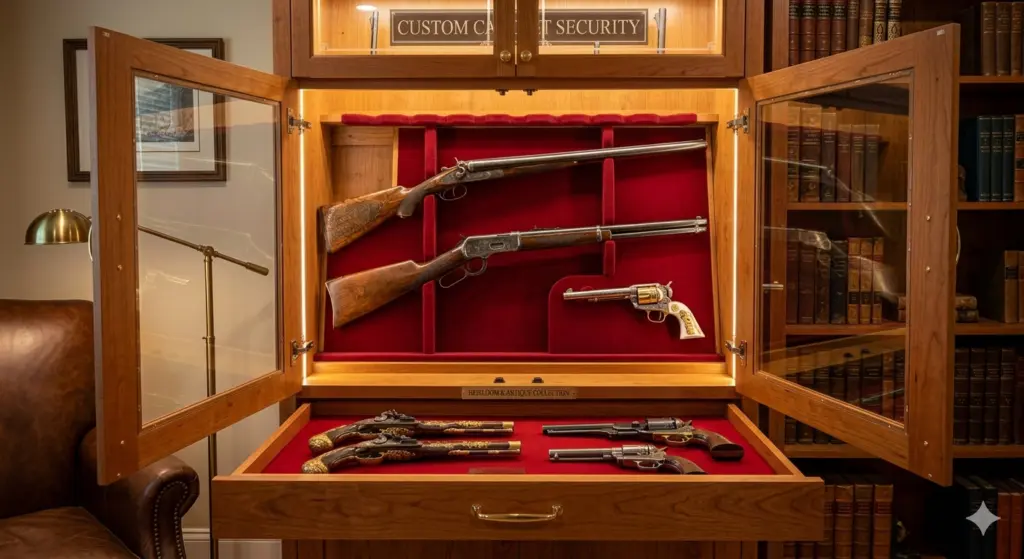
The interior lining color creates a background for the display. Red felt lining, as used throughout Custom Cabinet Security’s interiors, creates a rich, warm background that makes blued steel and dark wood stocks read clearly and appear more three-dimensional than they do against a neutral or light background. The lining choice is a curatorial decision.
The glass quality affects how clearly objects are seen. Bulletproof glass in a display cabinet is not only a security feature. High-quality glass with minimal distortion and appropriate anti-reflective properties allows the objects inside to be seen clearly rather than through a visible medium. Standard float glass has distortion and reflectivity that high-quality glazing does not.
The proportions of the cabinet affect the composition of the display. A tall, narrow cabinet creates a vertical display composition that emphasizes the length of long guns. A lower, wider cabinet creates a more horizontal composition that may suit a display of pistols and shorter firearms. The cabinet’s proportions are part of the display design, not independent of it.
The collection of cabinets available from Custom Cabinet Security represents different proportional configurations, wood species, and interior layouts that serve different collection types and display approaches. Understanding how each configuration contributes to the presentation of the specific collection it will house is part of what the selection and consultation process should address.
Principle 6: Documentation and Context Enrich the Display
Museum displays rarely present objects without context. A label, a brief explanatory text, a photograph, a map, or a related document provides the information that transforms an object from a thing to be seen into a story to be understood.
For a private firearm collection, formal museum labels are not typically appropriate. But the principle that context enriches display is directly applicable.
Ways to Add Context to a Private Display
A display book or binder: A companion volume that the viewer can consult while looking at the display, with a brief entry for each piece: acquisition date and source, historical significance, any documentation of provenance or original ownership. This transforms a showing of the collection into a guided experience.
A framed document or photograph: A photograph of the original owner, a historical document related to the firearm’s provenance, or a manufacturer’s record associated with a specific piece can be framed and displayed alongside the relevant firearm or in the display room more generally.
Oral narrative: For a collector who is physically present when showing the collection, the most effective context is the collector’s own account of each piece: how it came into the collection, what makes it significant, and what the collector finds interesting about it. A collection shown this way is not just a display. It is a conversation.
Acquisition notations inside the cabinet: For pieces with specific histories, a small acid-free card placed discreetly within the cabinet near the relevant piece can note the key provenance points for viewers who look closely.
These contextual elements are optional and depend entirely on the collector’s preference for how the collection is experienced. But for a collection that includes historically significant pieces, the addition of context makes the display exponentially more interesting to the range of viewers who encounter it.
Principle 7: Access Design Affects How the Display Is Used
A display that is difficult to access is one that is not accessed frequently, which means it is not maintained well, and which means guests are not shown it with ease.
Museum curators design for access as carefully as they design for presentation. Objects that are only shown under glass, never handled, are displayed differently than objects that are regularly retrieved for examination.
For a private firearm collection, access design involves:
Door operation: Hinged glass doors that open fully and stay open without a second hand are easier to use than doors that require the viewer to hold them or that close unexpectedly. Magnetic closures or quality detent hinges that hold doors open are preferable to doors that swing freely.
Retrieval path: Each firearm should have a retrieval path that does not require moving or touching other pieces. If retrieving the third rifle from the left requires moving two adjacent rifles, the display is not organized for easy access. The spacing and arrangement should give each piece a clear path from its position to the viewer’s hands.
Lighting that illuminates the retrieval process: The interior lighting should make it easy to see what you are reaching for and where adjacent pieces are. A dark interior where retrieval requires reaching into an uncertain space is both difficult and risks accidental contact with adjacent pieces.
Lock accessibility: The locking mechanism should be operable with one hand while the other steadies the door or the retrieved firearm. A lock that requires significant manipulation or two-hand operation is a friction point that reduces the ease of access.
These are operational rather than aesthetic considerations, but they affect how enjoyable and safe it is to use the display regularly, which affects whether the collection is displayed and shared as frequently as it deserves to be.
Bringing It Together: A Display Planning Checklist
For a collector who is planning a new display or rethinking an existing one, this checklist summarizes the actionable steps derived from the principles above.
Room and placement:
- [ ] Is the cabinet positioned where it is visible from the room’s primary entry point?
- [ ] Does the cabinet scale appropriately to the room and to the collection?
- [ ] Is the ambient room lighting controllable to create contrast with the cabinet’s interior lighting?
Lighting:
- [ ] Does the cabinet have interior LED lighting positioned to illuminate displayed objects from above?
- [ ] Is the lighting touch-controlled so the display can be illuminated without opening the doors?
- [ ] Does the interior lighting create shadow and dimensionality on the objects, or is it flat?
Negative space and organization:
- [ ] Does each displayed piece have appropriate spacing from its neighbors?
- [ ] Are the most significant pieces positioned at eye level at the focal point of the display?
- [ ] Is there a discernible organizational logic that a viewer can follow without explanation?
- [ ] Are there pieces in the display that would be better stored elsewhere, freeing space for the pieces most worth seeing?
The cabinet:
- [ ] Does the cabinet’s material and finish register match the room and the collection’s character?
- [ ] Is the interior lining color creating an effective background for the displayed objects?
- [ ] Is the glass quality allowing a clear view without significant distortion or reflection?
Context and access:
- [ ] Is there contextual material available for viewers who want to understand individual pieces?
- [ ] Does each piece have a clear retrieval path that does not require disturbing adjacent pieces?
- [ ] Is the door operation and lock mechanism easy to use with one hand while the other holds a firearm?
The Right Cabinet as the Foundation
All of the display principles above apply most effectively when the cabinet itself is well-designed for display purposes: quality glass that allows clear viewing, interior lighting that illuminates effectively, felt lining that creates an appropriate background, and proportions that allow appropriate negative space and organization.
This is the context in which a custom handcrafted display cabinet from Custom Cabinet Security serves the collector’s display goals. The cabinet is not just the container for the collection. It is the designed environment in which the collection is experienced, and its specific dimensions, wood species, interior configuration, and lighting are all variables that the craftsmen in Arthur can design around the specific collection and specific display goals of the specific buyer.
The custom consultation process is where this design conversation begins. A collector who has worked through the display principles in this post and who has a clear sense of how they want the collection to be experienced can come to that conversation with specific goals, and the craftsmen will design a piece that serves those goals.
The Bottom Line
A serious firearm collection displayed like a museum is not a pretentious thing. It is a statement that the objects in the collection have been assembled with knowledge and care and deserve to be understood individually rather than stored collectively.
The principles that curators apply to the world’s most significant objects scale directly and effectively to a residential collection in the right cabinet:
- Control the sightline so the display announces itself
- Light the cabinet so the objects illuminate the room
- Use negative space so each piece can be read individually
- Organize the display so it tells a story
- Choose a cabinet that participates in the presentation
- Add context so the display can be shared meaningfully
- Design the access so the display is used frequently
A collection displayed this way is not just stored. It is presented. And a collection that is presented with this kind of intentionality is one that the collector, their family, and their guests can genuinely enjoy for as long as the collection endures.
That is what the right cabinet makes possible, and it is what the craftsmen in Arthur build toward with every piece they make.
Related Posts
View All
Uncategorized
Reading Time: 8 min
The Resale Value of a Custom Gun Cabinet: Does a Handcrafted Amish Safe Hold Its Value Over Time?
If you’ve ever bought a mass-produced gun safe from a big-box retailer, you already know what happens the moment it
Read More
Uncategorized
Reading Time: 11 min
Women Gun Owners: How to Choose a Gun Storage Solution That Fits Your Home’s Style Without Compromise
Key Takeaways The Storage Problem Nobody Talks About Walk into almost any sporting goods store and look at the gun
Read More

Uncategorized
Reading Time: 10 min
How to Protect Antique and Vintage Firearms in Wood Storage: What Collectors Need to Know About Climate and Finish
Key Takeaways Why Antique Firearms Demand a Different Standard of Storage Storing a modern production firearm and storing an 1860s
Read More
