07 Aug 2026 • Reading Time: 14 min
Key Takeaways
- Inheriting a firearm collection triggers legal responsibilities that vary by state and by the type of firearms involved. Understanding what the law requires should be the first step before anything else is handled.
- The physical condition of inherited firearms should be assessed by someone qualified to evaluate them before any cleaning, restoration, or repair is attempted. Well-intentioned cleaning of an antique or collector-grade piece can permanently reduce its value.
- Storage for an inherited collection should be approached with the same seriousness as storage for a collection the new owner assembled themselves. Humidity, security, and organization all matter from day one.
- An inherited collection may have significant financial value that the estate documentation does not reflect. A formal appraisal by a qualified firearms appraiser is the appropriate step before any decisions about keeping, selling, or insuring the pieces.
- Preserving the historical and personal context of an inherited collection matters as much as preserving the physical condition of the pieces. The documentation and stories that accompany the firearms are part of what makes the inheritance significant.
- The decision to keep, sell, or transfer pieces from an inherited collection is a personal one with legal, financial, and sentimental dimensions. Making that decision well requires understanding all three before acting.
Important note: This post provides general educational information. Firearm laws vary significantly by state and locality, and they change over time. Consult with an attorney familiar with firearms law in your jurisdiction before taking legal action with inherited firearms.
The Situation Nobody Fully Prepares For
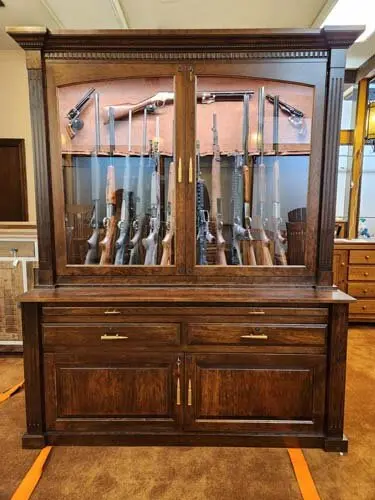
The notification comes in an unexpected form. A phone call. A reading of a will. A conversation with a parent who is settling their affairs. Someone has passed, or a family member is transferring their collection, and you are now the person who needs to figure out what to do with a cabinet full of firearms that you may or may not have expected to receive.
If the collection belonged to someone who was deeply knowledgeable about firearms, the transfer may come with documentation, organized storage, and clear records of what each piece is and what it is worth. More often, the transfer comes with a cabinet that was locked for years, a collection that was meaningful to the person who built it, and minimal documentation that explains what is there or what should happen next.
This situation is more common than most people realize, and it arrives at a moment when the recipient is already dealing with the emotional complexity of loss or major life change. The last thing most people want in that moment is to make a consequential mistake about firearms.
This post is designed to provide a clear, organized framework for the decisions and actions that an inherited collection requires, in the right order, so that nothing important is missed and nothing irreversible happens before it should.
Step 1: Understand What You Have Legally Before You Handle It Physically
The first and most important step with an inherited collection is legal, not physical. Before anything is moved, cleaned, assessed, or transferred, you need to understand what the law requires in your specific situation.
The Federal Framework
Under federal law, inheriting firearms is generally permitted without going through a Federal Firearms License (FFL) dealer for a transfer. Firearms inherited through an estate are typically exempt from the standard background check requirement that governs commercial sales and dealer transfers.
However, this general principle has specific limitations:
NFA items require special handling. Firearms regulated under the National Firearms Act (NFA) include short-barreled rifles, short-barreled shotguns, suppressors, machine guns, and destructive devices. These items are subject to registration with the Bureau of Alcohol, Tobacco, Firearms and Explosives (ATF), and the transfer of NFA items through an estate requires specific paperwork and ATF approval. An NFA item that is not properly transferred remains in violation of federal law regardless of how it was inherited.
Machine guns manufactured after 1986 cannot be legally transferred to civilians. If an inherited collection includes what appears to be a machine gun, this is a significant legal matter that requires immediate consultation with an attorney familiar with NFA law before the item is moved or stored.
Out-of-state transfers have additional requirements. If the collection is being transferred from a state different from the one where the recipient lives, the legal framework governing the transfer becomes more complex. Interstate transfer of handguns in particular typically requires going through an FFL dealer in the recipient’s state.
State Law Variations
State law adds another layer of requirements that vary significantly across jurisdictions:
- Some states require registration of inherited firearms regardless of federal requirements
- Some states have mandatory safety training requirements that apply to new owners
- Some states have waiting periods or permit requirements that affect what can be possessed or transported
- Some states have specific categories of firearms that are legal federally but restricted under state law
The only reliable source of guidance on the specific legal requirements in your situation is an attorney who practices firearms law in the relevant state or states. Online resources and general information are useful starting points but are not substitutes for specific legal counsel when the stakes are legal compliance.
The Practical First Step
Before handling the collection physically, determine: are there any items in the collection that could be NFA-regulated? Items that could qualify include any rifle with a barrel under 16 inches, any shotgun with a barrel under 18 inches, any suppressor or suppressor-like device, any item that appears to fire more than one round per trigger pull, and any item that seems unusually large or constructed differently from a standard firearm.
If any of these apply, contact an attorney before proceeding. If the collection appears to consist of standard commercial firearms (hunting rifles, sporting shotguns, handguns) with no unusual modifications, the general inheritance framework likely applies, but confirming this with a professional is still the responsible approach.
Step 2: Assess the Collection’s Condition and Character
Once the legal status is established, the physical assessment can begin. The goal of this step is to understand what you have before making any decisions about what to do with it.
What to Inventory
Go through the collection systematically and create a written record of each item:
- Make, model, and caliber or gauge
- Serial number (found on the receiver or frame of most firearms)
- Approximate condition (excellent, very good, good, fair, poor based on visual inspection)
- Any unique features, modifications, or accessories that accompany the piece
- Any documentation that accompanies the piece: original box, manuals, certificates of authenticity, provenance letters
Photograph each piece from multiple angles before handling it extensively. These photographs become the baseline condition record, which matters for insurance, appraisal, and future sale or transfer decisions.
The Critical Rule: Do Not Clean Anything Until You Know What You Have
This bears emphasis because it is the single most common well-intentioned mistake people make with inherited collections:
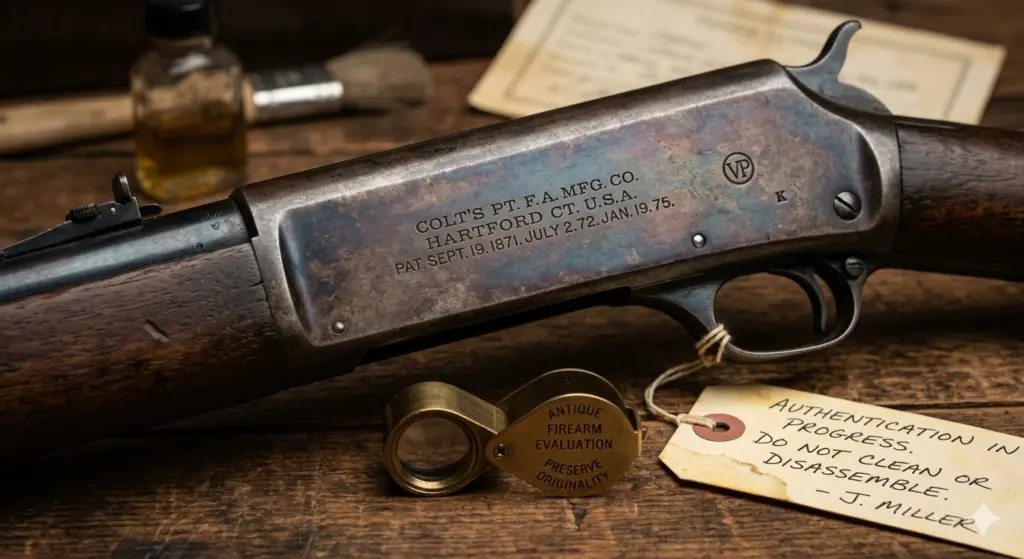
Do not clean, polish, or restore any firearm until its collector value has been established by someone qualified to assess it.
The patina on an old firearm, which may look like age and tarnish that should be cleaned off, is frequently a significant component of the piece’s collector value. A Winchester Model 1894 with 90 percent original blue and an untouched original stock is worth substantially more than the same rifle after a well-meaning cleaning that strips the patina and bright-polishes the metal.
The word “restoration” is similarly complicated. A firearm “restored” to factory-new appearance has usually been significantly devalued in the collector market. Collectors and appraisers use the term “original condition” to describe a firearm that shows honest age without being restored, and this condition is typically more valuable than one that has been actively refurbished.
Have an expert assess the collection before any cleaning or maintenance occurs. A qualified gunsmith who specializes in antique or collector-grade firearms, or a formal appraiser, can tell you which pieces should be left exactly as they are and which ones may benefit from careful cleaning by someone who knows how to do it without damaging collector value.
Identifying What Is Significant
Not every inherited firearm is historically significant or financially valuable in the collector market. But identifying which pieces are requires the same knowledge that the original collector may have had and that the inheritor may not yet possess.
Clues that a piece may have collector significance:
- Very old manufacture date (pre-World War II pieces are more likely to have collector interest)
- Unusual features, calibers, or configurations that differ from standard production
- Manufacturer markings, proof marks, or inspector cartouches that suggest government or military issue
- Original accessories, boxes, or documentation that add to provenance
- Family stories or documentation that connect the piece to a specific historical event or person
- Serial numbers that place the piece in a historically significant production window
A qualified appraiser is the appropriate resource for determining which pieces in an inherited collection deserve special treatment and what that treatment should be.
Step 3: Get a Formal Appraisal
An appraisal establishes the fair market value of each piece in the collection. This information is necessary for several subsequent decisions:
Estate settlement: If the inherited collection has financial value, that value may be relevant to the estate’s accounting, particularly for larger estates subject to estate tax.
Insurance: Your homeowner’s insurance policy almost certainly has limited coverage for firearms (typically $1,500 to $2,500 for theft under standard policies). For a collection with significant value, this limit may be vastly insufficient. An appraisal establishes the value that an appropriate insurance policy needs to cover.
Decision making: Deciding whether to keep, sell, or transfer specific pieces is much better made with accurate value information than without it. A piece that appears to be an ordinary hunting rifle may be a pre-war variant worth several thousand dollars. A piece that appears to be an exotic and impressive collection centerpiece may have more modest collector value. The appraisal tells you which is which.
Tax basis: For estate purposes, the appraised value at the time of inheritance establishes the tax basis for calculating capital gains if the pieces are later sold.
Finding a Qualified Appraiser
A qualified firearms appraiser has specific expertise in the categories of firearms being assessed. An appraiser who is expert in Western Americana antiques may not be the right choice for a collection of modern sporting rifles. An appraiser specializing in military surplus may not provide the most accurate valuation for a collection of fine sporting shotguns.
Sources for finding qualified appraisers:
- Auction houses that specialize in firearms (Rock Island Auction, James D. Julia, Morphy’s) have staff who conduct appraisals and are deeply knowledgeable about current market values
- The American Society of Appraisers and the Appraisers Association of America maintain member directories
- Local gun clubs and shooting organizations often know the experienced collectors and historians who have deep category knowledge
- Reputable gun dealers who handle high-end firearms can sometimes provide informal assessments, though a dealer opinion of value and a formal written appraisal for insurance or estate purposes are different things
For a collection of significant value, a written appraisal document with the appraiser’s credentials, methodology, and conclusions is the appropriate output.
Step 4: Secure the Collection Properly
While the legal and appraisal steps are being completed, the collection needs to be stored securely. This is not a step that should wait for the longer-term decisions to be made.
Immediate Secure Storage
Any collection being held during the transition period should be in locked storage that prevents unauthorized access. If the collection came with existing storage (a safe, a cabinet), assess whether that storage is adequate:
- Is the storage locked with a functional lock?
- Is the storage positioned where unauthorized persons (children, visitors) cannot access it without significant effort?
- Is the storage in an environment that is not subject to extreme humidity, temperature variation, or other conditions that could damage the collection?
If the existing storage is not adequate, temporary secure storage options include a rented safe deposit box for handguns and small items, or a temporary commercial safe purchase while the longer-term storage decision is being made.
Long-Term Storage for an Inherited Collection
Once the collection’s character, value, and legal status are understood, the long-term storage decision can be made with appropriate information.
The storage question for an inherited collection has dimensions beyond the purely functional:
If the collection includes historically significant pieces: The storage needs to protect the condition of those pieces over time. Humidity control, appropriate lining materials that will not chemically affect original finishes, and physical protection from contact damage are all relevant.
If the collection has emotional and personal significance: The way the collection was stored and displayed by the original owner may inform how the inheritor wants to store and display it. A collection that was displayed with pride by a father or grandfather may deserve a display that continues to honor it, rather than being locked away in a steel safe where it cannot be seen or shared.
If the inheritor plans to pass the collection forward: Storage that serves as a generational heirloom, that will still be appropriate and functional when the collection is eventually transferred again, is qualitatively different from storage that serves a shorter-term holding function.
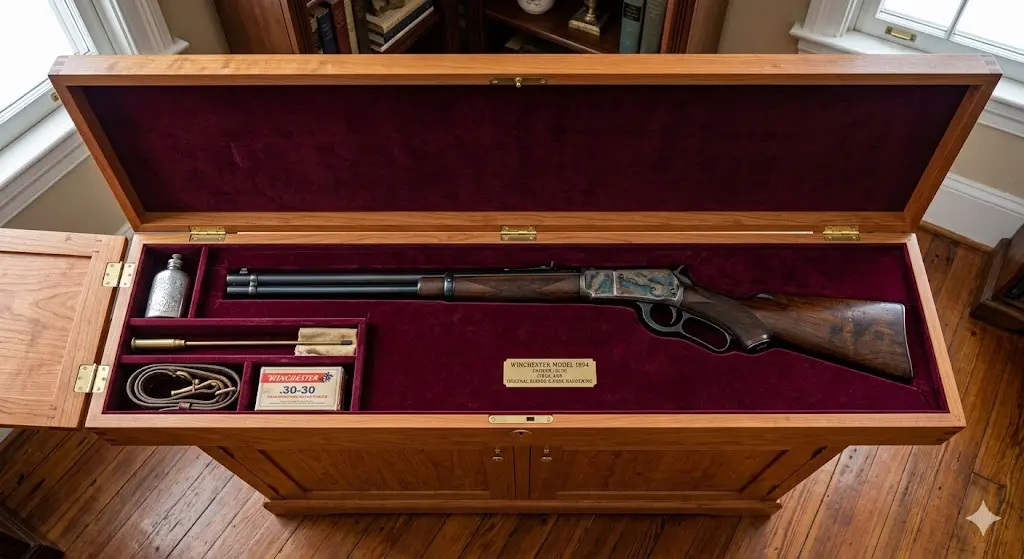
A custom handcrafted cabinet from Custom Cabinet Security addresses all of these dimensions: it provides genuine security, appropriate environmental conditions including integrated humidity management, and the furniture quality that allows the collection to be housed, displayed, and preserved in a way that honors what it represents.
The consultation process can be a conversation specifically about an inherited collection: what it contains, what its character is, and what storage format would serve both the collection’s preservation needs and the inheritor’s desire to honor what they received.
Step 5: Address the Insurance Gap
The gap between standard homeowner’s insurance coverage for firearms and the actual value of a meaningful collection is one of the most common and most significant practical oversights in collection management, inherited or otherwise.
Standard Coverage and Its Limits
Most homeowner’s and renter’s insurance policies include what is called “other structures” or “personal property” coverage that applies to firearms, but with specific sublimits for theft. A typical policy’s firearms theft sublimit is $1,500 to $2,500.
For a collection appraised at $15,000 or $50,000 or $150,000, this is a serious underinsurance situation. If the collection is stolen, the policy pays the sublimit and the remainder of the loss is unrecovered.
Options for Appropriate Coverage
Scheduled personal property endorsement: Adding a rider to the homeowner’s policy that specifically lists each firearm at its appraised value. Each listed item is covered at the scheduled value rather than the sublimit. This requires the appraisal to establish the values.
Specialty firearms or collectibles insurance: Several insurers specifically serve the collector market with policies designed for high-value collections. These policies typically provide broader coverage (including mysterious disappearance, accidental damage, and coverage while in transit) at values that match the appraised collection.
Documentation for any coverage: Any firearms insurance, whether a standard policy endorsement or a specialty policy, benefits from having detailed documentation: the inventory list, serial numbers, photographs, and appraisal documents. This documentation supports claim processing and reduces the likelihood of claim disputes.
Review the existing insurance coverage on any inherited collection and contact your insurer about what the current limits are and what options exist for appropriate coverage. Do this before any other decisions about the collection’s storage or disposition are made.
Deciding What to Do With the Collection: The Three Paths
With legal compliance established, an appraisal completed, secure storage in place, and insurance appropriately updated, the inheritor is in the best possible position to make considered decisions about what to do with the collection.
The three general paths forward are keeping, selling, and transferring. Most inheritors use a combination.
Keeping All or Part of the Collection
Keeping pieces from an inherited collection is the most personally meaningful path, and it is the appropriate path for pieces with personal significance, historical importance, or financial value that warrants long-term stewardship.
Keeping a collection responsibly means:
- Securing it appropriately with storage that protects it physically and provides appropriate environmental conditions
- Insuring it at appropriate value
- Understanding and complying with applicable legal requirements in your jurisdiction
- Maintaining awareness of any ongoing legal changes that affect what is permissible
- Thinking about the eventual transfer of the collection to the next generation
Pieces that the inheritor intends to use (for hunting, range use, or self-defense) should be evaluated for mechanical condition and safety by a qualified gunsmith before use, even if the pieces were regularly used by the previous owner.
Selling Pieces That Are Not Being Kept
Selling pieces from an inherited collection is entirely appropriate and, for very large or highly valuable collections, may be the most responsible stewardship of the estate’s assets.
Selling through appropriate channels:
Auction: Specialist firearms auction houses provide access to the collector market and typically achieve the strongest prices for collector-grade pieces. The auction process takes time but is the appropriate channel for pieces with significant collector value.
Licensed dealer (FFL): Selling to or through a licensed dealer is the safest and most legally straightforward way to transfer firearms. The dealer handles the background check and transfer documentation requirements.
Private sale: Private party sales are permissible in most states for long guns without going through a dealer, though state laws vary. Handgun private sales have additional requirements in many states. Consulting state law before a private sale is the appropriate step.
What to avoid: selling or giving firearms to private individuals without appropriate compliance with applicable state law. The consequences of an improperly transferred firearm are potentially serious for the transferor as well as the recipient.
Transferring Pieces to Other Family Members
Family members who are legal firearms owners in their state of residence can receive pieces from an inherited collection, subject to the same legal framework that governs any firearms transfer. The applicable requirements vary by state.
NFA items transferred to family members require ATF approval as noted above, regardless of the family relationship. This process requires time, paperwork, and may involve a tax payment to the ATF.
Preserving the Collection’s Story
Of all the aspects of an inherited collection, the one most commonly neglected in the practical focus on legal and physical handling is the preservation of the collection’s story.
A firearm is an object. A firearm with documented history, personal provenance, and a recorded account of why it mattered to the person who owned it is a legacy.
What should be preserved:
- Any written documentation that accompanied specific pieces (original purchase receipts, correspondence, provenance letters)
- Photographs of the original owner with pieces from the collection
- The original owner’s own account of the collection, if any was recorded (interview recordings, written notes, letters)
- The inheritor’s own memories of conversations about specific pieces
- Any certificates of authenticity or historical documentation
What should be created if it does not exist:
- A written description of each piece that includes whatever is known about its history within the family
- A record of how the collection came to the inheritor and the circumstances
- Any family stories that connect specific pieces to specific events or people
This documentation is part of what transforms a collection of firearms into a family heirloom. Without it, the next transfer of the collection to the following generation loses the thread of meaning that connects the objects to the people and the history they represent.
Custom Cabinet Security’s heirloom gun cabinet collections and custom pieces can include document storage as part of the interior design, so the historical record is housed alongside the collection it documents.
The Emotional Dimension Nobody Talks About
Inheriting a firearm collection is not only a legal and logistical event. For many people, it is one of the more emotionally complicated aspects of receiving a family member’s estate.
A collection represents decades of a person’s interests, knowledge, relationships, and judgments. Going through it is, in a real sense, going through a piece of who that person was. It can bring forward memories, unresolved feelings, and a complicated mix of grief and responsibility.
There is no obligation to make every decision about an inherited collection immediately. The legal requirements around secure storage and compliance need to be addressed promptly, but the decisions about what to keep, how to display it, and what to do with the pieces that will not be kept can be made thoughtfully over time.
Handling inherited pieces with care, getting them appropriately assessed, and taking the time to understand what the collection meant to the person who built it before making decisions about what it will mean going forward: these are acts of respect that the moment deserves.
The decision to house an inherited collection in a quality display cabinet from Custom Cabinet Security is, for many inheritors, partly a practical decision and partly a way of honoring what the collection represents. A piece that was important to a parent or grandparent, displayed in a well-crafted cabinet in a living space where it can be seen and shared, continues to be present in the family story rather than being locked away in an anonymous box.
That is a choice worth making consciously.
A Step-by-Step Summary
For inheritors who want a clear sequence to work through:
- Before anything else: Identify whether any items may be NFA-regulated. If yes, consult an attorney before proceeding. If no, confirm applicable state law requirements for the inherited transfer in your jurisdiction.
- Inventory the collection: List each piece with make, model, caliber, serial number, and condition. Photograph everything.
- Do not clean or restore anything until an expert has assessed each piece’s collector value and recommended treatment.
- Secure the collection in appropriate locked storage with humidity control while other steps are being completed.
- Get a formal appraisal from a qualified firearms appraiser or specialist auction house.
- Review insurance coverage and obtain appropriate coverage for the appraised collection value.
- Make decisions about keeping, selling, and transferring individual pieces, with legal guidance as appropriate.
- Preserve the documentation and stories that accompany the collection before they are lost with the passage of time.
- Make long-term storage arrangements that serve both the collection’s preservation needs and the inheritor’s desire to honor what they received.
For guidance on appropriate long-term storage that serves an inherited collection’s character and value, the consultation process at Custom Cabinet Security is the right conversation to have. The craftsmen in Arthur build pieces specifically for collectors who want to honor a collection, and an inherited collection that deserves to be treated as a family heirloom is exactly the kind of situation their work is designed for.
The Bottom Line
Inheriting a firearm collection is a responsibility that arrives without a manual. The legal requirements are real and vary by jurisdiction. The physical condition of the collection may be in a state that requires expert assessment before anything is done to it. The financial value may be significantly different from what appears evident without professional appraisal. And the personal significance of what has been transferred is something that deserves to be honored, not rushed past in the practical press of administration.
Working through these steps in the right order, with appropriate professional guidance at each stage, produces the right outcomes: a collection that is legally compliant, physically preserved, appropriately valued, correctly insured, and stored in a way that honors what it is.
That is what responsible stewardship of an inherited collection looks like. And it is worth doing well.
Related Posts
View All
Uncategorized
Reading Time: 8 min
The Resale Value of a Custom Gun Cabinet: Does a Handcrafted Amish Safe Hold Its Value Over Time?
If you’ve ever bought a mass-produced gun safe from a big-box retailer, you already know what happens the moment it
Read More
Uncategorized
Reading Time: 11 min
Women Gun Owners: How to Choose a Gun Storage Solution That Fits Your Home’s Style Without Compromise
Key Takeaways The Storage Problem Nobody Talks About Walk into almost any sporting goods store and look at the gun
Read More
Uncategorized
Reading Time: 10 min
How to Protect Antique and Vintage Firearms in Wood Storage: What Collectors Need to Know About Climate and Finish
Key Takeaways Why Antique Firearms Demand a Different Standard of Storage Storing a modern production firearm and storing an 1860s
Read More
