18 Sep 2026 • Reading Time: 11 min
Key Takeaways
- A military or law enforcement collection is not a collection in the conventional sense. The firearms it contains are often direct physical connections to specific events, specific assignments, and specific periods of a service career that cannot be replicated or replaced.
- Service sidearms, issue rifles, retirement pieces, and personally owned duty firearms each have specific storage and display requirements that reflect both their practical character as working firearms and their significance as career artifacts.
- A custom gun cabinet for a service collection is designed around the specific pieces in that collection, including non-standard configurations, unusual dimensions, and accessories that standard storage cannot accommodate well.
- The significance of a service collection extends beyond the firearms themselves to the documentation, insignia, and context that connect each piece to the career events it represents. The best storage solutions for these collections accommodate both the firearms and the associated context.
- Military and law enforcement collections are often the most appropriate of any collection type to be displayed and explained to family. The context and stories behind the pieces make the display an act of preservation and transmission rather than simply a security decision.
- For veterans and officers considering how to preserve a career collection for the next generation, the storage piece itself becomes part of the legacy: a solid hardwood cabinet built to last generations is the right housing for a collection assembled over a career.
The Collection That Nobody Else Has
A serious civilian collector builds a collection through the market: auctions, dealers, private sales, and deliberate acquisitions based on knowledge and preference. The collection reflects the collector’s taste, their knowledge of specific manufacturers, periods, and configurations, and the opportunities the market provided.
A military or law enforcement officer’s collection is built differently. Some pieces were issued, carried in specific places, and involved in events that can be described precisely. Some were acquired as retirement or service recognition gifts from colleagues who knew what would be meaningful. Some were personally purchased for duty or backup use and carry associations with specific assignments or periods of service that have nothing to do with the firearms market.
The result is a collection whose significance is largely intrinsic rather than market-driven. A commercial version of the same pistol might be worth a specific dollar amount. The personally issued service sidearm carried through a specific deployment is worth something entirely different to the officer who carried it, and that worth does not appear in any pricing guide.
This distinction matters for storage because it means the collection deserves housing that reflects its actual significance, not its market significance. A handcrafted cabinet from artisans who take their work as seriously as a service career was taken is the appropriate housing for a collection assembled through years of service.
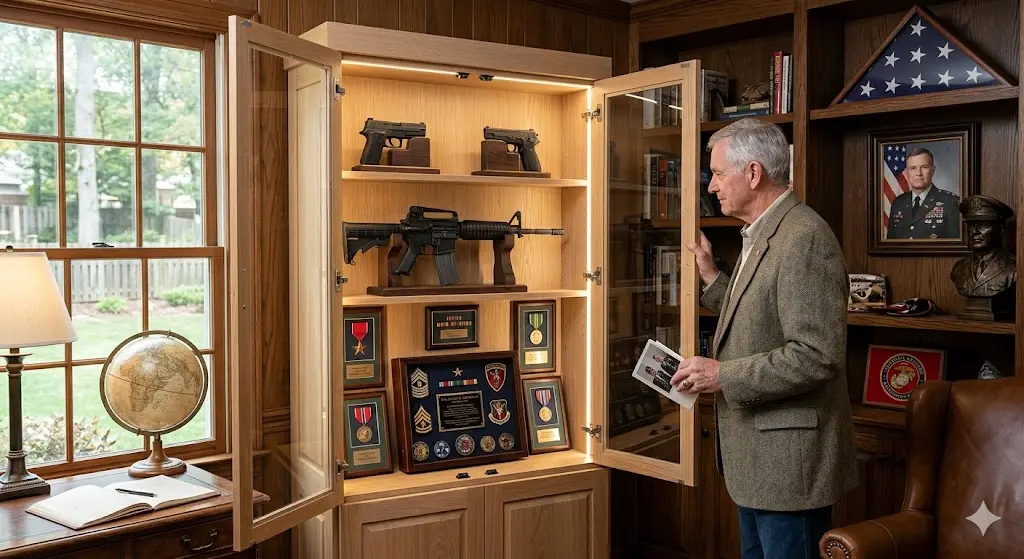
What Makes a Service Collection Distinct From a Civilian Collection
Understanding the specific character of military and law enforcement collections clarifies why standard storage approaches often fall short and what a purpose-configured cabinet needs to address.
Issue and Duty Firearms
The most significant pieces in most service collections are the firearms actually carried and used in the course of duty. For military veterans, this typically includes the service rifle (most commonly an M16 or M4 variant for those who served in the modern era), the service sidearm (typically an M9 Beretta for those who served in the relevant period, or a SIG Sauer P320 for more recent service), and in some cases specialty weapons associated with specific roles or units.
For law enforcement officers, the duty collection typically centers on the primary service pistol carried over the course of a career, which may include multiple generations of department-issued or personally approved sidearms as the officer’s career spanned different issue standards.
The storage consideration: These firearms often carry accessories associated with their service role: optics, weapon lights, suppressors where applicable, or specific holster configurations. Standard storage that accommodates the bare firearm may not accommodate the firearm as it was actually configured in service.
A custom cabinet configuration accounts for the specific dimensions of service firearms in their actual service configuration, including mounted accessories that increase overall dimensions beyond what a bare firearm would require.
Retirement and Recognition Pieces
Many service careers produce specific recognition firearms: a departmental pistol engraved with the officer’s name and retirement date, a unit-presented shotgun, a challenge coin display piece with an associated firearm, or a service rifle presented with official recognition. These pieces frequently have engraving, custom grips, or special finishes that mark them as recognition pieces rather than standard issue equipment.
The display consideration: Recognition pieces are among the most natural candidates for display in a glass-front cabinet, because the specific engraving, presentation, and finish work that makes them recognition pieces is meant to be seen. These are pieces whose significance is communicated visually, and displaying them in a visible format honors the recognition they represent.
The interior configuration for recognition pieces should position them prominently, with appropriate spacing that allows the specific details of engraving or finish to be appreciated rather than crowded against adjacent pieces.
Training and Qualification Firearms
Many service members and officers maintain personally owned firearms that were used in training and qualification settings. These may not be the issue piece but are closely associated with specific qualification milestones, specific training programs, or specific instructors who had meaningful influence on the officer’s professional development.
These pieces are meaningful to the owner in ways that are not always obvious to others but are entirely real. Their inclusion in the collection, and their placement in the display, reflects the officer’s own accounting of what matters from their career.
Decommissioned and Transfer Pieces
Some service collections include legally decommissioned and transferred former issue pieces that the officer was able to acquire through official programs. Department buy-back programs, official sale of retired equipment, or other authorized transfer channels create opportunities for officers to acquire the actual piece they carried rather than a commercial equivalent.
These pieces have specific provenance that distinguishes them from commercial versions of the same firearm. The provenance is part of their significance and should be documented and preserved alongside the physical piece.
The Documentation and Context Problem
One of the distinctive challenges of military and law enforcement collections is that the firearms themselves carry meaning that is not visible in the physical object. A standard M9 pistol is a standard M9 pistol to anyone who does not know its history. The same pistol carried through a specific deployment by a specific officer on a specific date has a significance that the physical object alone cannot communicate.
This is why documentation and context are as important as the physical storage for a service collection.
What Documentation Should Accompany a Service Collection
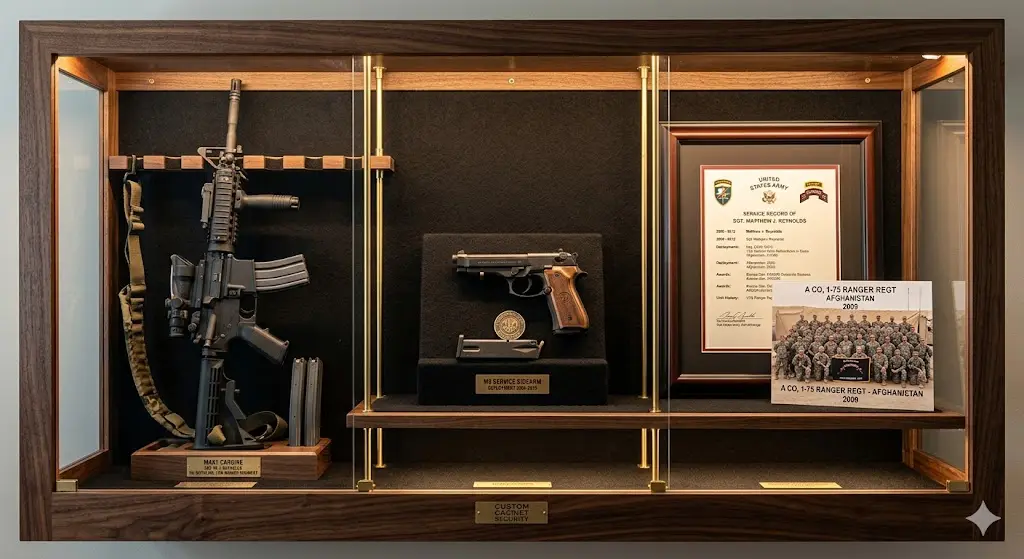
Service records connecting specific pieces to specific periods: A notation that identifies the serial number of the service sidearm with the deployment period, unit, and specific assignment during which it was carried transforms the firearm from an undifferentiated example of the type into a specific artifact with verifiable provenance.
Photographs: Images of the officer carrying or using the specific piece in a service context are among the most powerful forms of documentation. A photograph of the officer in uniform with the pistol on their hip, or with the service rifle in a training context, creates a visual connection between the physical object and the career event that no written description fully replaces.
Certificates, orders, and official documentation: Retirement orders, unit citations, qualification certificates, and other official documents that reference the service period associated with specific pieces provide formal documentation of the career context.
Personal accounts: A written account of the career events associated with specific pieces, in the officer’s own words, is the documentation most likely to be valued by the next generation who receives the collection. The facts of a deployment or assignment are documented in official records. The personal experience of carrying a specific firearm through specific events is documentation that exists only in the officer’s memory and deserves to be written down while it can be.
How the Cabinet Can House Documentation
A custom cabinet configuration for a service collection can include a dedicated section for documentation display: a framed card with the service history of each piece visible alongside the firearm, a dedicated shelf or drawer for associated documentation, or a display arrangement that incorporates photographs or shadow box elements.
The collection and its documentation belong together in the display, because the documentation is what gives the collection its full meaning.
Specific Storage Considerations for Common Service Firearms
Different service firearms have specific storage requirements that a custom cabinet can be configured to address.
Service Rifles and Carbines
The M16 and M4 families of service rifles have a specific profile that creates predictable storage considerations:
- Overall length in the stored configuration depends on whether the stock is collapsed or extended, and whether any accessories (optics, lights, forward grips) are mounted
- The carrying handle or optics rail height creates a specific clearance requirement above the action
- Some service members stored the lower receiver disassembled from the upper for transport or storage; the cabinet configuration should accommodate whichever configuration the owner prefers
Bolt-action service rifles (for those who carried precision platforms in specialized roles) have longer overall lengths and potentially very large objective optics that create significant clearance requirements at the top of the storage space.
Service Sidearms
Standard service pistols (M9, P320, Glock variants issued by departments) are relatively compact and do not create unusual storage challenges in terms of overall dimensions. The specific considerations for service sidearms relate more to accessories:
- Weapon lights mounted to the rail increase the overall footprint of the pistol and may not fit in standard pistol drawer compartments designed for bare pistols
- Extended magazines or department-specific accessories associated with the piece may be part of the display
- The holster associated with the service piece, particularly a retired duty holster from the same era, adds context to the display
Shotguns in Law Enforcement Collections
Many law enforcement officers’ service collections include department shotguns, particularly patrol shotguns that were regularly part of their equipment during specific periods of their career. Pump-action patrol shotguns in 12 gauge are the most common type, typically with 18 to 20-inch barrels and a folding or pistol grip stock configuration that may differ from the standard field shotgun profile.
These pieces fit within standard long gun cabinet configurations but may have accessories (extended magazine tubes, side-saddle shell carriers, specific stock configurations) that affect their actual stored dimensions.
Wood Selection for a Service Collection Cabinet
The wood species chosen for a service collection cabinet communicates something specific about the collection and the career it represents.
White Oak: The Neutral Professional Choice
White oak’s neutral, open-grained character works across a wide range of interior settings and does not push toward warmth or formality in the way that cherry does. For a veteran or officer whose home has a more contemporary or transitional character, white oak provides the furniture quality and permanence appropriate for a significant collection without the formality of cherry.
White oak is also consistent with certain institutional and governmental visual registers: the open grain and neutral tone have a working quality that relates to professional environments rather than suggesting the more decorative tradition of formal furniture.
Cherry: For Formal Recognition
If the collection is centered in a traditional study, library, or formal room where the aesthetic register calls for refinement and warmth, cherry’s deepening reddish-brown and fine grain provides the appropriate visual character for a piece that is meant to honor a significant career.
Cherry in a formal room with leather furniture, framed commendations, and the other elements of an officer’s or veteran’s personal gallery creates a visual environment that communicates the significance of the career it documents.
Hickory: For Character and Directness
Some veterans and officers have a personal aesthetic that is direct, unpretentious, and characterful rather than formally elegant. Hickory’s bold grain variation, American hardwood identity, and working-tool tradition make it the natural fit for this kind of personal character.
A hickory cabinet in a study that reflects a career of direct service, without pretension and with genuine pride, is the right visual expression for that specific person and that specific career.
The species choice is a personal expression of the career’s character, made by the person who built the career.
Display Formats for Service Collections
The appropriate display format for a service collection depends on the owner’s priorities and the specific character of the collection.
Glass-Front Display: When the Career Should Be Seen
For veterans and officers who want the collection to be visible, who plan to share it with family and explain its pieces, or whose service career is an important part of their personal identity in their home environment, a glass-front display cabinet with LED lighting creates the appropriate presentation.
The collection displayed in a lit, visible cabinet is a collection that is actively present in the daily life of the home. It invites questions. It creates opportunities to explain the significance of specific pieces to children and grandchildren. It is a form of documentation as much as it is a form of storage.
For the most significant pieces in a service collection the retirement firearm with its specific engraving, the service sidearm from a specific deployment, the recognition piece that came with a specific commendation visible display in a quality cabinet is the presentation that honors the significance of what the piece represents.
Solid-Door Cabinet: When Privacy Is Preferred
Many veterans and law enforcement officers prefer not to advertise their firearms to general visitors, or simply prefer the more private relationship with the collection that a solid-door cabinet provides. The pieces are present, accessible, and cared for. They do not need to be visible to every person who enters the room.
A solid-door cabinet in quality solid hardwood is as appropriate for a service collection as a glass-front display. The choice between them is personal and depends on the owner’s relationship with the collection and their preferences about sharing it.
For collections in rooms that children access regularly, the considerations from our guide on childproofing gun storage affect this choice as well: a solid-door cabinet eliminates the glass vulnerability entirely.
The Legacy Dimension: Keeping the Story With the Collection
For military and law enforcement service collections, the legacy question is more pressing than for most collections: who will receive this collection, and what will they know about what they are receiving?
Why Service Collections Are Worth Explicit Legacy Planning
A civilian collection of commercially acquired firearms has market value that is relatively straightforward to document. A service collection has intrinsic value that is documented only through the records, photographs, and personal accounts that accompany it.
The child or grandchild who inherits a service collection without context inherits a set of firearms. The child or grandchild who inherits the same collection with documentation that explains each piece, its service history, and the career events associated with it inherits a family legacy.
The documentation is as perishable as the person who could provide it. The written account of a deployment, the photograph that connects a specific pistol to a specific place and date, the notation that explains why a specific qualification rifle was meaningful: these exist only as long as the person who holds the memory is available to record them.
The cabinet that holds the collection is built to last generations. The documentation that gives the collection its full meaning should be preserved with the same permanence.
The Custom Consultation as a Planning Conversation
For veterans and officers who are actively thinking about the legacy dimension of their collection, the consultation process at Custom Cabinet Security is not just a design conversation for a cabinet. It is an opportunity to think through what the collection contains, what its pieces represent, and what housing would best serve both the current display and the eventual inheritance.
A piece built from solid hardwood by craftsmen whose own tradition spans generations is built with the generational timeline in mind. The cherry cabinet that a retiring officer orders today may be the piece a granddaughter opens forty years from now, with documentation that explains what service meant and what each piece carried through it.
That is the inheritance a career deserves.
What a Custom Configuration for a Service Collection Actually Includes
Custom Cabinet Security’s consultation process develops the specific configuration based on the actual collection. For a service collection, the relevant configuration elements include:
Long gun allocation: How many and which service rifles, patrol rifles, or other long guns in the collection need to be accommodated, and in what configuration (with or without optics and accessories).
Handgun drawer configuration: Fitted drawers for specific service sidearms, with compartments sized for the actual pieces including any mounted accessories.
Documentation display integration: A framed-card slot or dedicated section for service documentation displayed alongside the relevant piece.
Recognition piece positioning: Prominent positioning for engraved or presented recognition pieces that are the visual centerpieces of the collection.
Accessory accommodation: Specific provisions for accessories, holsters, or associated pieces that are part of the collection’s context.
Wood species selection: Based on the aesthetic character of the room and the personal expression of the owner.
The collection of standard pieces provides reference for configurations that serve many service collections directly. For collections with specific dimensions, unusual pieces, or a display philosophy that requires specific design decisions, the custom path produces a piece built around the actual career it honors.
The Bottom Line
A military or law enforcement service collection is built through years of carrying, training, and service in ways that no amount of careful market acquisition can replicate. The pieces in it carry specific associations, specific history, and specific personal significance that distinguishes them from commercially equivalent firearms in ways that matter enormously to the person who assembled the collection.
The housing for this collection should reflect its character. A handcrafted cabinet built by craftsmen who take their work as seriously as a service career, from solid hardwood that will last as long as the documentation that accompanies the collection, is the appropriate housing for what a career of service produced.
Cherry for the formal recognition. Hickory for the working character. White oak for the contemporary home. Any of these, configured for the specific pieces in the specific career, produces a piece that honors both what was carried and who carried it.
For veterans and officers ready to have this conversation, start with a consultation. The craftsmen in Arthur build one piece at a time, for the specific collection and the specific person it represents.
Related Posts
View All
Uncategorized
Reading Time: 8 min
The Resale Value of a Custom Gun Cabinet: Does a Handcrafted Amish Safe Hold Its Value Over Time?
If you’ve ever bought a mass-produced gun safe from a big-box retailer, you already know what happens the moment it
Read More
Uncategorized
Reading Time: 11 min
Women Gun Owners: How to Choose a Gun Storage Solution That Fits Your Home’s Style Without Compromise
Key Takeaways The Storage Problem Nobody Talks About Walk into almost any sporting goods store and look at the gun
Read More
Uncategorized
Reading Time: 10 min
How to Protect Antique and Vintage Firearms in Wood Storage: What Collectors Need to Know About Climate and Finish
Key Takeaways Why Antique Firearms Demand a Different Standard of Storage Storing a modern production firearm and storing an 1860s
Read More
