26 Jun 2026 • Reading Time: 12 min
Key Takeaways
- Custom Cabinet Security is built on a three-generation woodworking tradition rooted in the Amish community of Arthur, Illinois, one of the largest and most established Amish communities in the United States.
- The Amish approach to craft is not a marketing style. It is a genuine cultural relationship with work that produces measurably different outcomes: personal accountability for quality, mastery developed through apprenticeship rather than certification, and a standard defined by lasting reputation rather than quarterly output.
- Every cabinet is built by hand using traditional joinery methods (dovetail, mortise and tenon, frame and panel) that are not shortcuts to an equivalent result. They are the reason the result is different from anything produced at scale.
- The materials begin as solid hardwood, not engineered panels. The craftsmen who select the wood understand how it will move, how it will finish, and how it will age, because they have watched the same wood species behave over the course of their own careers and through the experience passed down from the generation before them.
- Arthur, Illinois is not a backdrop. It is the community that produced the craftsmen and continues to hold them to account. The work that leaves this shop carries a name and a reputation that lives within a specific place.
- Understanding how the cabinet is made changes how you experience owning it. A piece built by a named craftsman in a specific place, using specific materials chosen with specific knowledge, is not the same object as a cabinet produced anonymously at scale.
Arthur, Illinois: Where the Tradition Lives
Most people who encounter Custom Cabinet Security come to it through a search for gun storage, a recommendation from someone who owns one of the pieces, or a moment when they decide that their collection deserves better than what they’ve been using.
Very few people begin by thinking about Arthur, Illinois.
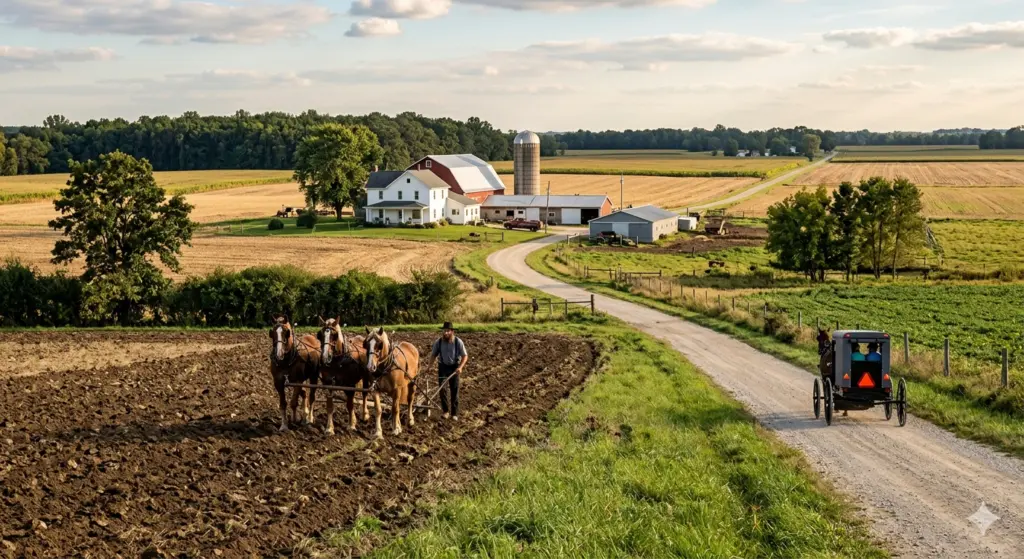
Arthur is a town of roughly 2,300 people in Moultrie County, in the east-central part of the state. By most external measures, it is a small rural community in agricultural Illinois. What makes it unusual is that it sits at the center of one of the largest Amish communities in the United States.
The Amish community in and around Arthur has been established for generations. The woodworking tradition that has developed within it is not a novelty or a tourism attraction. It is the livelihood and identity of families who have been building things with their hands for as long as anyone in the community can remember, and who pass that knowledge to the next generation the same way a farmer passes knowledge of the land: by working alongside, making mistakes under guidance, and understanding through practice what cannot be understood through instruction alone.
This is where Custom Cabinet Security’s pieces come from. Not from a factory with a rustic brand identity. From a community of craftsmen for whom the work is the point.
What Apprenticeship Actually Produces
The modern professional world mostly trains people through formal education: degrees, certifications, standardized courses. The Amish woodworking tradition works differently, and the difference matters in ways that show up in every cabinet.
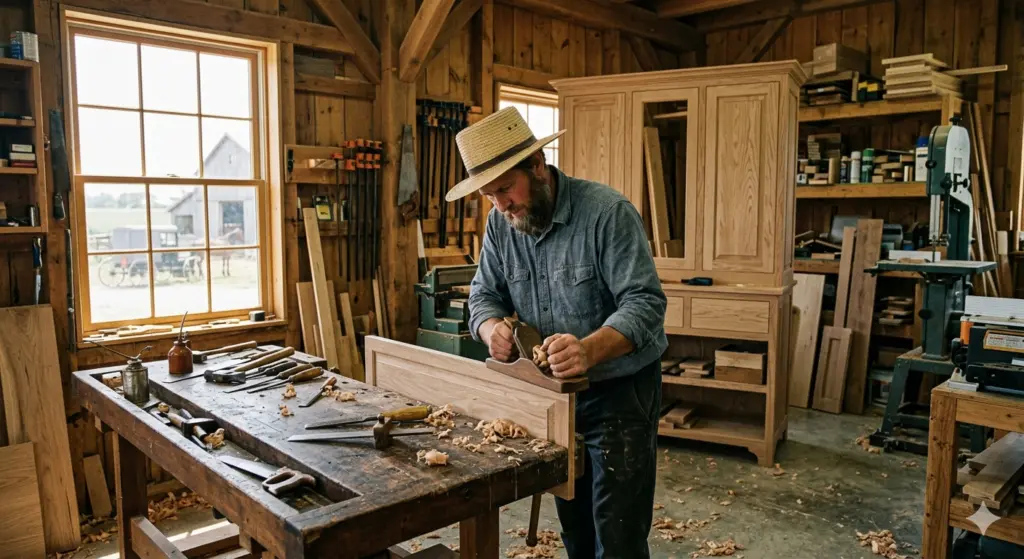
In the Amish craft tradition, a young person who shows aptitude for woodworking does not attend a school for furniture making. They work alongside someone who already knows how to do it, for years, doing real work on real pieces, with the guidance of someone whose livelihood and reputation depend on the quality of the output.
This apprenticeship model produces something that formal certification cannot: a craftsman who has watched the same wood species behave across seasons, who has made the mistakes that cannot be taught around, and who has developed the hand-eye coordination and material intuition that can only be accumulated through thousands of hours of actual work.
What this looks like in practice:
A craftsman who has been cutting dovetail joints for fifteen years does not approach each joint as a calculation. The angle, the depth, the sequence of cuts, the moment when the blade is right and the moment when it needs adjustment: these are known in the hands before they are known in the mind. The result is a joint that fits correctly not because a measurement was followed precisely but because the craftsman’s body knows what correct feels like.
This is not mysticism. It is the physiological reality of expertise developed through repetition over time. And it is the thing that is genuinely not replicable in a factory setting, regardless of how sophisticated the machinery becomes.
The three-generation dimension:
When a craft is passed from grandparent to parent to child within a family, something additional accumulates: the specific knowledge of how the materials they work with behave, what approaches work in the specific workshop environment they share, and what standards have been held and refined across multiple lifetimes of work.
The craftsmen who build Custom Cabinet Security pieces are not working from a tradition they researched. They are working from a tradition they inherited by living within it.
The Wood Selection: Where the Piece Begins
Before a single joint is cut or a panel is assembled, the piece begins with the wood.
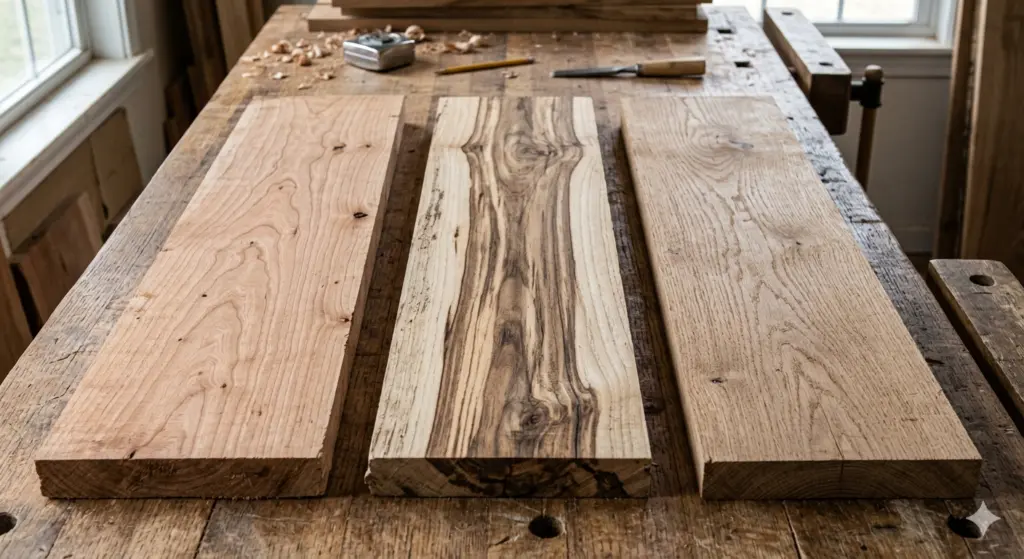
Custom Cabinet Security builds in three hardwood species: cherry, hickory, and white oak. Each of these species has specific characteristics that affect how it is worked, how it finishes, and how it ages.
Cherry is a fine-grained, consistent hardwood native to the eastern United States. It begins with a warm pinkish-tan tone and deepens over years of light exposure into the rich reddish-brown that is the characteristic of aged cherry furniture. Cherry cuts cleanly and finishes beautifully with oil or hand-rubbed finishes that allow the grain to read clearly.
The craftsman who selects cherry boards for a specific cabinet is looking at the grain character of each board: whether the grain runs consistently or shifts in ways that would create visual irregularity at a glued-up panel face. They are considering how the boards will move with seasonal humidity changes and how to orient the grain direction to minimize stress at glue joints. They are looking for any figure or character that should be placed prominently and any defect that should be avoided or worked around.
Hickory is significantly harder than cherry and has the most dramatic visual character of the three species. The grain variation in hickory, from near-white sapwood to dark reddish-brown heartwood, can create striking visual contrast in a finished piece. This character is part of what makes hickory distinctive, and it requires a craftsman’s judgment to work with it effectively: knowing which boards to pair together so the variation creates visual rhythm rather than visual chaos.
White oak has an open grain structure with a distinctive ray figure that appears as flecks or medullary rays in the surface when the board is quartersawn. White oak’s neutral, slightly gray tone and its association with traditional and contemporary furniture styles make it work across a wide range of room aesthetics.
Each species requires specific tooling adjustments, specific blade angles, and specific finishing approaches. A craftsman who works with all three develops a material knowledge that a specialist in a single species does not have in the same way.
The Joinery: Why Traditional Methods Produce Better Results
The specific joinery methods used in Custom Cabinet Security pieces are not chosen because they are traditional. They are chosen because they work better than the alternatives for the specific purpose of building furniture that is expected to last generations.
Understanding why helps explain why this kind of furniture is different from anything built at scale.
Dovetail Joints in Drawer Construction
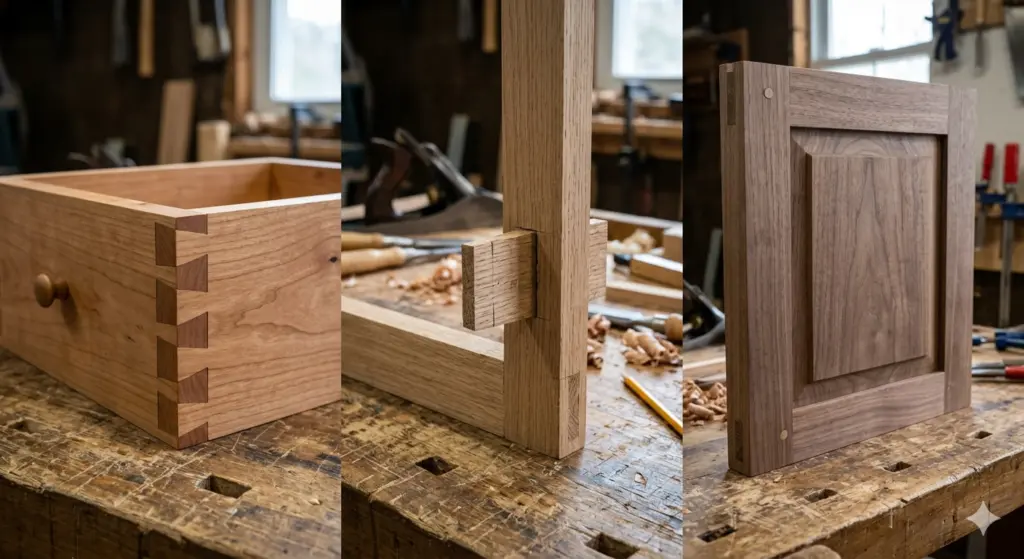
A dovetail joint is a mechanical interlock between two pieces of wood created by cutting trapezoidal projections (the tails) from one piece that fit into corresponding recesses (the pins) cut in the other. The geometry of the joint means that it resists being pulled apart perpendicular to the joint direction without relying solely on adhesive.
In a drawer box, a dovetail joint at all four corners creates a structure that resists the pulling force applied every time the drawer is opened. A drawer built with this joint and quality adhesive will not separate at the corners from normal use over decades.
Factory drawer construction typically uses stapled joints with MDF or plywood panels. The joint relies on the fastener and the adhesive with no mechanical interlock. These joints loosen over time as the panels move seasonally and the fastener holes in engineered wood expand slightly with use.
The difference between a dovetailed drawer at year twenty and a stapled drawer at year twenty is not subtle.
What cutting a dovetail by hand requires:
The craftsman lays out the joint with a marking gauge and a sliding bevel set to the appropriate angle for the specific wood species (the angle that provides maximum mechanical resistance without creating a fragile thin section). The tails are cut with a dovetail saw and pared to the line with a chisel. The pins are marked from the tails and cut to match.
A well-fit dovetail comes together hand-tight with gentle pressure before glue is applied. Achieving this requires the kind of dimensional consistency that can only be maintained over many repetitions, because the fit depends on accumulated skill in holding a saw on a line and paring a chisel face to a marking line, not on a machine setting.
Mortise and Tenon in Frame Construction
The mortise and tenon is the foundational joint of frame-and-panel furniture. One component carries a projecting tongue (the tenon) that fits into a rectangular hole (the mortise) cut in the other. The mechanical connection transfers load through the joint itself before adhesive is considered.
In the face frame of a cabinet, mortise and tenon joints hold the vertical stiles and horizontal rails in relation to each other while resisting the racking forces that would otherwise cause a frame to distort into a parallelogram over time.
In factory furniture, frame members are typically joined with pocket screws, dowels, or biscuits. These methods are faster and adequate for many purposes. They do not produce the same mechanical strength or longevity as a well-fitted mortise and tenon, particularly under repeated dynamic loading over decades.
Frame and Panel Construction for Panels and Doors
Frame-and-panel construction is the approach that allows large solid wood panels to exist in a cabinet without splitting or warping as the wood moves seasonally.
A panel is set into grooves in the surrounding frame members with room to move as the wood expands and contracts with humidity changes. The frame provides the structural stability; the panel floats within it. This system has been used in quality furniture for centuries because it works: it allows the natural movement of solid wood without stressing the joints.
Factory case furniture typically uses sheet goods (plywood or MDF) for panel areas, which are dimensionally stable without allowance for movement. This approach works for panels but produces a result that is structurally and visually different from solid wood frame-and-panel construction.
The Security Hardware Integration: Design, Not Addition
The security features in a Custom Cabinet Security piece are not items selected from a hardware catalog and added to an otherwise completed cabinet. They are designed into the piece from the beginning, which is what allows the integration to look and function as it does.
The steel-reinforced locking bar:
The locking bar is a steel mechanism that extends from the door into the cabinet frame when engaged. In the production process, the frame members of the cabinet are mortised or routed to accept the bar housing and the strike plates at each engagement point. The finished exterior of the door and frame shows no industrial hardware; the locking mechanism is entirely internal.
This integration is a design and construction decision that requires the security hardware to be known before the piece is built, not added after. The craftsman who is building the frame is building around the lock from the first stage of frame assembly.
Bulletproof glass panels:
Display cabinets with glass panels use bullet-resistant glass in place of standard float glass. The glass panels are heavier than standard glass and require specific frame construction to carry the additional weight without deflecting. The craftsman building the door frames for a glass-panel display cabinet accounts for this in the frame dimensions and the glass retention detail.
The dehumidifier integration:
The Golden Rod dehumidifier rod is sized to the interior volume of the specific cabinet and positioned at the base of the interior with a routing for the power cord that exits the cabinet through a specific, sealed opening. This routing is cut during construction, not drilled through a finished piece later.
The pick-resistant lock cylinder:
The lock cylinder is specified for the piece and fitted into the cabinet’s door in a way that is mechanically secure and aesthetically consistent with the overall design. The lock’s exterior face is the only hardware visible on the door front.
The Finishing Process: Surface as Character
The finishing of a solid hardwood cabinet is not a final step applied to a completed object. It is the process that reveals the character of the material that the construction created the conditions for.
Preparation:
The surfaces are hand-planed or hand-sanded to a level of smoothness that allows the finish to penetrate or adhere consistently across the entire surface. Any mill marks, any tear-out from machining, any glue residue are addressed at this stage. The care applied here determines whether the finished piece has the visual consistency of quality furniture or the subtle irregularities of rushed production.
Finish type and application:
Traditional Amish woodworking uses hand-rubbed oil finishes, penetrating finishes that soak into the wood fiber rather than building a film on the surface. This approach is more labor-intensive than spray-applied lacquer or polyurethane, and it produces a result that is visually different: the surface has depth and warmth that a film finish does not, and it can be renewed with additional application if the surface ever needs refreshing.
Color development:
Cherry wood changes color significantly over time as it is exposed to light. A newly finished cherry cabinet is a warm pinkish-tan. After six months to a year of light exposure, it begins to develop the deeper reddish-brown that is the characteristic of aged cherry furniture. After years, the surface has a richness that cannot be replicated by applying stain to a lighter species.
A buyer who purchases a cherry cabinet and understands this is not receiving a static object. They are receiving a piece that will develop and improve over the years they own it.
What Accountability Looks Like in a Small Community
Every Custom Cabinet Security piece that leaves the workshop in Arthur, Illinois carries the specific craftsman’s implicit signature. Not literally, though the culture of named craftsmanship is valued, but in the sense that the person who built the piece is identifiable, is part of a specific community, and cannot be separated from the quality of their work.
This is the accountability structure that the Amish tradition of craft produces and that no production-at-scale system can replicate.
When a craftsman builds a piece and ships it to a collector in another state, the piece carries their workmanship into a home they may never see. But the quality of that work is known in Arthur. It is known by the people they work beside, by the community members who have seen their work, and by the customers who return or refer others based on what they received.
This is a more direct accountability relationship than the one between a consumer and a manufacturer. A manufacturer’s quality control process is designed to catch problems before they leave the facility. A craftsman’s accountability is personal: the work that leaves is the work that reflects them, and the standard they hold is internal before it is external.
This is why the three-generation tradition matters in practical terms. The craftsmen who build these pieces inherited a standard that was demonstrated to them, not described to them. They have seen what good work looks like over the course of years of observation, and they have worked alongside people for whom that standard was already deeply held.
What Owning One of These Pieces Actually Means
This post has described the where, the who, the materials, and the methods. What it means to own one of the resulting pieces is the thing that is hardest to write about and most important to understand.
A custom Amish-built gun cabinet from Custom Cabinet Security is not primarily a product. It is a piece of made work. The making was performed by a specific person using specific materials in a specific place, with a standard formed over years and inherited from generations. The result carries that origin.
When a collector opens the doors of a piece like this to retrieve a firearm for a range session, or to show a son or daughter or grandchild something in the collection, the cabinet that holds the collection is part of the context in which the collection is understood. It says something about how the collection is valued. It says something about the decision to house it properly rather than adequately.
The collection of standard pieces at Custom Cabinet Security represents the range of what the craftsmen in Arthur build. For buyers whose specific situation calls for something designed for their exact collection and their exact space, the custom consultation process is where that conversation begins.
The piece that results from either path carries the same tradition. Built by hand. Built in Arthur. Built by craftsmen who learned the work the only way that produces mastery: by doing it, over time, alongside people who already knew how.
The Bottom Line
Every Custom Cabinet Security gun cabinet represents a specific origin: the Amish community of Arthur, Illinois, the craftsmen trained within it, the hardwood selected for each piece, and the joinery methods that produce furniture intended to last as long as it is cared for.
This origin is not marketing. It is the actual explanation of why the pieces are what they are, and why they are different from what you find on a retail shelf or in a factory catalog.
Understanding how a cabinet is built changes how you experience owning it. A piece with this kind of origin is not a container for the collection. It is part of the story of the collection, built to the same standard that the collection itself was assembled: with care, with knowledge, and with the intention that it will still be present and worthy of what it holds long after the original owner’s memory of acquiring it has faded.
That is what three generations of tradition produces. And it is what arrives when you open the doors of a Custom Cabinet Security piece for the first time.
Related Posts
View All
Uncategorized
Reading Time: 8 min
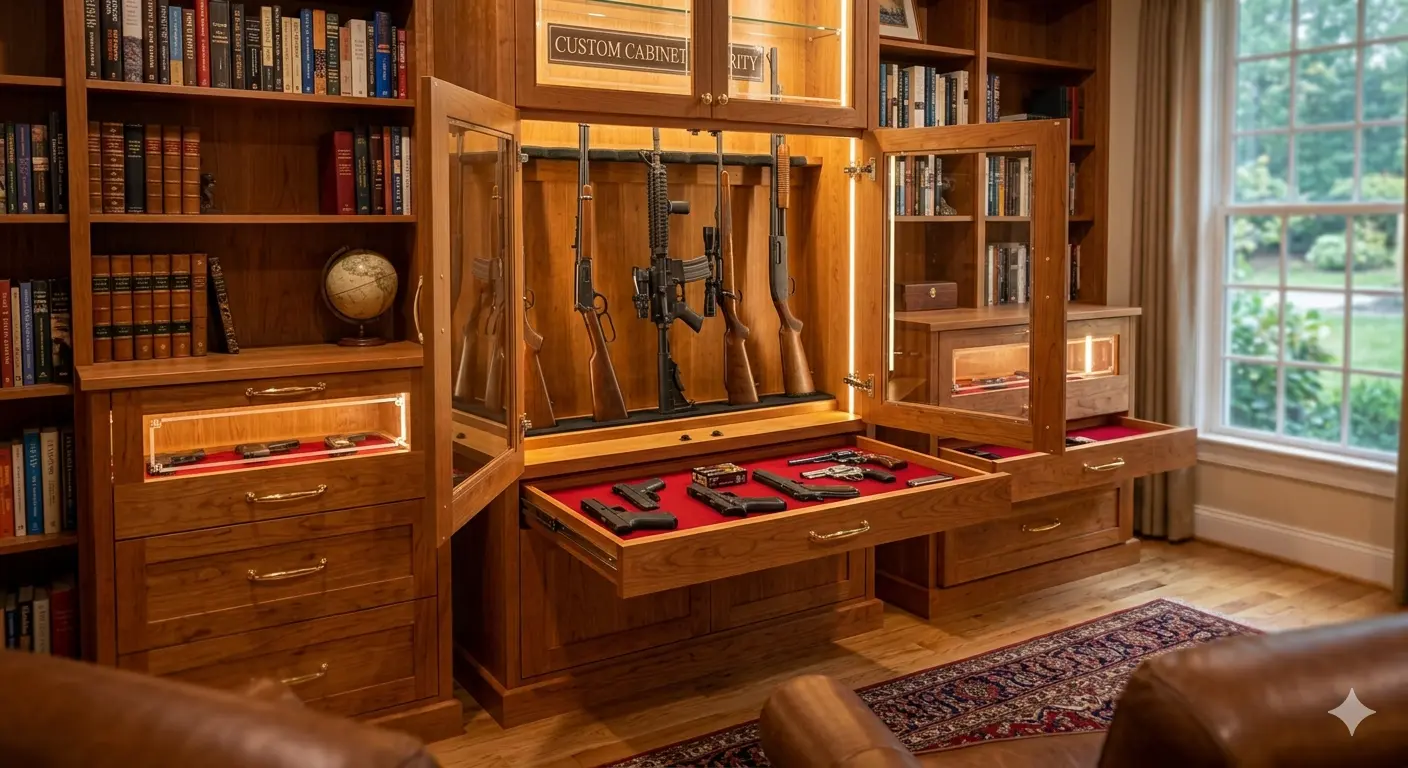
The Resale Value of a Custom Gun Cabinet: Does a Handcrafted Amish Safe Hold Its Value Over Time?
If you’ve ever bought a mass-produced gun safe from a big-box retailer, you already know what happens the moment it
Read More
Uncategorized
Reading Time: 11 min
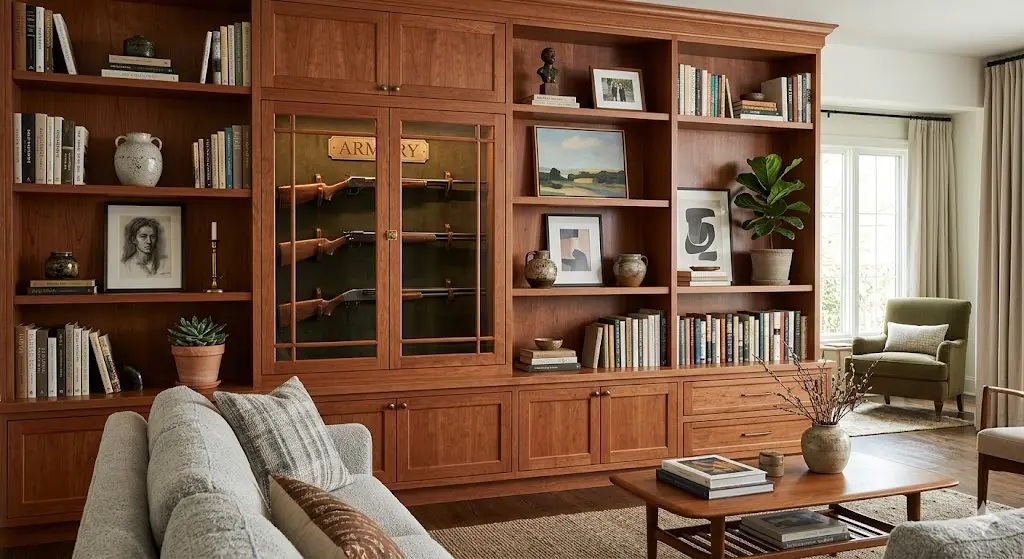
Women Gun Owners: How to Choose a Gun Storage Solution That Fits Your Home’s Style Without Compromise
Key Takeaways The Storage Problem Nobody Talks About Walk into almost any sporting goods store and look at the gun
Read More
Uncategorized
Reading Time: 10 min
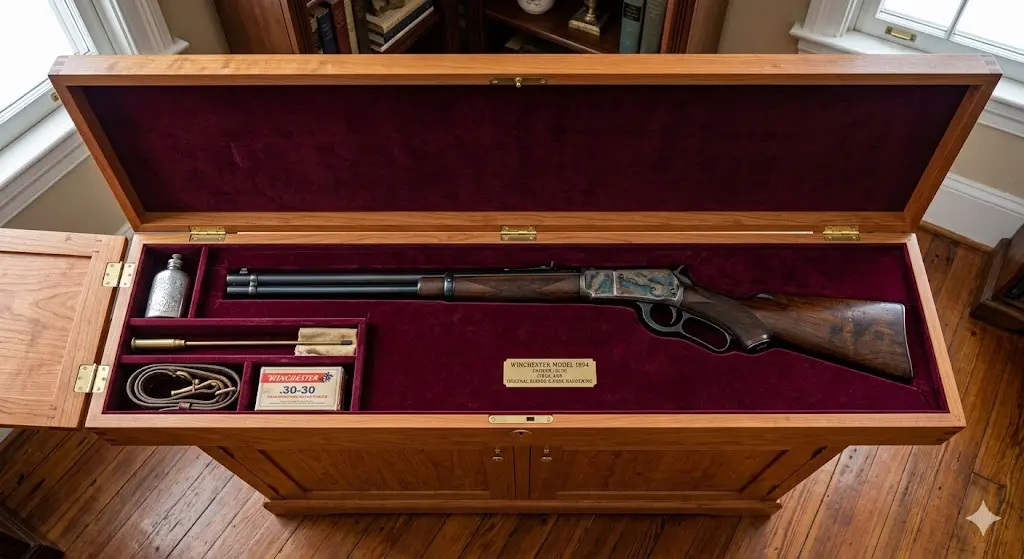
How to Protect Antique and Vintage Firearms in Wood Storage: What Collectors Need to Know About Climate and Finish
Key Takeaways Why Antique Firearms Demand a Different Standard of Storage Storing a modern production firearm and storing an 1860s
Read More
