10 Jul 2026 • Reading Time: 11 min
Key Takeaways
- A “mixed collection” of long guns and handguns has storage requirements that a single format often cannot address well. Long guns need vertical space; handguns need organized horizontal storage. A storage solution that handles one optimally often handles the other as an afterthought.
- Pistol display cases are purpose-built for handgun collections and do their job well for collections that are primarily or exclusively handguns. They are not the right primary solution for collectors whose collection includes a significant number of long guns.
- Gun cabinets designed for long guns can accommodate handgun storage as a secondary function through drawers, trays, or lower compartments, but the handgun access and organization is rarely as precise as in a dedicated pistol chest.
- The most complete solution for a serious mixed collection is often two pieces working in complementary roles: a display cabinet for the long gun collection and a pistol chest for the handgun collection. Each piece does its primary job at the highest level.
- Display format (glass-panel doors with visible collection) versus private storage format (solid doors with organized interior) is a separate dimension from the long gun vs. handgun question. Collectors have preferences on both, and the best solution respects both dimensions.
- Custom Cabinet Security builds pieces specifically designed for each of these roles and the configurations that serve mixed collections, including integrated pieces that house both gun types within a single unified design.
The Storage Problem That Grows With the Collection
Most gun collections do not start as mixed collections. A new collector typically begins with one type of firearm: a handgun for home defense, a shotgun for upland bird hunting, a rifle for deer season. The storage question at that stage is relatively simple.
Over time, collections grow and diversify. The hunter who started with a pump shotgun adds a bolt-action rifle, then a lever-action, then a semi-automatic hunting rifle. The handgun collector who started with a defensive pistol adds competition revolvers, historical pieces, and a growing collection of specific manufacturers or calibers. Eventually, both types of collectors arrive at the same place: a mixed collection that includes long guns and handguns in significant numbers.
And that is when the storage question becomes genuinely complicated, because the two firearm types have fundamentally different physical storage requirements that pull in opposite directions.
Long guns need vertical space. A rifle or shotgun is typically 36 to 52 inches long. Storing it properly means supporting it vertically with barrel-up or barrel-down orientation in a padded rest that protects the finish of the stock and barrel. This requires a tall, narrow footprint per gun.
Handguns need organized horizontal storage. A pistol or revolver is compact but has a specific three-dimensional geometry. Storing multiple handguns well means fitted trays or drawers where each piece has a defined position, is accessible without disturbing the others, and is protected from contact with adjacent pieces.
These two storage logics do not naturally coexist in a single solution without compromise. A cabinet optimized for long guns treats handguns as secondary objects in whatever space is left. A case optimized for handguns has no provision for long guns at all.
Understanding how to serve both types of collection at the appropriate level is what this post addresses.
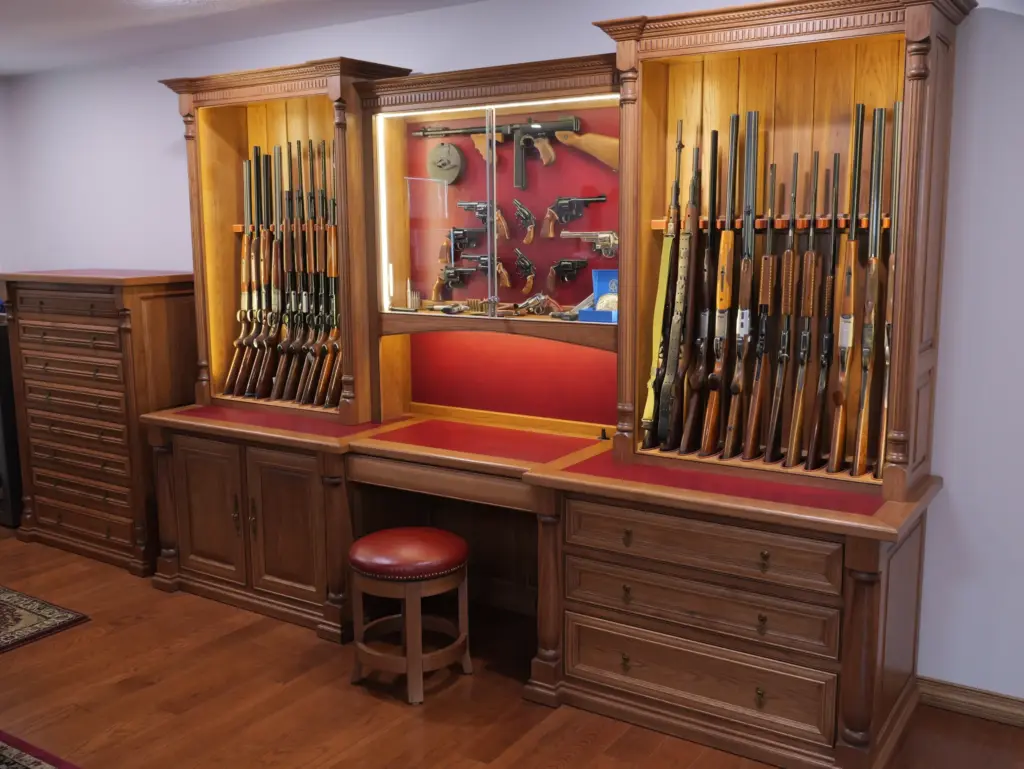
What a Pistol Display Case Actually Does Well
Pistol display cases are a specific storage format that is well-suited to one specific purpose. Understanding that purpose clearly helps identify when a case is the right solution and when it is not.
The Purpose of a Pistol Display Case
A pistol display case is a glass-topped or glass-sided case designed to display handguns in a visible, organized arrangement. In the best versions, each handgun rests in a fitted position with a lining material that protects the finish, and the arrangement is visible from outside without requiring the case to be opened.
The display function is the defining characteristic of this format. A pistol display case is not primarily a secure storage solution or an organizational system for frequent access. It is a presentation format for handguns that the collector wants to show.
This makes the display case format ideal for:
- Historically significant handguns with aesthetic or provenance value that rewards display
- Matched or thematically related pistols that are more interesting as a set than as individual pieces
- Commemorative or limited-edition pieces whose visual character is part of the point of ownership
- A collection that is primarily displayed for aesthetic enjoyment rather than accessed for regular range use
The Limitations of Pistol Display Cases for Mixed Collections
For a collector with a mixed long gun and handgun collection, a pistol display case addresses only one part of the storage problem and does so without integrated security or the furniture quality that a serious collection warrants.
Most commercially available pistol display cases are:
- Small in format (desktop or wall-mounted cases for six to twelve handguns)
- Constructed from materials inferior to solid hardwood (MDF, plywood with thin veneer, or plastic trim)
- Equipped with minimal security (basic hinged locks without reinforced locking mechanisms)
- Designed for display without regard for organization or frequent-access practicality
A serious mixed collection that includes both historically significant handguns and actively used long guns requires more than a display case can provide: real security, quality construction that matches the collection’s value, practical organization for daily use, and a format that serves the entire collection rather than one small segment of it.
What a Long Gun Cabinet Does (and Doesn’t) Do for Handguns
The standard gun cabinet format, designed primarily for long guns, addresses the handgun problem in ways that range from adequate to genuinely useful depending on the design.
How Long Gun Cabinets Handle Handguns
Most quality gun cabinets include some provision for handgun storage. The most common configurations:
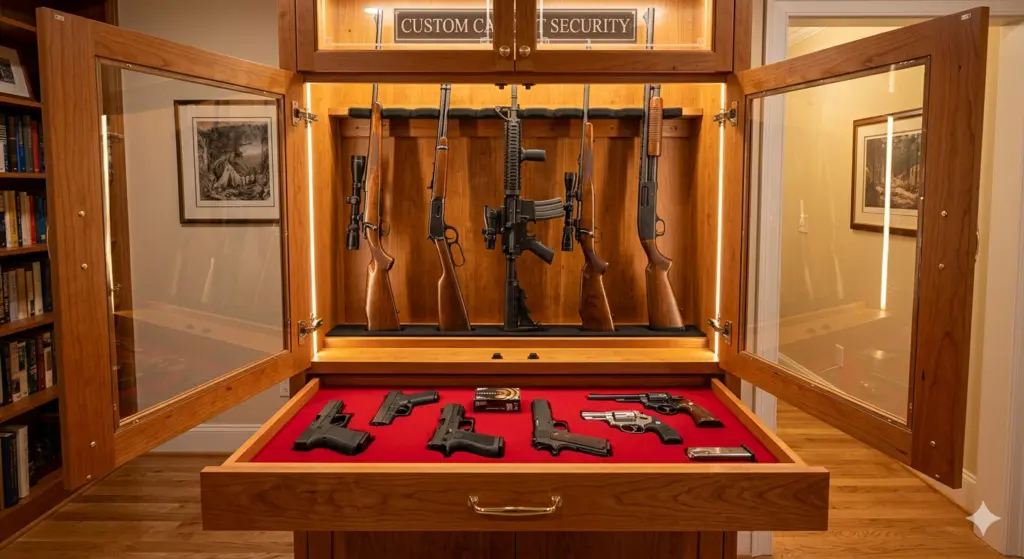
Integrated lower drawers: A long gun display cabinet with one or more drawers in the lower section allows handguns to be stored in a fitted tray below the main display area. This configuration separates the two firearm types by vertical zone: long guns above, handguns below.
A door-mounted pistol storage panel: Some cabinet designs include a panel on the interior of the door with fitted holster-style pockets or tray sections for handgun storage. This uses space that would otherwise be dead space at the door, but the access angle when the door is open is awkward for organizing multiple handguns.
A secondary lower compartment with separate lock: Some larger cabinets include a separate locked compartment below the main display area. This can accommodate a pistol tray or fitted foam for multiple handguns with independent access from the main cabinet.
The Honest Limitation
In any of these configurations, the handgun storage is secondary to the long gun function. The drawer is sized to fit within the lower portion of the cabinet footprint, which means the drawer depth is constrained by the cabinet’s structural requirements. The tray layout is a general configuration rather than one designed specifically around a defined handgun collection.
For a collector with two or three handguns, this secondary integration is entirely adequate. For a collector with fifteen or twenty handguns that span different sizes, eras, and configurations, a cabinet’s secondary handgun provision will feel compromised in ways that a purpose-built pistol chest would not.
The Purpose-Built Pistol Chest: The Right Solution for Serious Handgun Collections
The pistol chest is a furniture format specifically designed for the organized storage of a significant handgun collection. It is not a display case and it is not a secondary compartment within a long gun cabinet. It is the primary storage format for handguns, built to do that job at the highest level.
What Makes a Pistol Chest Different
Drawer organization: A quality pistol chest has multiple drawers, each sized for a defined number of handguns in fitted compartments. The drawers are the primary organizational mechanism. Each handgun has a position; that position is defined by the drawer’s fitted tray, and the position keeps the handgun from shifting, contacting other pieces, or being difficult to locate when a specific gun is needed.
Felt lining throughout: Red felt lining, as used throughout Custom Cabinet Security’s pistol chests, protects the finish of each handgun from abrasion and provides a consistent, soft contact surface. This is not a minor detail for a collection that includes pieces with blued steel, polished stainless, or original case hardening whose finish condition is part of the piece’s value.
Drawer construction quality: The dovetailed drawer construction in a quality pistol chest produces drawers that open with precision and close flush, year after year. This is the joinery detail that distinguishes furniture-quality construction from case goods construction. A pistol chest from Custom Cabinet Security uses the same joinery traditions in its drawer boxes that have been producing quality furniture drawers for centuries.
Security appropriate to the purpose: A pistol chest with a pick-resistant lock and steel-reinforced locking mechanism provides genuine security against unauthorized access, not the nominal security of a basic keyed cabinet lock.
Furniture quality that belongs in a living space: A solid hardwood pistol chest in cherry, hickory, or white oak is a furniture piece that belongs in a study, a master bedroom, or a living room. It is not a utilitarian storage box. It carries the same quality of construction and finish as any fine piece of furniture, which means it can occupy the same space as other quality furniture without looking out of place.
The Integrated Approach: Two Pieces, One Complete Solution
For a serious collector with both a significant long gun collection and a significant handgun collection, the most complete solution is often two pieces working together: a display cabinet for the long guns and a pistol chest for the handguns.
This approach allows each piece to do its primary job at the highest level, without the compromises that come from asking one piece to serve both functions.
How the Two-Piece Configuration Works in Practice
The display cabinet holds the long gun collection in a visible, organized format that allows the collector to access, admire, and maintain the collection with ease. The display format with glass-panel doors, LED lighting, and fitted vertical rests does what a display cabinet does best: presents the collection in a way that honors the individual pieces.
The pistol chest holds the handgun collection in precisely organized drawers with individual compartments for each piece. The fitted drawers provide the organization and protection that a serious handgun collection warrants, with access that is practical for frequent use and storage that maintains finish condition over years.
The two pieces can be positioned to complement each other in the same room: the taller display cabinet against one wall, the chest serving as a low surface piece against an adjacent wall or in a related position in the room’s layout. In a dedicated gun room, both pieces together define the space as organized and intentional.
When an Integrated Single Piece Is Better
Not every collector has room for two pieces, and not every collection is large enough to warrant it. A single integrated piece that combines display cabinet functions with a pistol chest lower section is the right solution for collectors who:
- Have a mixed collection that does not yet justify two separate dedicated pieces
- Have a defined space that accommodates one larger integrated piece better than two separate pieces
- Want a unified visual statement rather than two pieces with related but separate design languages
Custom Cabinet Security builds integrated pieces that house both long guns in the upper display section and handguns in fitted lower drawers or a lower chest section. The piece reads as a single unified cabinet while serving both functions. This is a custom configuration in the most direct sense: the proportions of the upper and lower sections, the number of rifle rests versus handgun drawers, and the overall dimensions are determined by the specific collection it is designed to house.
Choosing the Right Configuration for a Mixed Collection: A Decision Framework
To move from the general framework above to a specific configuration for a specific collection, work through these questions.
Step 1: Count and Characterize the Collection
How many long guns? How many handguns? Are the long guns primarily rifles, primarily shotguns, or a mix of both? (This affects the height of rests needed.) Are the handguns primarily compact carry pistols, full-size pistols, revolvers, or historically large-framed pieces? (This affects drawer depth and tray configuration.)
Write these numbers down before the conversation with a craftsman or consultant begins. The numbers determine the scale of the solution, and the scale determines the cost.
Step 2: Identify Which Type of Firearm the Collection Is “About”
For many collectors, the collection has a primary identity even when it is mixed. A hunter whose collection is primarily long guns with a few handguns has a primarily long gun collection with handgun storage needs. A self-defense or competition collector whose primary interest is handguns but who also owns several rifles has a primarily handgun collection with long gun storage needs.
This primary identity should drive the format choice. A primarily long gun collection that has a secondary handgun presence is best served by a quality long gun display cabinet with integrated lower drawer storage for handguns. A primarily handgun collection with a few long guns may be better served by a pistol chest as the primary piece with a smaller or simpler long gun solution as the secondary.
Step 3: Assess the Display vs. Private Storage Preference
Is the collection for display or for private organized storage?
Display preference: The collection, or a significant portion of it, is something the collector wants to see and show. Glass-panel doors, LED lighting, and fitted presentation rests are the format that serves this preference.
Private storage preference: The collection is organized and protected but not displayed. Solid door panels, organized drawers, and a furniture aesthetic rather than a display aesthetic serve this preference.
Many serious mixed collections have a mixed preference: certain pieces with display value (historically significant long guns, matched pistols) warrant display format, while others warrant private organized storage. A custom configuration can address both within a single piece.
Step 4: Define the Space Available
The space where the piece or pieces will live sets practical limits on format. A tall display cabinet with a large handgun drawer requires a specific wall height and floor footprint. A side-by-side arrangement of display cabinet and pistol chest requires space for both.
Measure the available wall space and ceiling height before committing to a configuration. A craftsman building a custom piece can work to specific dimensions; what cannot be changed after the piece arrives is whether it fits in the space.
What Custom Cabinet Security Builds for Mixed Collections
The specific pieces in the Custom Cabinet Security collection address the mixed collection storage problem from multiple angles.
Long gun display cabinets with integrated handgun storage: Display cabinets with fitted drawers in the lower section serve mixed collections where the long guns are the primary display piece and handguns are stored in organized secondary drawers.
Pistol chests as complementary pieces: The 8-Drawer Pistol Chest in cherry wood or hickory is the primary solution for a serious handgun collection used alongside a separate long gun display piece.
Combined pistol display cabinet and storage: The 14-Gun Pistol Cabinet configuration serves collectors whose handgun collection warrants both display and organized storage in a single piece.
Custom integrated configurations: For collectors whose specific mixed collection does not fit neatly into standard configurations, the custom consultation process produces a piece designed specifically for the collection in question: the right proportions of vertical display space for long guns, the right number and configuration of handgun drawers, and the right overall dimensions for the specific space.
Custom work in this sense is not a premium tier added onto a standard product. It is the natural outcome of taking the collector’s specific situation seriously enough to design for it rather than asking the collection to fit a production format.
The Mixed Collection Is Not a Compromise Problem
There is a tendency to frame the mixed collection storage question as a problem of compromise: how do we accommodate both types of firearms in a solution that does neither quite as well as a dedicated solution would?
That framing is wrong.
A well-designed integrated piece, or a well-chosen complementary pair of pieces, serves a mixed collection better than any single-type solution because it reflects the collection accurately. A hunter-shooter who has spent decades building a collection that spans both long guns and handguns has a collection that is genuinely mixed, and the storage that serves it should be designed with that reality in mind.
The collectors who get this right end up with a storage and display arrangement that is more satisfying than they expected, because it reflects the full scope of what they’ve assembled rather than prioritizing one part of it and treating the rest as an afterthought.
That is what custom work makes possible, and it is what the craftsmen in Arthur are building when they design a piece for a specific collector’s specific mixed collection.
The Bottom Line
Pistol display cases serve handgun display well but are not an adequate solution for serious mixed collections. Long gun cabinets with secondary handgun provisions serve long gun collectors with a few handguns. Neither fully addresses the needs of a serious collector who has built a significant collection of both types.
The most complete solutions for mixed collections are:
Two dedicated pieces: A display cabinet for long guns and a pistol chest for handguns, each doing its primary job at the highest level without compromise.
An integrated custom piece: A single cabinet designed specifically for the collection’s proportions of long guns and handguns, with the display and storage format determined by what the collection actually contains and what the collector values most about it.
The collection of pieces available from Custom Cabinet Security provides the starting point for either path. For collectors whose mixed collection warrants a fully custom configuration, the consultation process is where that conversation begins.
The collection deserves storage designed for it. That is what the craftsmen in Arthur make possible.
Related Posts
View All
Uncategorized
Reading Time: 8 min
The Resale Value of a Custom Gun Cabinet: Does a Handcrafted Amish Safe Hold Its Value Over Time?
If you’ve ever bought a mass-produced gun safe from a big-box retailer, you already know what happens the moment it
Read More
Uncategorized
Reading Time: 11 min
Women Gun Owners: How to Choose a Gun Storage Solution That Fits Your Home’s Style Without Compromise
Key Takeaways The Storage Problem Nobody Talks About Walk into almost any sporting goods store and look at the gun
Read More
Uncategorized
Reading Time: 10 min
How to Protect Antique and Vintage Firearms in Wood Storage: What Collectors Need to Know About Climate and Finish
Key Takeaways Why Antique Firearms Demand a Different Standard of Storage Storing a modern production firearm and storing an 1860s
Read More
