05 Jun 2026 • Reading Time: 15 min
Key Takeaways
- Humidity is the primary cause of firearm damage in storage, responsible for rust, corrosion, stock warping, and finish degradation that accumulates silently over time until it becomes visible and often irreversible.
- The ideal relative humidity for firearm storage is between 45 and 55 percent. Below 40 percent, wood stocks crack and dry out. Above 60 percent, corrosion begins to accelerate on metal surfaces.
- Most residential environments fall outside the ideal range at some point during the year, making passive storage without humidity control inadequate for any collection worth protecting.
- A Golden Rod dehumidifier rod is the most reliable, lowest-maintenance solution for maintaining safe humidity inside a closed storage environment. It does not require consumables, produces no condensation itself, and runs continuously without attention.
- Different firearm materials respond to humidity differently. Blued steel, case-hardened surfaces, and original antique finishes are more vulnerable than modern matte or Cerakoted surfaces. Wood stocks are moisture-sensitive regardless of the finish applied.
- Proper humidity control inside a quality sealed cabinet is not a secondary feature. It is as fundamental to protecting a collection as the lock on the door.
The Damage That Happens When Nobody Is Looking
A gun safe or cabinet does something counterintuitive if it is not designed to manage humidity: it can make the moisture problem worse than leaving the firearms stored in open air.
A closed steel safe seals the interior environment. If the humidity inside was high when the safe was closed, that humidity stays concentrated inside. When temperature changes cause the interior air to cool slightly, the relative humidity rises further, and the enclosed air is at or above the condensation threshold against the coolest surfaces: the steel walls of the safe and the metal surfaces of the firearms themselves.
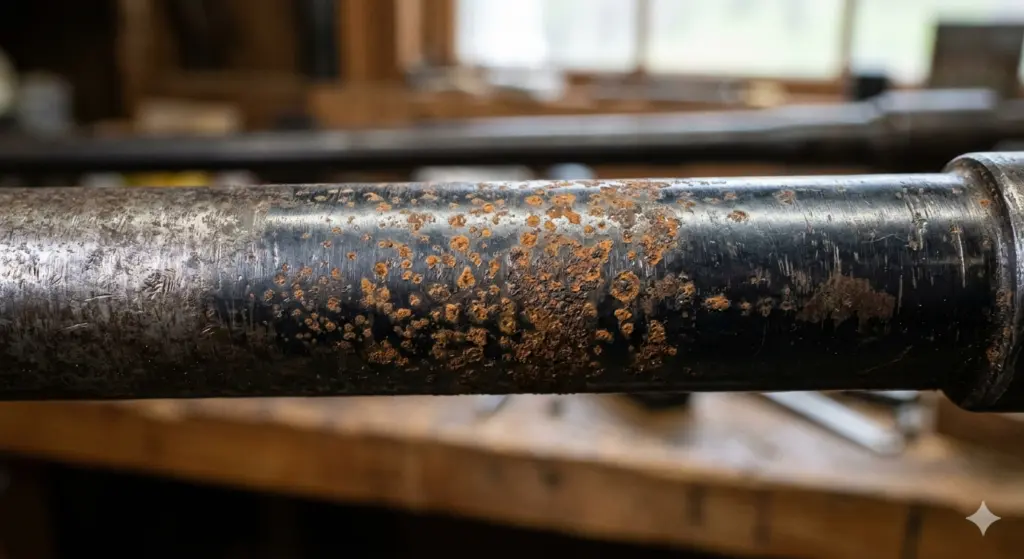
The moisture that condenses in these conditions does not evaporate quickly in a sealed environment. It sits. And steel rusts in contact with moisture at a rate that is invisible in the short term and becomes clearly visible over months and years.
This process is not dramatic. It does not announce itself. A firearm stored in a humid sealed environment does not look different after a week. After six months, there may be a slight discoloration in the bore or a faint oxidation on a blued surface. After two years, that oxidation is surface rust. After five, the original finish may be compromised in ways that cannot be fully reversed.
For a working firearm, this matters in terms of function and maintenance cost. For an heirloom, a collectible, or any piece with original finish that contributes to its value, this kind of slow damage can be financially and historically significant.
Understanding why this happens, and what to do about it, is the starting point for protecting any collection stored in a closed environment.
The Science of Humidity and Firearms: What Is Actually Happening
Understanding the mechanism of humidity damage makes the protective measures more intuitive.
Relative Humidity and What It Measures
Relative humidity (RH) is the percentage of moisture that air contains relative to the maximum it could hold at the current temperature. Air at 60 percent RH holds 60 percent of the maximum possible moisture for that temperature.
The critical detail is the relationship between temperature and moisture capacity. As air cools, its capacity to hold moisture decreases. Air that was at 60 percent RH at 70 degrees Fahrenheit may be at 80 percent RH at 60 degrees Fahrenheit, with no additional moisture added, simply because cooler air holds less moisture.
This is why a sealed safe that reaches the condensation point on its surfaces is often not simply stored in a humid location. It experiences temperature fluctuations that drive the interior RH above 100 percent at the coolest surface, producing condensation directly on the metal.
The Corrosion Threshold
Steel begins to corrode measurably when the relative humidity at its surface exceeds approximately 50 to 55 percent, in the presence of oxygen. At higher humidity levels, the corrosion rate accelerates. At humidity above 70 percent, corrosion on bare steel is relatively rapid. At humidity above 80 percent, even finishes that provide some protection begin to fail.
The practical implication is that maintaining interior humidity below 50 percent reliably prevents the majority of corrosion from initiating. Maintaining it above 35 to 40 percent prevents the desiccation effects that crack wood and dry out seals.
Why Finishes Are Not Sufficient Protection
A common assumption is that a well-finished firearm is protected against humidity regardless of the storage conditions. This is partly true in the short term and largely false over extended storage.
Bluing: Traditional hot-bluing applies a controlled oxide layer to steel that provides moderate corrosion resistance. It is not impermeable to moisture. In high-humidity conditions, bluing slows but does not stop the underlying corrosion process.
Phosphating (Parkerizing): Used on many military firearms, Parkerizing is a matte gray surface treatment that provides slightly more moisture resistance than bluing but is still porous and requires oil maintenance to function effectively in humid conditions.
Cerakote and similar polymer coatings: These provide significantly better moisture resistance than traditional metal treatments and are the current standard for duty firearms expected to operate in adverse conditions. Even Cerakote is not impermeable, and it does not protect the bore or internal surfaces that are not coated.
Nickel and chrome plating: Provides good corrosion resistance but can trap moisture under the plating if the base metal develops any corrosion entry point, leading to subsurface corrosion that lifts and damages the plating from beneath.
No finish eliminates the need for humidity management in stored firearms. All provide only partial and time-limited protection that maintenance and environmental control supplement.
What Humidity Does to Different Parts of a Firearm
The damage pattern from humidity exposure differs by material, and understanding where to look helps owners assess condition during storage.
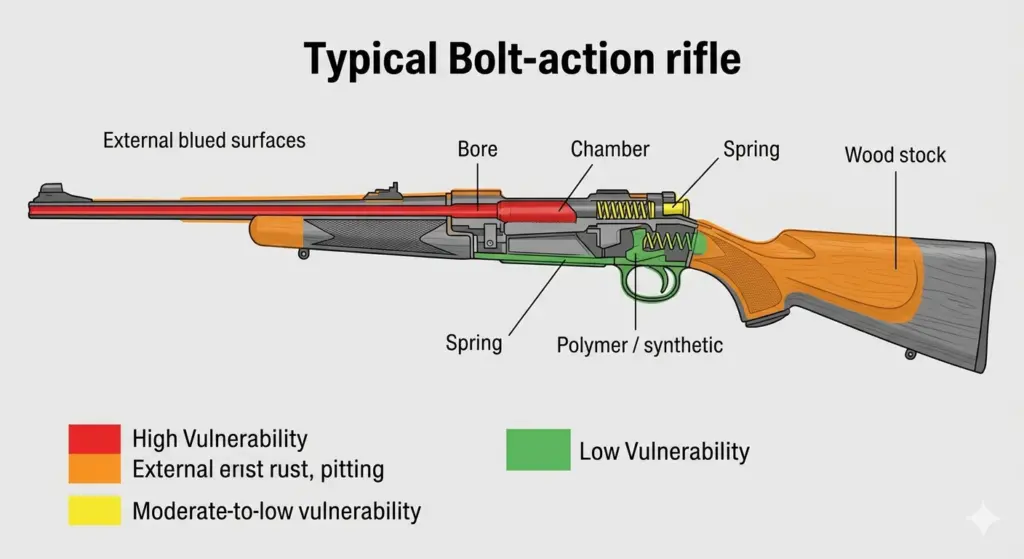
Steel Components: Rust and Pitting
Exposed or lightly protected steel surfaces show rust first in areas where the finish is thinnest: the edges of machined parts, the bore interior, the chamber, and any area where mechanical contact has worn the surface finish. These are also the areas where rust affects function most significantly, because surface oxidation in the bore and chamber changes the internal dimensions that affect both accuracy and safety.
Rust in the bore is visible under lighting with a bore light, appearing as reddish discoloration or visible pitting in advanced cases. Early-stage bore rust that has not progressed to pitting can often be removed with careful cleaning. Pitting in the bore is permanent dimensional damage.
Spring Steel and Small Parts: Corrosion and Failure
Coil springs, flat springs, and small internal components are often made from spring steel or similar alloys that are not finished to the same standard as exterior surfaces. These parts corrode in humid conditions and may develop surface rust that affects their spring tension or leads to cracking.
Inspection of small parts during routine maintenance catches this before it leads to mechanical failure. Springs that have corroded in storage may appear functional until placed under load, at which point they fail.
Wood Stocks: Warping, Checking, and Finish Damage
Wood responds to humidity changes by absorbing and releasing moisture, which causes dimensional changes. Wood stock dimensions change with the seasons in most climates even in well-regulated storage. These changes are managed by the fit between wood and metal being designed to accommodate some movement.
What causes actual damage is humidity at the extremes:
High humidity (above 65 percent): Wood absorbs moisture and expands. If expansion is constrained by the metal bedding, the wood can crack along the grain as the stress builds. High humidity also allows mold growth on wood surfaces and can cause the finish to cloud, bubble, or lift from the surface.
Low humidity (below 35 percent): Wood loses moisture and contracts. Checking (small surface cracks) develops as the outer surface of the wood dries faster than the interior. Stocks and forends can crack, and the fit between wood and metal loosens as the wood shrinks.
The ideal range for wood stock preservation, approximately 45 to 55 percent relative humidity, is the same range that protects metal surfaces from corrosion. This alignment makes a single humidity target appropriate for the whole collection.
Synthetic Stocks and Modern Materials
Polymer and composite stocks are far less sensitive to humidity than wood and are not significantly affected by humidity within the typical residential range. Optics with sealed nitrogen-purged interiors are similarly not directly affected by external humidity.
However, even a firearm with polymer furniture and modern finish still has steel internal components, a steel barrel, and metal action components that benefit from humidity management.
The Ideal Humidity Range and How to Measure It
Target Range: 45 to 55 Percent Relative Humidity
This range represents the practical center of the zone that protects both metal and wood components from the primary humidity-related damage mechanisms.
- Below 40 percent: Wood desiccation risk begins
- 40 to 45 percent: Acceptable, wood risk moderate, metal well-protected
- 45 to 55 percent: Ideal for both wood and metal protection
- 55 to 60 percent: Acceptable, metal corrosion risk begins at the upper end
- Above 60 percent: Corrosion accelerates, wood absorption risk rises
- Above 70 percent: Significant corrosion risk, active damage to most surfaces
Measuring Humidity Inside Storage
A hygrometer is the tool for measuring relative humidity. Several types are appropriate for use inside a gun cabinet:
Digital hygrometers: Battery-powered, typically accurate to within 2 to 3 percent, and available in small form factors that fit inside a cabinet or safe without taking significant space. Look for models that display both temperature and relative humidity and that can be calibrated against a known reference.
Analog hygrometers: Mechanical devices that do not require batteries. They tend to drift over time and are less accurate than good digital units, but they work without power and can serve as a secondary reference.
Hygrometer placement: For accurate measurement, a hygrometer should be placed in the interior of the cabinet, not near the door seal where air exchange is highest, and not directly against the dehumidifier rod. A central position on a shelf or mounted to the interior wall provides representative readings.
Calibrating a digital hygrometer: A simple calibration check uses the saturated salt method. A teaspoon of table salt moistened with a few drops of water, placed in a sealed bag with the hygrometer for 6 to 8 hours at room temperature, should produce a stable reading of approximately 75 percent. A hygrometer reading 70 or 80 percent in this test is reading 5 percent low or high, which can be factored into the interpretation or corrected with the calibration adjustment most digital hygrometers include.
Dehumidification Solutions: What Works and What Does Not
The Golden Rod Dehumidifier Rod: The Standard Solution
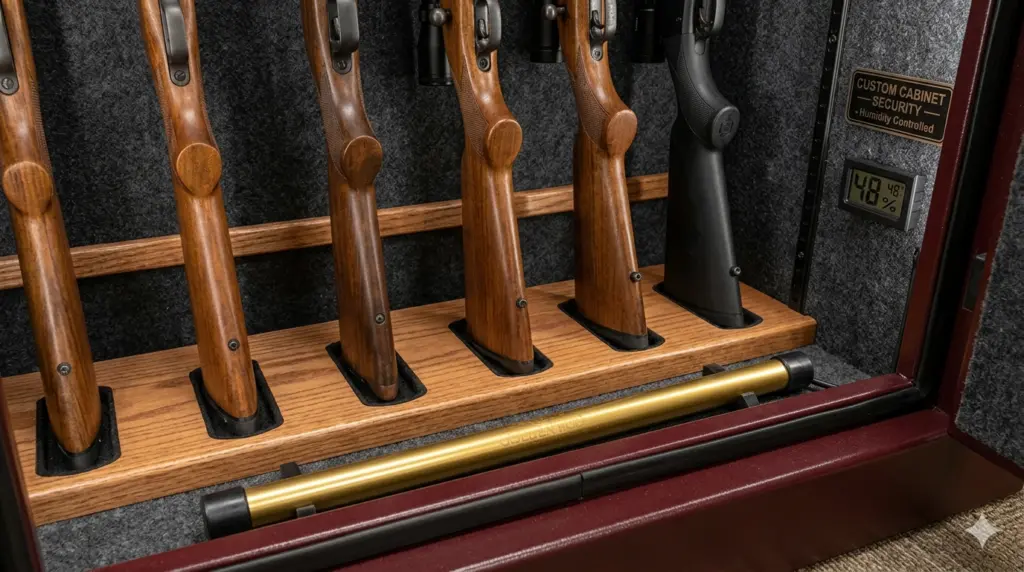
A Golden Rod dehumidifier rod is an electrically powered heating element sized to fit inside a closed storage environment. It draws between 10 and 20 watts of continuous power (varying by length), operates at a surface temperature well below any fire risk, and functions by gently warming the interior air.
Why this works: Warmer air holds more moisture at the same absolute humidity level, which means its relative humidity is lower. A Golden Rod rod that raises the interior temperature by 5 to 10 degrees Fahrenheit reduces the relative humidity inside the cabinet by a corresponding amount, keeping it consistently below the condensation and corrosion threshold.
Why it is the standard solution: The Golden Rod approach requires no consumables, produces no condensation itself, operates continuously with no attention required, and has a service life measured in decades rather than months. The only requirement is an electrical outlet near the cabinet.
At Custom Cabinet Security, the Golden Rod dehumidifier is integrated into the cabinet design as a standard element, positioned at the base of the interior where warm air rises naturally through the storage space. This integration is a design decision that reflects the understanding that humidity control is not a feature to be added later. It is part of what makes the cabinet function correctly as a storage environment.
Sizing: Golden Rod rods are sized by length to match the interior volume of the storage. The manufacturer provides guidance for matching rod length to cubic feet of storage. An undersized rod in a large cabinet works less effectively than a properly sized one.
Silica Gel Desiccants: Supplemental, Not Primary
Silica gel canisters or packs absorb moisture from the surrounding air and are commonly included with or sold alongside gun safes. They are useful as a supplemental measure but have significant limitations as a primary humidity control method.
What they do well: Absorb moisture from the ambient air, reducing humidity when actively capable of doing so. Available without an electrical connection, making them useful in storage locations without power.
What they do not do well: A silica gel canister has a finite capacity. Once it is saturated, it stops absorbing moisture and may begin releasing it back into the environment. The service interval between regeneration cycles depends on the interior humidity and the size of the canister, but in a humid environment, this cycle can be relatively short.
They require active management: monitoring, regeneration (typically by heating in an oven at low temperature), and replacement when they reach the end of their service life. In practice, many owners fail to maintain this cycle and end up with saturated desiccant providing no protection.
Best use case: As a supplemental measure inside a cabinet that also has a Golden Rod rod, particularly in a high-humidity environment where the rod alone may not bring humidity to the full target range.
Container Desiccants (Indicating Types)
Color-changing desiccants that visually indicate their saturation state (typically changing from blue to pink when saturated) provide better active management feedback than non-indicating types. For owners who use desiccants as a primary or supplemental measure, indicating types reduce the guesswork about when regeneration is required.
What Does Not Work
Two-way humidity control packs: Products designed for musical instrument storage or similar applications that attempt to both absorb and release moisture to maintain a specific humidity level can work in very small, well-sealed enclosures. In the larger and less perfectly sealed interior of a gun cabinet, they are rarely effective at maintaining the target range.
Open containers of moisture-absorbing material: Placing a container of cat litter, chalk, or similar desiccant materials inside a cabinet is not an effective humidity control strategy. The capacity is poorly matched to the space and the material degrades without a reliable way to assess saturation.
Oil and Protective Coating as a Complement to Humidity Control
Humidity control inside the storage environment reduces the external moisture that reaches firearm surfaces. A light protective oil coating on metal surfaces adds a secondary barrier that interrupts the corrosion mechanism even at the surface level.
Which Oils and Protectants Work
Light lubricating oils (Rem Oil, CLP): Multi-purpose products that clean, lubricate, and provide moderate corrosion protection. Appropriate for regular maintenance and as a light protective coat before storage. Not the highest-performance option for long-term storage.
Dedicated preservative oils (Eezox, Sentry Solutions TUF-GLIDE): Products formulated specifically for long-term corrosion protection rather than lubrication. These products leave a very thin, stable film that provides better long-term protection than general lubricants without the gumming and thickening that some oils experience over time.
Renaissance Wax: A microcrystalline wax product used in museum conservation for metal surfaces. Appropriate for antique and collectible firearms where maintaining original condition is the priority. Provides a stable, inert barrier that does not affect original finishes.
What to avoid: Heavy petroleum greases for long-term storage, as they attract dust and can congeal in mechanisms over time. Products containing silicone near wooden stocks, as silicone can penetrate wood and prevent future refinishing.
Application for Storage
For a firearm being placed in storage for an extended period:
- Clean the bore and exterior surfaces to remove any existing moisture, fouling, or contamination that could accelerate corrosion under the protective coat.
- Apply a light coat of appropriate protective oil to all metal surfaces, including the bore interior, the chamber, and the external surfaces.
- Wipe down evenly to ensure no pooling. The goal is a thin, uniform film, not a visible wet coat.
- For wood stocks, a light application of appropriate stock oil or wax provides some surface protection without affecting the fit or the finish character of the wood.
The Interaction with Felt Lining
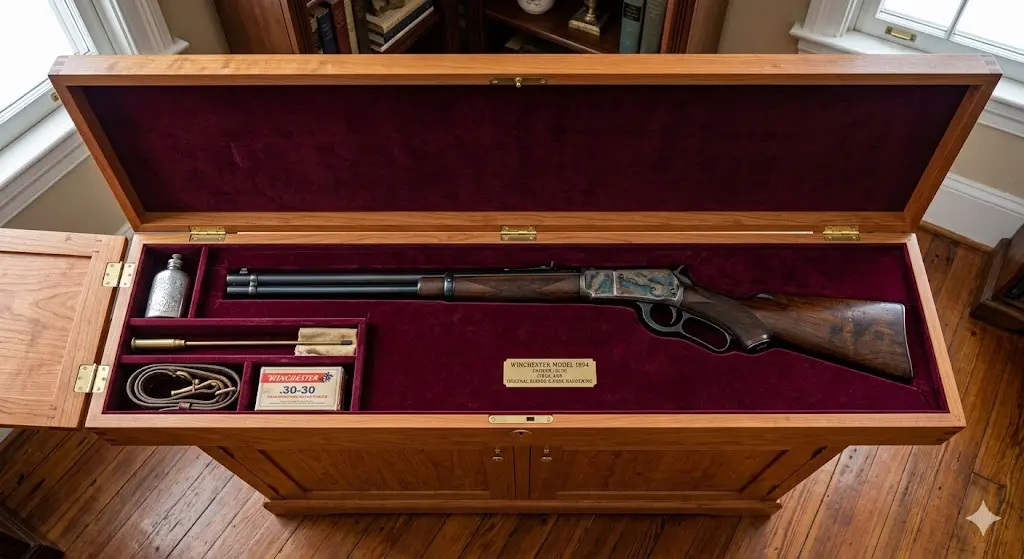
The red felt lining used in Custom Cabinet Security’s interiors provides soft contact protection for firearm surfaces. Felt is chemically inert and does not react with metal finishes or with light protective oils applied to stored firearms.
What felt can do is hold moisture in humid conditions. In a well-humidity-controlled interior, this is not a concern. In storage where humidity control is inadequate, saturated felt can hold moisture in contact with firearm surfaces, which is counterproductive.
This is another reason why humidity control is the foundational requirement and everything else, oil coats, felt lining, and desiccants, functions as a complement to it rather than a substitute.
Seasonal Humidity Patterns and What They Mean for Storage
In most of North America, residential humidity follows a predictable seasonal pattern that creates predictable risk periods for improperly managed gun storage.
Summer: Outdoor humidity is highest in summer in most regions. Without climate control, indoor humidity rises correspondingly. Air conditioning reduces indoor humidity significantly, but firearms stored in an unconditioned garage, outbuilding, or basement may experience high summer humidity. This is the highest-risk period for corrosion initiation in most climates.
Fall and winter: As outdoor temperatures drop and heating systems run, indoor relative humidity typically drops substantially. Heated air with the same absolute moisture content as cooler air has a lower relative humidity. In very cold climates with high heating loads, indoor humidity in winter can fall below 30 percent, creating wood desiccation risk.
Spring: Transition periods bring fluctuating humidity as outdoor temperature rises and indoor climate control adjusts. This is also when condensation events are most likely in storage spaces that experience temperature cycling.
The seasonal cycle reinforces why passive storage without active humidity control is inadequate. The environmental conditions that damage firearms do not require unusual events. They are the normal seasonal variation of residential conditions.
A properly sized Golden Rod rod inside a properly designed cabinet compensates for this seasonal variation by maintaining the interior at a consistent temperature slightly above ambient, which keeps the relative humidity stable regardless of seasonal swings in the surrounding environment.
Inspecting for Humidity Damage During Maintenance
Regular inspection during maintenance is the early warning system that catches humidity-related damage before it becomes irreversible.
What to inspect and how often:
For a collection stored with proper humidity control, annual inspection is typically sufficient. For storage in questionable conditions, quarterly inspection is appropriate.
Bore inspection: Use a bore light or bore scope to inspect the bore interior of every stored firearm. Look for reddish discoloration, roughness, or visible pitting. Early rust in the bore appears as a reddish or brownish discoloration that may have some texture. Pitting appears as definite surface irregularities visible under magnification.
External surfaces: Examine all metal surfaces under good lighting at multiple angles. Run a clean white patch lightly over the surface. Any reddish or orange discoloration on the patch indicates surface oxidation that should be addressed immediately.
Action and mechanism: Function the action manually, inspecting for stiffness, roughness, or unusual resistance that might indicate corrosion on internal components. Field strip for inspection if stiffness or roughness is detected.
Wood stocks: Run a hand over wood surfaces, feeling for any raised grain texture, checking, or soft spots that indicate moisture infiltration. Examine the junction between wood and metal for any gap or loosening of fit that indicates dimensional change in the wood.
Storage environment: Check the hygrometer reading inside the cabinet. If it reads outside the target range on a regular basis, the humidity control system needs adjustment, the cabinet needs to be inspected for air gaps that allow uncontrolled exchange with the exterior environment, or the placement of the cabinet needs to be reconsidered.
How Cabinet Design Affects Humidity Management
Not all storage environments are equally manageable. The design of the cabinet affects how well humidity control works inside it.
Sealed vs. Permeable Interiors
A cabinet that seals relatively well when closed provides a more controllable interior environment than one with significant air gaps around the door, through vent holes, or through poorly fitted joints. A Golden Rod rod in a well-sealed cabinet maintains temperature and humidity within the target range with relatively little power. The same rod in a cabinet with significant air exchange with the room works against the room’s humidity rather than maintaining a controlled interior environment.
The handcrafted solid hardwood construction of Custom Cabinet Security’s cabinets, with properly fitted doors and quality door seals, creates a more manageable interior environment than thin-walled factory cabinets with imprecise tolerances.
Interior Volume and Sizing
A Golden Rod rod is sized for a specific cubic footage of interior space. A rod appropriately sized for the cabinet it is installed in maintains target humidity more consistently than one that is undersized for the volume. Custom Cabinet Security integrates the dehumidifier at the design stage to ensure proper sizing, which is a detail that matters practically in the long-term performance of the humidity control system.
Material Off-Gassing
Some synthetic materials used in factory safe interiors, including certain foam linings, can off-gas acidic compounds over time that affect metal finishes even in a controlled humidity environment. Museum-quality conservation materials are specifically formulated to be chemically inert.
The felt lining used in Custom Cabinet Security’s interiors is selected for this quality: it provides soft contact protection without the chemical risks associated with some synthetic alternatives.
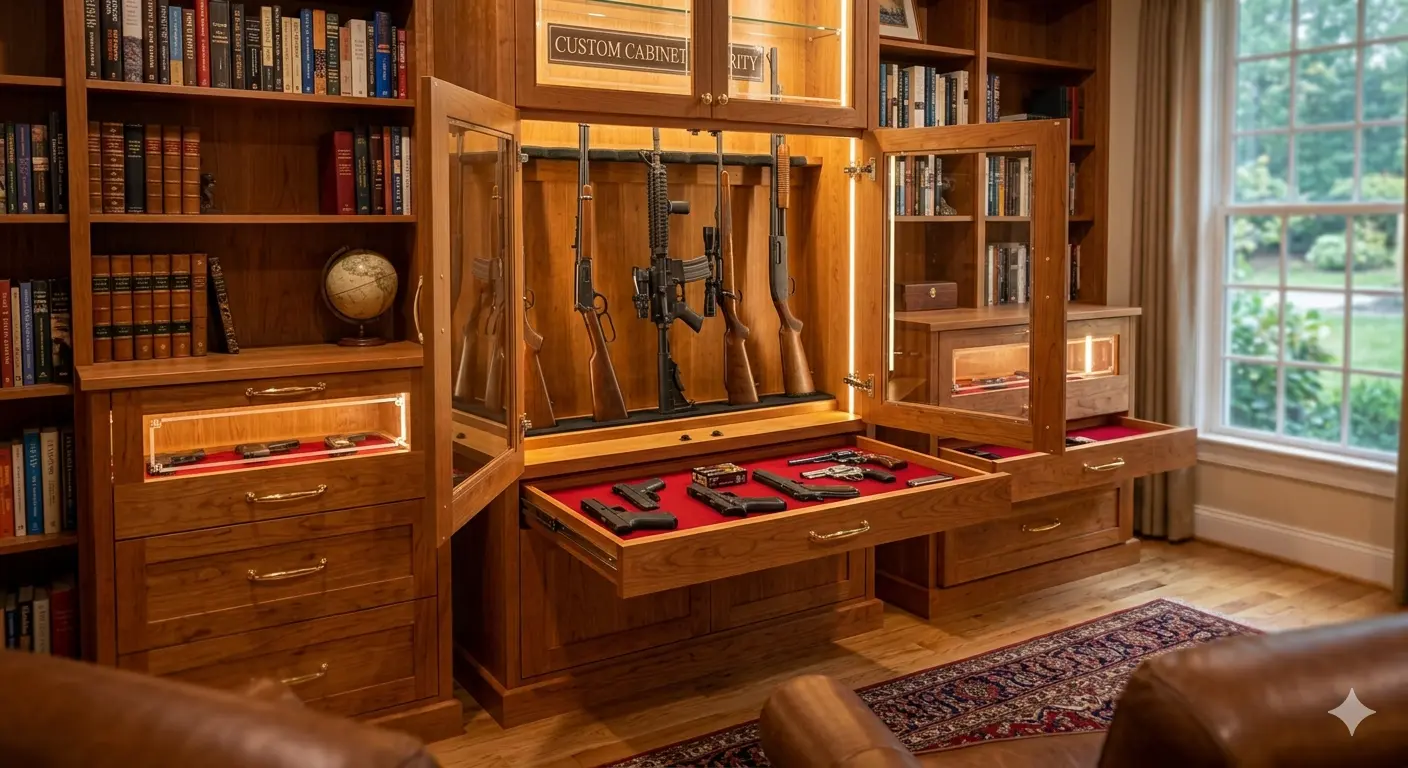
If you would like to see the full range of cabinets and pistol chests built with these design principles in mind, the complete collection at Custom Cabinet Security illustrates how each element contributes to a storage environment designed for long-term preservation.
A Practical Humidity Management Setup
For a collector putting together a complete humidity management system for a gun cabinet, here is the practical setup in order of priority.
Step 1: Install a properly sized Golden Rod dehumidifier rod. Size it according to the manufacturer’s recommendations for the interior cubic footage of the cabinet. Connect it to a dedicated outlet or a discreet extension cord that exits through the cabinet without creating a significant air gap.
Step 2: Install a digital hygrometer inside the cabinet. Mount it in the center of the interior, away from the door and away from the rod itself. Allow it to run for 48 hours before taking baseline readings, to let the cabinet environment stabilize with the rod running.
Step 3: Measure the baseline interior humidity. If it is consistently in the 45 to 55 percent range, the system is performing correctly. If it is above 60 percent, the rod may be undersized for the cabinet volume, the cabinet may have significant air gaps, or the surrounding room may have humidity levels high enough to overwhelm the rod’s capacity.
Step 4: If supplemental desiccant is needed, add indicating-type silica gel in an amount sized to the cabinet interior. Monitor and regenerate as needed.
Step 5: Apply protective oil to stored firearms. A light, even coat of appropriate protective oil on all metal surfaces provides a secondary barrier that works alongside the controlled environment.
Step 6: Inspect annually. Check the hygrometer reading, examine all firearms for signs of surface oxidation or stock change, and function-check each piece.
The Bottom Line
Humidity is the most patient enemy of a stored firearm collection. It does not announce its damage in a single event. It accumulates slowly, in the enclosed darkness of a closed cabinet, on surfaces that are not examined until the next maintenance cycle.
The protection against this threat is not complicated. A properly sized Golden Rod dehumidifier rod inside a quality sealed cabinet maintains the interior environment in the range that prevents both corrosion and wood damage. A hygrometer confirms the system is working. Periodic inspection catches any issues that develop despite the controls.
These measures are not optional features for a collection worth protecting. They are the baseline of responsible storage for any firearms that the owner cares about in the long term.
A handcrafted gun cabinet or pistol chest from Custom Cabinet Security integrates the Golden Rod dehumidifier and quality felt lining as standard design elements, because the craftsmen in Arthur, Illinois build for the same long-term standard they apply to the wood and joinery of the cabinet itself. For a collection that deserves this level of care, the conversation starts with a custom consultation.
Related Posts
View All
Uncategorized
Reading Time: 8 min
The Resale Value of a Custom Gun Cabinet: Does a Handcrafted Amish Safe Hold Its Value Over Time?
If you’ve ever bought a mass-produced gun safe from a big-box retailer, you already know what happens the moment it
Read More

Uncategorized
Reading Time: 11 min
Women Gun Owners: How to Choose a Gun Storage Solution That Fits Your Home’s Style Without Compromise
Key Takeaways The Storage Problem Nobody Talks About Walk into almost any sporting goods store and look at the gun
Read More
Uncategorized
Reading Time: 10 min
How to Protect Antique and Vintage Firearms in Wood Storage: What Collectors Need to Know About Climate and Finish
Key Takeaways Why Antique Firearms Demand a Different Standard of Storage Storing a modern production firearm and storing an 1860s
Read More
